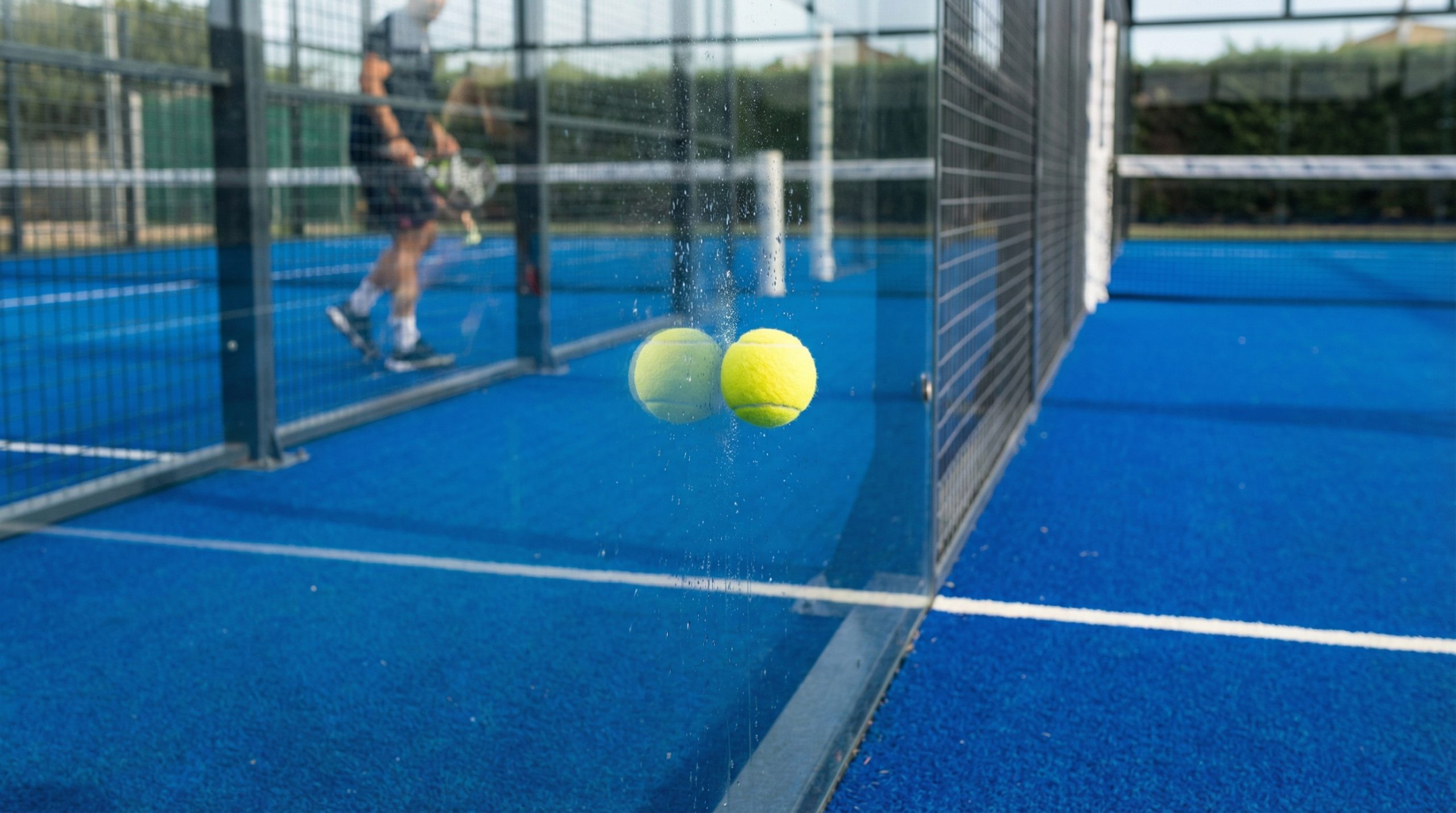
What is the history of padel vs paddle?
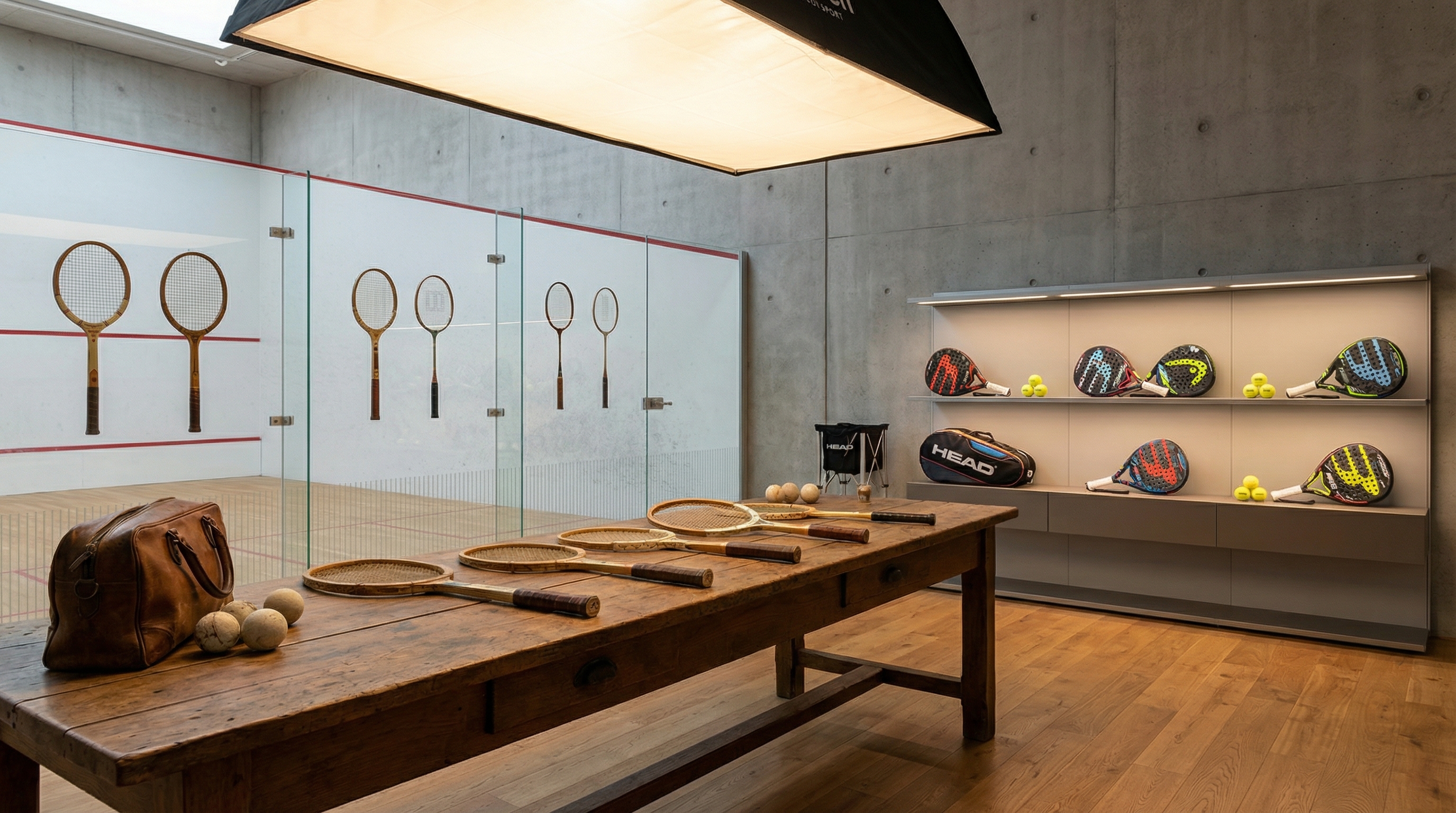
Padel originated in Mexico in 1969 when Enrique Corcuera built walls around a small tennis court to keep balls in, whereas paddle tennis started in the US as a scaled-down tennis variant. The evolution of padel vs paddle reflects a shift from simple wooden rackets to high-tech carbon fiber equipment. You can see how these sports diverged based on their structural requirements and social play styles.
Where did paddle tennis originate?
Paddle tennis was created in the United States during the early 20th century to occupy passengers on transatlantic ships. It eventually moved to land, specifically gaining popularity in Venice Beach as a fast-paced game.
- Reduced court size compared to tennis.
- The use of solid wooden or composite paddles.
- Pressureless tennis balls for controlled play.
- Underhand serving rules to maintain rallies.
How was modern padel invented?
Modern padel was born when a Mexican businessman wanted to stop plants from invading his court and realized the walls added a new dimension to the game. Think about this: it essentially merged tennis, squash, and Basque pelota into one dynamic experience.
- Installation of concrete walls (later evolved to glass).
- Standardization of the 10×20 meter court size.
- Creation of the foam-core, stringless “pala” racket.
- Global expansion starting in Spain and Argentina.
Key Takeaway: Padel is a modern synthesis of multiple racket sports designed for social interaction and long rallies, while paddle tennis is a legacy tennis variant.
| Feature | Padel History | Paddle Tennis History |
|---|---|---|
| Founder | Enrique Corcuera | Frank Beal |
| Invention Year | 1969 | Early 20th Century |
| Origin Country | Mexico | USA |
The historical divergence proves that padel was designed specifically for enclosure-based play from its very inception.
Is the court size different for padel vs paddle?
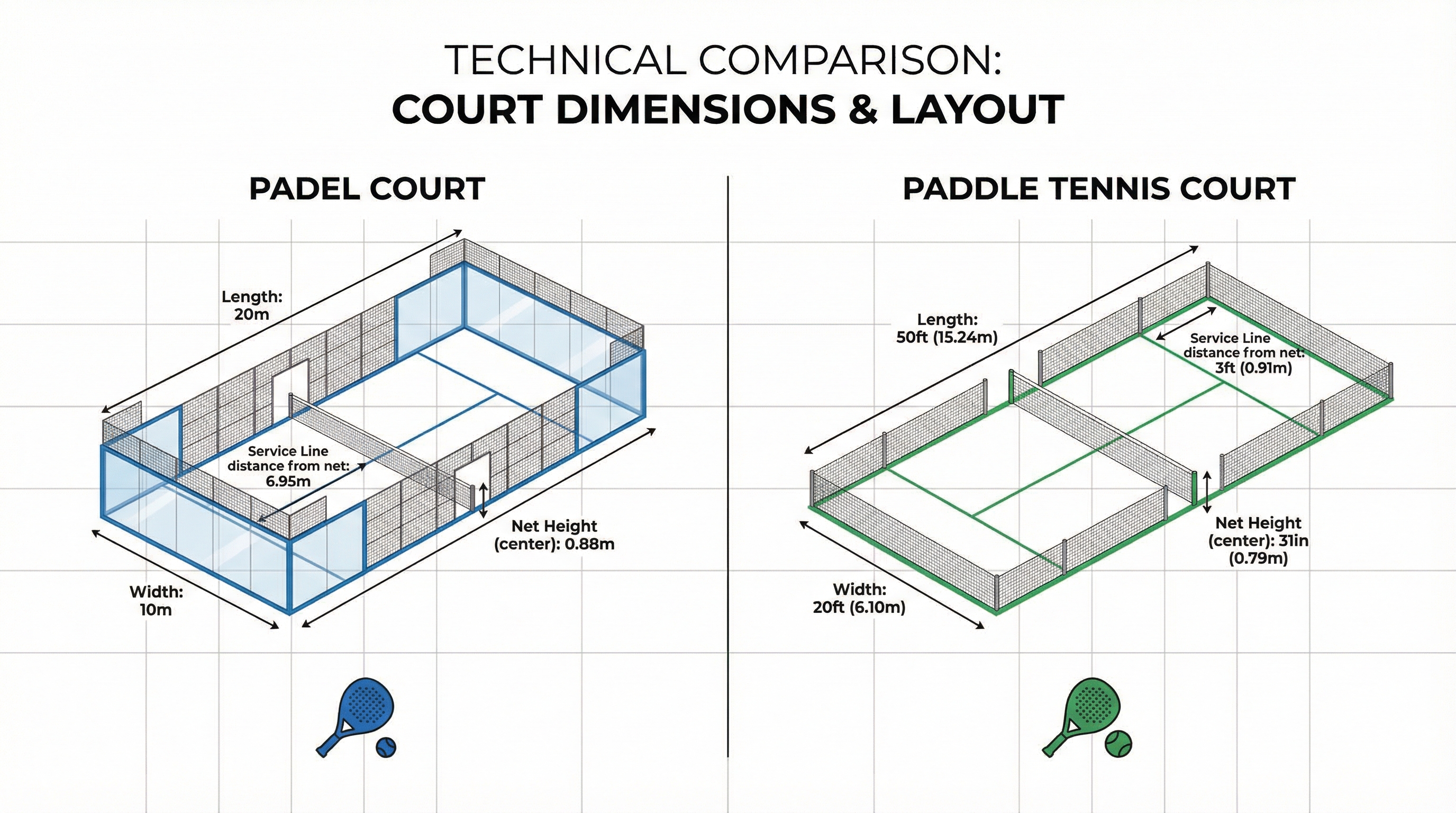
Yes, a padel court is strictly 10 meters wide by 20 meters long, while paddle tennis courts are slightly smaller and lack the mandatory surrounding walls. When analyzing padel vs paddle, you must account for the additional footprint required for the structural steel and glass. You need to ensure your site can accommodate these specific Standard Padel Court dimensions.
What are standard dimensions?
The standard dimensions for padel require a 200-square-meter playing area plus a safety perimeter. Here is the deal: if you are building for international competition, your clearances must be exact.
- Padel: 10m x 20m internal dimensions.
- Paddle Tennis: 15.24m x 6.10m (50ft x 20ft).
- Padel net height: 0.88m at the center.
- Paddle tennis net height: 0.79m (31 inches).
Do walls affect the footprint?
Walls are the defining characteristic of padel, requiring robust foundations that extend beyond the play line. You should know that these glass and mesh panels exert significant lateral force on the base.
- Foundations for 12mm tempered glass panels.
- Support pillars every 2 to 4 meters.
- Perimeter drainage systems for outdoor builds.
- Anchor bolt spacing for structural stability.
Key Takeaway: You must plan for a larger, more complex footprint when building for padel due to the structural requirements of the glass walls.
| Specification | Padel Court | Paddle Tennis Court |
|---|---|---|
| Length | 20 Meters | 15.24 Meters |
| Width | 10 Meters | 6.10 Meters |
| Enclosure | 3m-4m Glass/Mesh | Low Mesh (Optional) |
Building the correct dimensions is the first step in avoiding costly site re-leveling or structural failures.
How do rules differ for padel vs paddle?
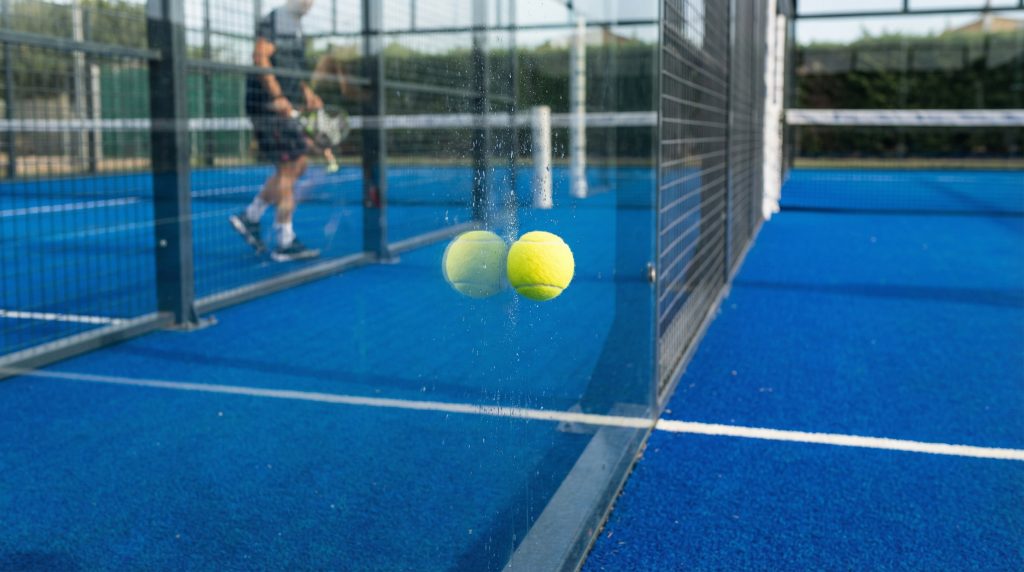
Padel rules allow players to play the ball off the back and side glass walls, whereas paddle tennis treats any contact with a wall as an “out” ball. In the context of padel vs paddle, the scoring remains similar to tennis, but the tactical use of the enclosure changes everything. You might find that a Panoramic Padel Court enhances this “wall-play” experience for spectators.
Are the walls in play?
In padel, the walls are your best friend during a defensive lob or a sharp cross-court shot. But there is more: the ball must always hit the ground before touching the wall on the return.
- Balls can be hit against your own glass wall.
- Opponent’s glass is in play after one ground bounce.
- Wire mesh sections cause unpredictable bounces.
- Directly hitting the opponent’s wall is a fault.
How does scoring work?
Scoring in padel follows the 15, 30, 40, and Game sequence used in traditional tennis. However, you should note that many professional tournaments now use the “Golden Point” to speed up matches.
- No-ad scoring (Golden Point) at deuce.
- Best of three sets for most matches.
- Tie-breaks played at six games all.
- Serves must be made underhand below the waist.
Key Takeaway: The inclusion of walls in padel creates a strategic depth that rewards patience and positioning over raw power.
| Rule Category | Padel | Paddle Tennis |
|---|---|---|
| Wall Play | Mandatory/In-play | Out of play |
| Serve Type | Underhand | Underhand |
| Bounce Rule | Ground before wall | Ground only |
The “in-play” wall rule is precisely why padel is often compared to a “human-sized game of chess.”
What equipment is needed for padel vs paddle?
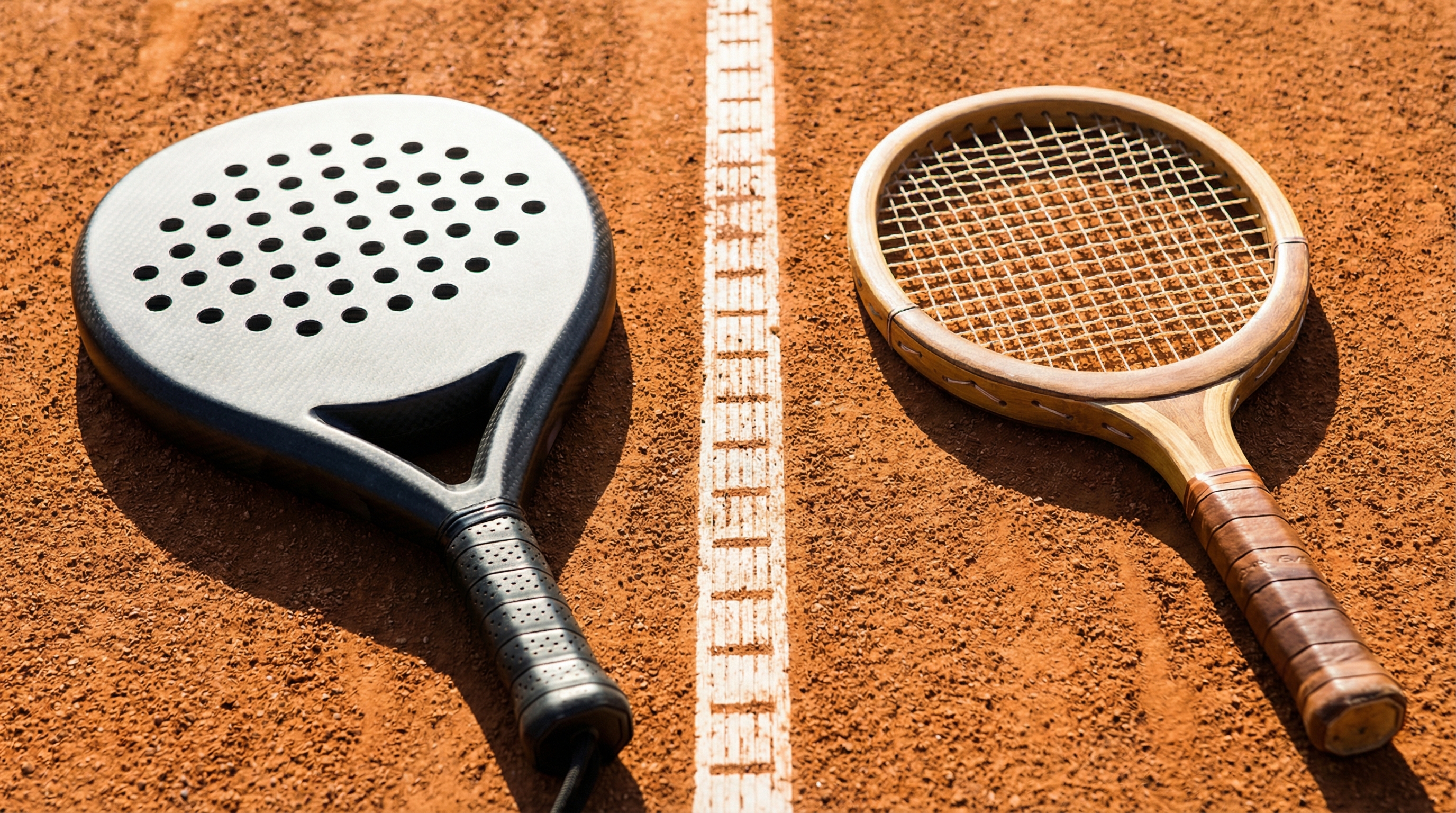
Padel requires a specialized foam-core racket without strings, while paddle tennis uses a solid paddle that is often smaller. Comparing the equipment of padel vs paddle, you will notice that padel rackets have holes drilled into the face to reduce air resistance. You need a durable Padel Structure to handle the high-velocity impact of these rackets.
What defines a padel racket?
A padel racket, or “pala,” is a solid piece of carbon fiber or fiberglass with an EVA foam core. It feels very different from a tennis racket because it lacks the “trampoline effect” of strings.
- Max length of 45.5 centimeters.
- Max width of 26 centimeters.
- Standard thickness of 38 millimeters.
- Safety wrist strap is mandatory for all players.
Which ball type is required?
While they look like tennis balls, padel balls have a lower internal pressure to accommodate the smaller court size. This ensures you get a consistent bounce off the glass walls during intense rallies.
- Internal pressure between 10psi and 11psi.
- Yellow or white color for high visibility.
- Specific felt weight to control flight speed.
- Designed to withstand impacts against glass.
Key Takeaway: You cannot use standard tennis equipment for padel if you want to ensure player safety and maintain game integrity.
| Equipment | Padel | Paddle Tennis |
|---|---|---|
| Racket Material | Carbon/Fiberglass + Foam | Wood/Composite |
| Surface | Holes/No Strings | Solid/No Strings |
| Ball Pressure | Low (Padel Specific) | Pressureless |
Using the correct gear is essential for the long-term durability of your court’s glass and turf surfaces.
Which has better ROI, padel vs paddle?
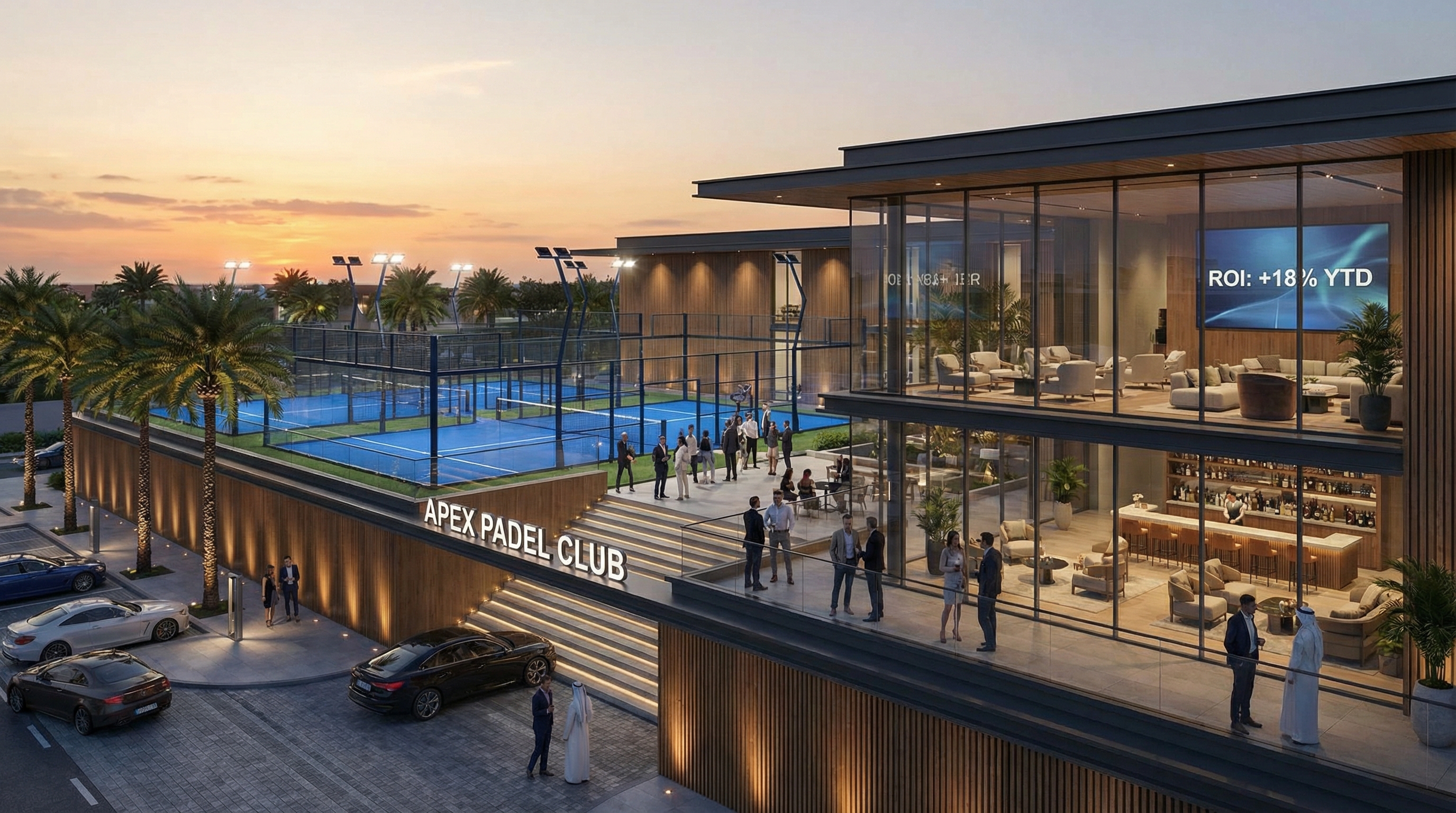
Padel currently offers a significantly higher ROI due to its explosive global growth and higher court rental fees in premium clubs. In the debate of padel vs paddle, padel wins on scalability because you can fit three courts in the space of one traditional tennis court. This density allows you to generate more revenue per square meter of your facility.
How do clubs generate revenue?
Revenue comes primarily from hourly court rentals, which can be shared by four players, making it affordable for them but profitable for you. Think about the potential for ancillary income through coaching and equipment sales.
- Peak-hour court rental premiums.
- Padel academy and group clinic fees.
- Pro-shop sales of rackets and balls.
- Tournament entry fees and sponsorships.
Why is padel growing faster?
The social nature of the sport makes it addictive for beginners, leading to high retention rates among your members. Here is the deal: people find it easier to learn than tennis, which broadens your potential customer base.
- Lower entry barrier for beginners.
- High “social” factor with 4-player format.
- Strong backing from professional sports stars.
- Rapidly expanding international tournament circuits.
Key Takeaway: Investing in padel provides a faster path to profitability due to high court density and a rapidly growing user demographic.
| Financial Metric | Padel Facility | Paddle Tennis |
|---|---|---|
| Players per Court | 4 | 2 or 4 |
| Market Growth | Exponential | Steady |
| Rental Demand | Very High | Moderate |
The ability to monetize social interaction is what makes the padel business model so resilient and attractive to investors.
How to choose glass for padel vs paddle?
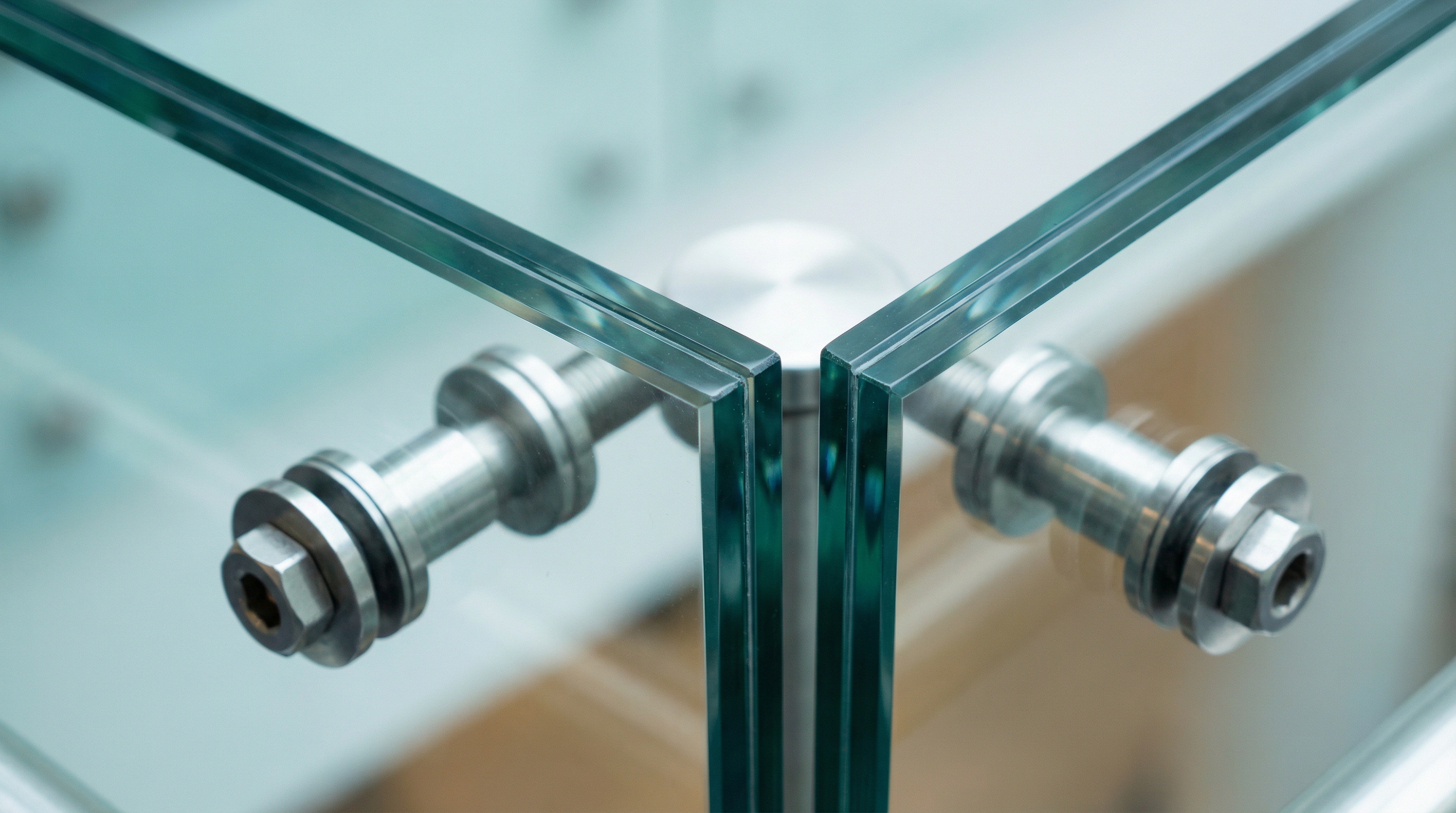
You must use 10mm or 12mm tempered safety glass for padel, whereas paddle tennis often uses simple chain-link fencing if any enclosure is present. Selecting glass for padel vs paddle is a critical safety decision because the panels must withstand players crashing into them. We recommend choosing certified Padel Glass that meets international EN 12150-1 safety standards.
Is tempered glass necessary?
Tempered glass is non-negotiable for commercial facilities because it crumbles into small, blunt pieces if it ever breaks. This prevents the dangerous shards associated with standard plate glass.
- 12mm thickness for panoramic court designs.
- 10mm thickness for standard framed courts.
- Heat-soak testing to prevent spontaneous breakage.
- Countersunk holes for flush structural mounting.
What are safety standards?
Safety standards ensure the glass can handle the dynamic loads of high-speed ball impacts and human contact. You should always check for certification marks on the corner of every panel.
- Compliance with CE and international standards.
- Resistance to high wind loads for outdoor courts.
- Polished edges to prevent stress fractures.
- Anti-explosion films for added player security.
Key Takeaway: Never compromise on glass quality; it is the most vital safety component and the most visible feature of your court.
| Glass Property | Recommended Spec | Benefit |
|---|---|---|
| Thickness | 12mm | Maximum durability |
| Treatment | Fully Tempered | Safety compliance |
| Standard | EN 12150-1 | Global certification |
Quality glass provides the transparency needed for spectators while ensuring a predictable ball bounce for competitive play.
Is turf choice key for padel vs paddle?
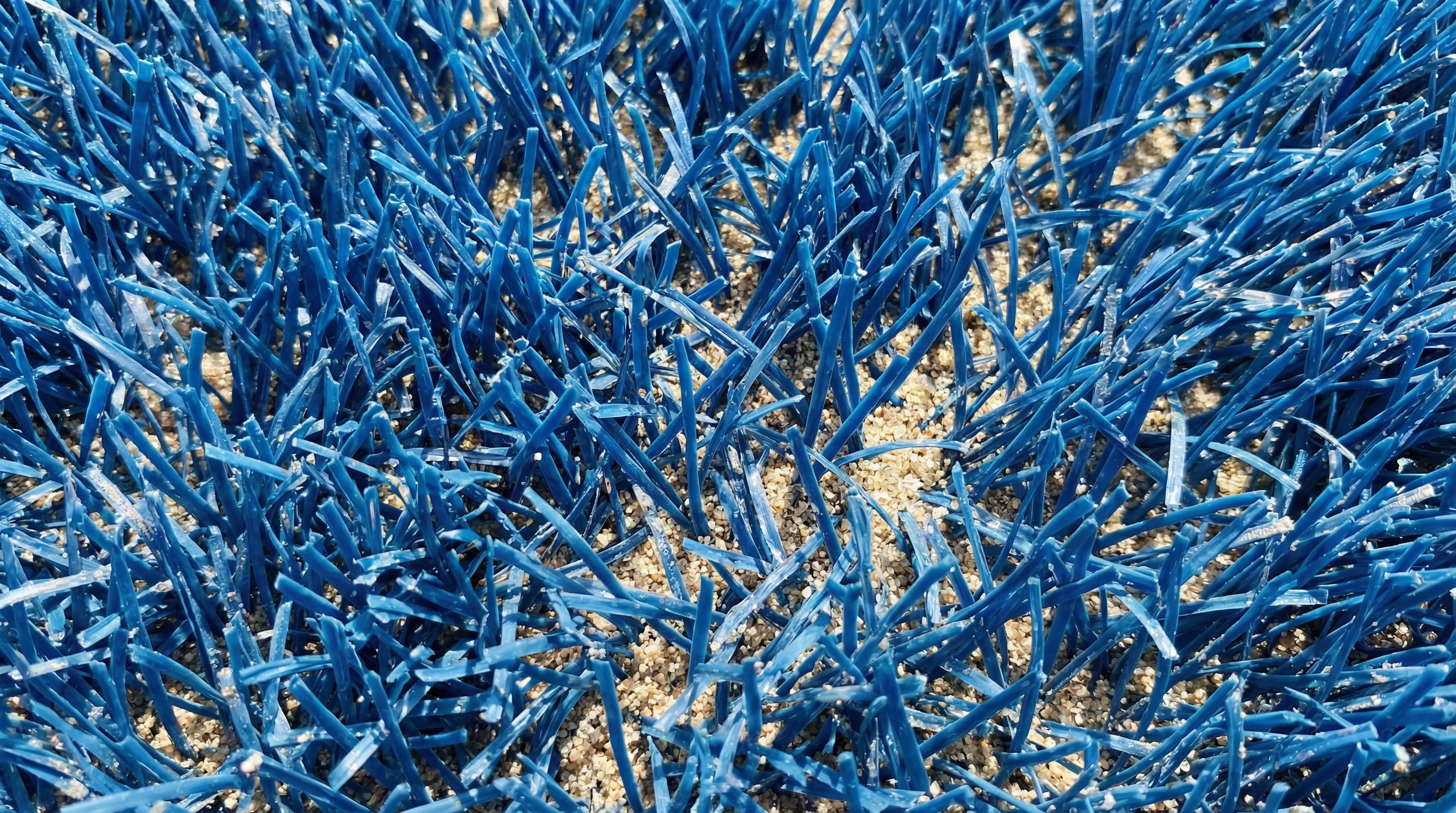
Yes, the turf determines the speed of the game and the safety of the players’ joints, making it a priority for any builder. When evaluating padel vs paddle, you will find that padel requires a specific amount of sand infill to allow for controlled sliding. You should consider high-density Padel Grass to ensure your facility can handle high-frequency use.
What is fibrillated turf?
Fibrillated turf features wider blades that split over time to “trap” the sand infill more effectively. It is a popular choice for clubs because it offers excellent durability and requires less frequent maintenance.
- Excellent sand retention for a consistent surface.
- High UV resistance for outdoor installations.
- Lower maintenance costs over a 5-year period.
- Good balance between speed and player grip.
How to ensure consistent bounce?
A consistent bounce is achieved through a perfectly level concrete base and even distribution of silica sand. But there is a catch: you must use the correct grain size for the sand to prevent the turf from clogging.
- Use 0.5mm to 1.0mm rounded silica sand.
- Ensure 3kg to 5kg of sand per square meter.
- Regular brushing to keep fibers standing upright.
- Integrated drainage layers for all-weather play.
Key Takeaway: High-quality monofilament or fibrillated turf is essential for preventing injuries and providing a professional playing experience.
| Turf Type | Best Use Case | Maintenance Level |
|---|---|---|
| Monofilament | Professional Clubs | Medium |
| Fibrillated | High-Traffic Centers | Low |
| Textured/Curly | Premium/World Tour | Medium |
Choosing the right turf prevents the “slipping” effect that can lead to ankle and knee injuries during rapid changes of direction.
What are the costs for padel vs paddle?
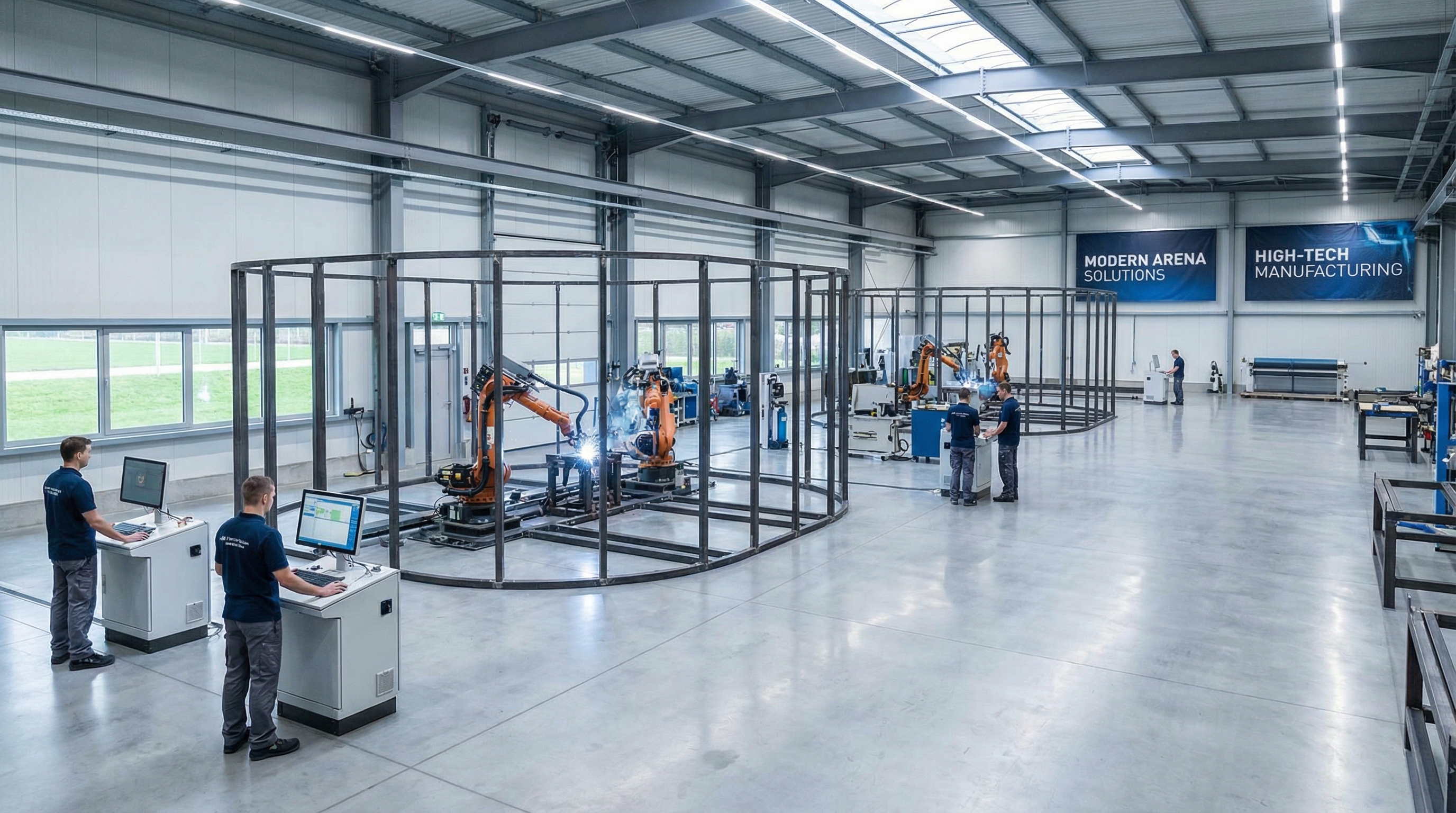
The cost to build a padel court typically ranges from $15,000 to $35,000, which is higher than a paddle tennis court due to the glass and steel structure. When you buy padel vs paddle components directly from a manufacturer, you can save up to 30% on procurement. Accessing factory-direct pricing is the best way to optimize your initial capital expenditure.
Are factory prices lower?
Buying directly from the factory eliminates the middleman and distributor markups that plague the sports construction industry. You get the same premium materials but at a price that significantly improves your project’s bottom line.
- Direct communication with the engineering team.
- Customized quotes delivered within 24 hours.
- No distributor commissions or retail overheads.
- Transparent material specifications and costs.
What affects shipping costs?
Shipping costs are influenced by the weight of the tempered glass and the volume of the steel structure. You should know that a standard 40ft container can typically hold materials for two complete courts.
- Weight of 12mm glass panels (approx. 2.5 tons).
- Volume of hot-dip galvanized steel frames.
- Port of destination and inland transport fees.
- Logistics support for customs and documentation.
Key Takeaway: Procuring courts directly from the manufacturer is the single most effective way to lower your total project cost.
| Cost Factor | Factory Direct | Local Distributor |
|---|---|---|
| Unit Price | 30% Lower | Higher |
| Customization | Full OEM Support | Limited |
| Support | Direct Technical | Varied |
Managing your budget through direct procurement allows you to invest more in premium features like panoramic views or high-efficiency lighting.
Can you customize padel vs paddle courts?
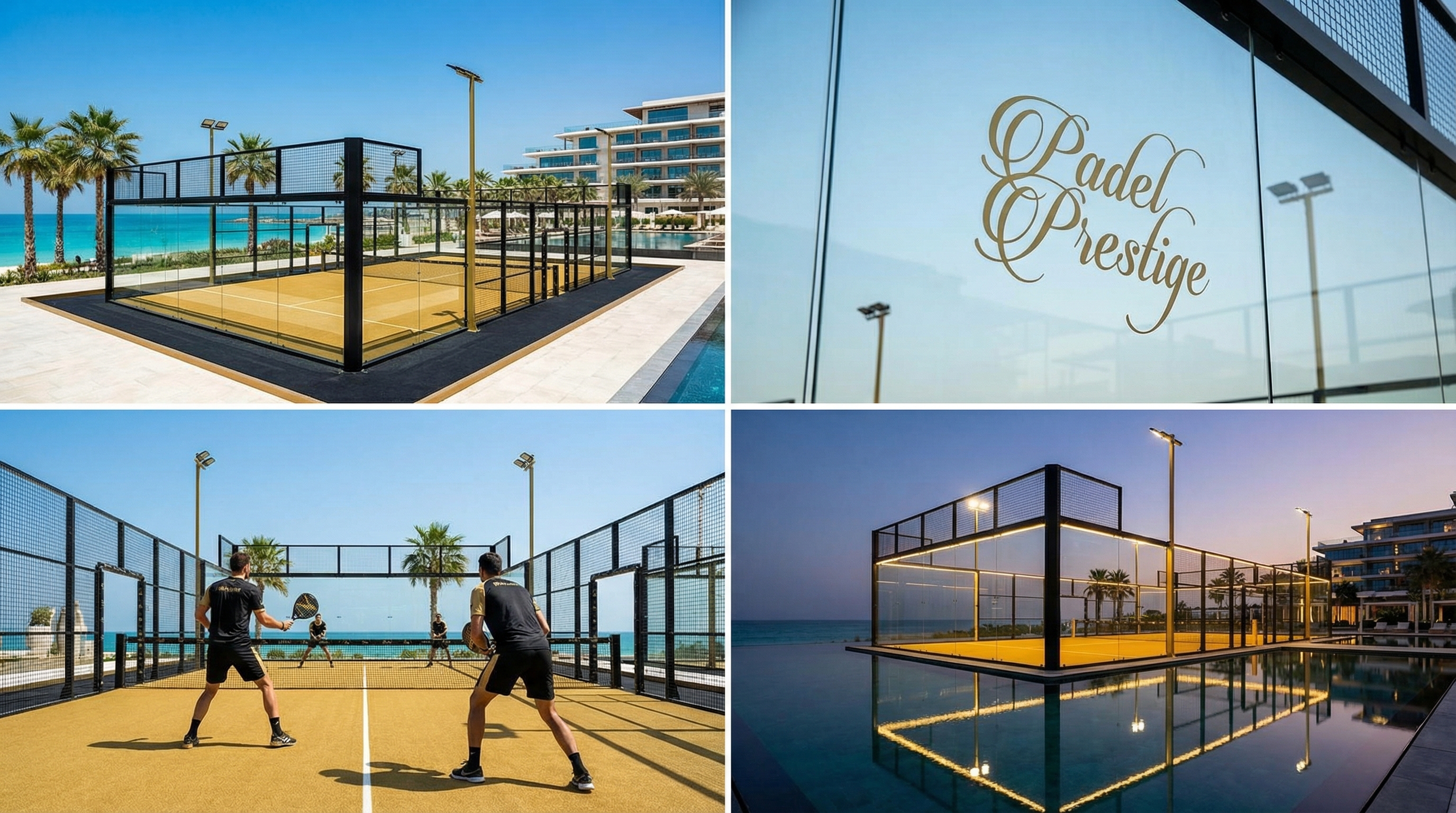
Yes, you can customize everything from the RAL color of the steel frame to the logo integrated into the turf or glass. In the world of padel vs paddle, branding your court helps you stand out in a competitive fitness market. You can choose colors that match your club’s identity or your property’s architectural style.
Is OEM branding available?
OEM (Original Equipment Manufacturer) services allow you to place your own logo on the court’s structural components. This is a powerful way to build brand equity and present a professional image to your members.
- Laser-cut logos on corner protectors.
- Custom-colored turf and line marking.
- Branded protective padding for the net posts.
- Logo integration on the entrance glass doors.
How to choose court colors?
While blue turf is the international standard, you have the freedom to select from a wide range of colors for the steel structure. Think about how a black frame looks sleek in a modern gym, while a green frame blends into a resort landscape.
- Black or anthracite for a premium, modern look.
- Traditional blue for a tournament-ready feel.
- Vibrant custom colors for boutique fitness clubs.
- Powder-coated finishes for maximum weather protection.
Key Takeaway: Customization turns a standard sports court into a unique marketing asset that elevates your facility’s brand value.
| Customization Option | Possible Choices | Impact |
|---|---|---|
| Steel Color | Any RAL Color | Aesthetic / Branding |
| Turf Color | Blue, Green, Red, Pink | Recognition |
| Logo Placement | Glass, Steel, Net | Marketing |
A customized court creates a “wow factor” that attracts influencers and helps you market your facility on social media.
How to start building padel vs paddle?
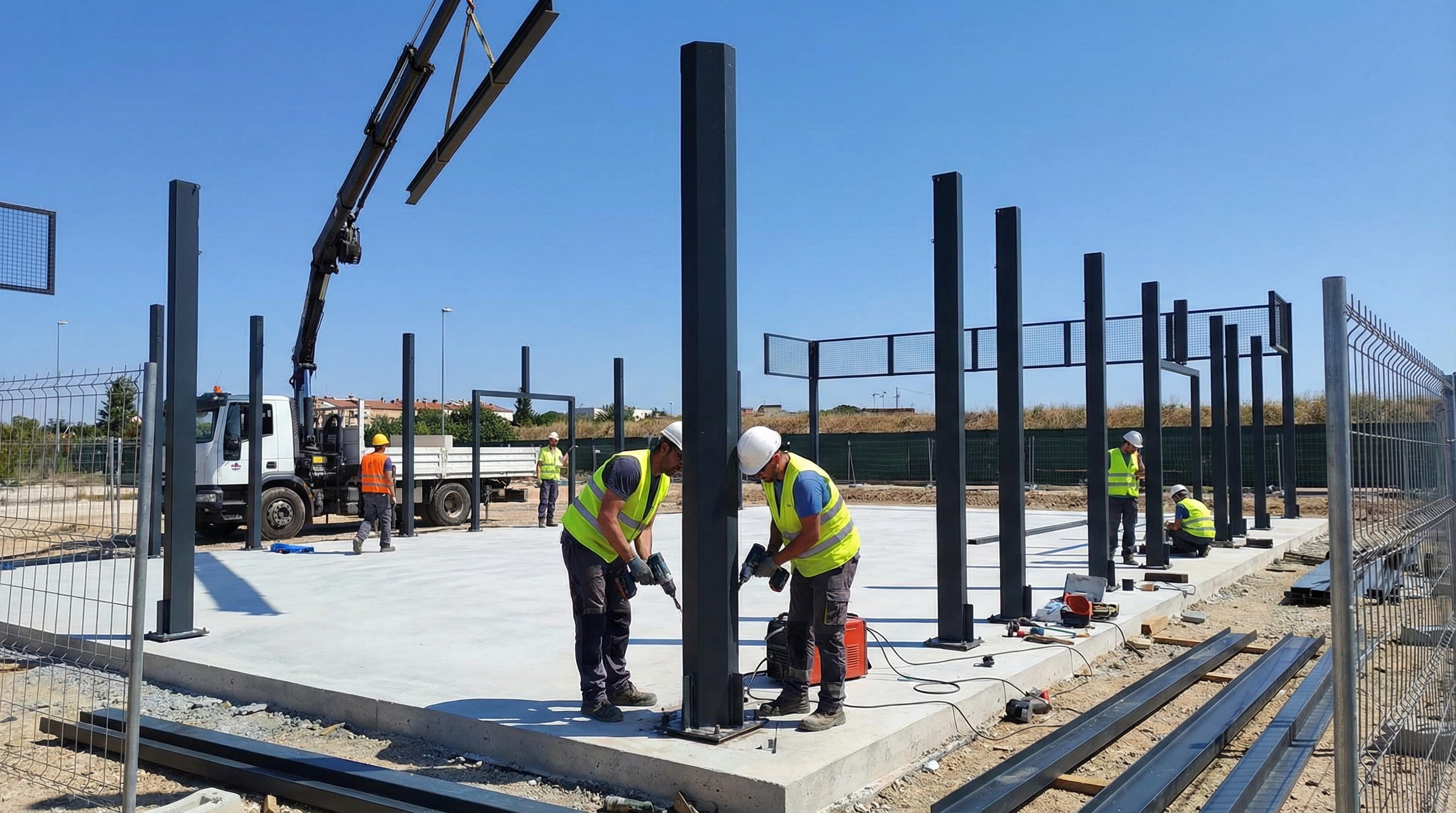
The first step is conducting a site survey and preparing a reinforced concrete base to ensure the padel vs paddle court remains level for decades. You will need to coordinate with local contractors for the civil works while we handle the manufacturing of the court kit. Proper Padel LED Lighting should also be planned at this stage to allow for night play.
Is installation support provided?
Most manufacturers provide detailed assembly manuals and remote video guidance to help your local team install the court. Because the design is modular, a team of four people can typically finish a court in 3 to 4 days.
- Step-by-step structural assembly guides.
- Video calls with technical engineers.
- Detailed packing lists for easy sorting.
- Installation kits including all necessary hardware.
What are the lighting needs?
Lighting is essential for maximizing revenue, as most club members play after work during the evening. Here is the deal: you should aim for uniform, flicker-free illumination that doesn’t blind players during high lobs.
- IP66 waterproof rated LED floodlights.
- Minimum of 8 units per court (200W each).
- Adjustable mounting brackets for precision.
- Asymmetric optics to reduce glare on the glass.
Key Takeaway: Success depends on a high-quality concrete base and following a professional modular assembly process.
| Build Phase | Requirement | Responsibility |
|---|---|---|
| Base Work | Level Reinforced Concrete | Local Contractor |
| Assembly | Modular Steel/Glass Kit | Your Team + Manual |
| Finishing | Turf, Sand, and Lights | Your Team |
The final result of a well-planned build is a durable, low-maintenance facility that starts generating revenue from day one.
Conclusion
Building a professional sports facility requires a clear understanding of the structural and commercial differences between padel and other racket sports. We have addressed the confusion surrounding the “padel vs paddle” debate by highlighting the specific engineering, equipment, and ROI advantages of the wall-based sport. Our vision at Superbpadel is to empower facility owners with factory-direct solutions that combine international safety standards with high-performance playability.
If you are ready to transform your space into a premier sports destination and maximize your investment, contact us today for a comprehensive consultation and a personalized quotation.
FAQ
- What is the Minimum Order Quantity (MOQ)?
One set is our standard MOQ. This low entry barrier allows you to test the market or start a small private project with minimal risk before scaling up to a full club. - Can I customize the court with my brand colors?
Absolutely. We offer full OEM support, including custom RAL colors for the steel structure and your logo integrated into the court’s protective padding or turf. - Do you provide technical documentation for planning?
Yes, a full documentation package is included. This contains structural drawings, material specifications, and installation manuals required for local permits and construction planning. - Is international shipping available to my port?
Yes, we ship globally to your designated port. Our logistics team handles the secure loading of containers to ensure all glass and steel components arrive in perfect condition. - How long does it take to get a quotation?
We guarantee a formal response within 24 hours. Simply provide your project details, and our multilingual sales team will deliver a comprehensive quote and technical specifications.