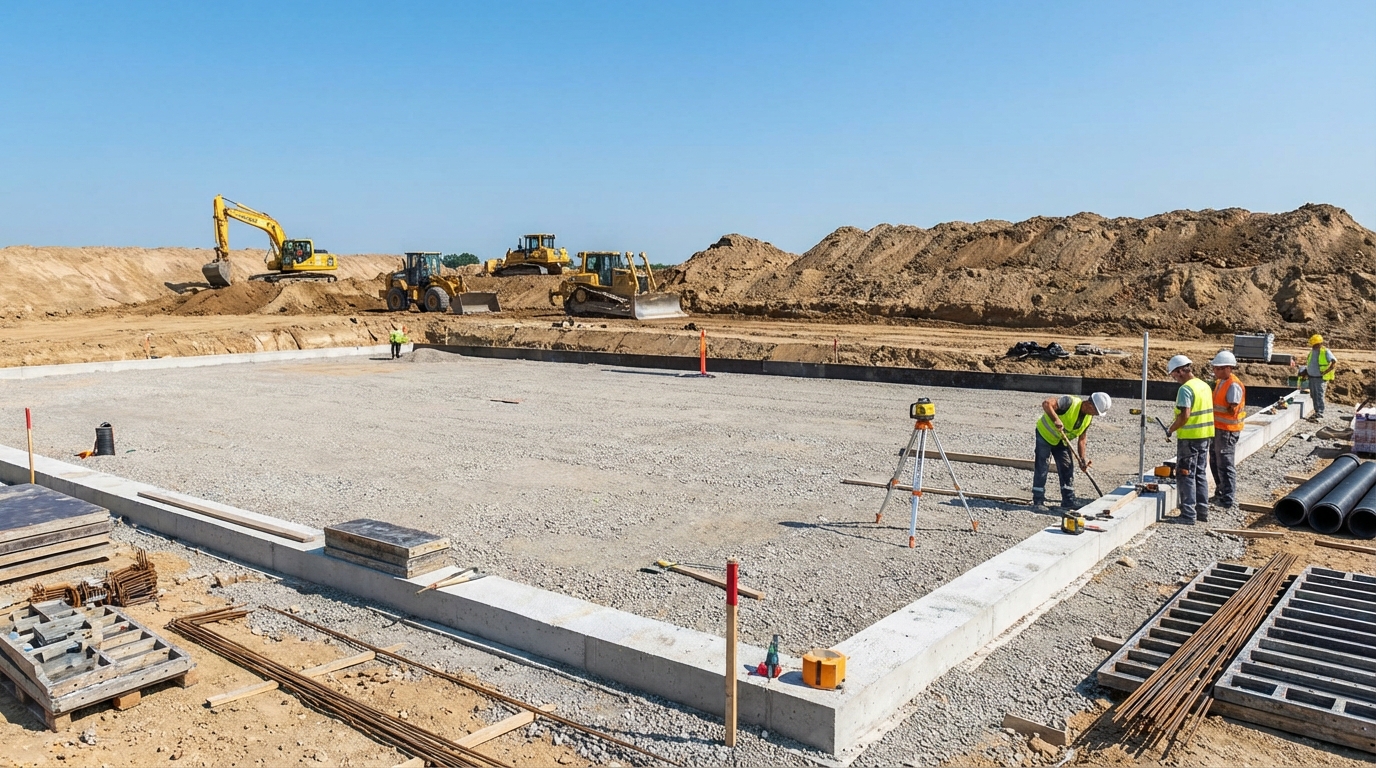
What is involved to build padel court correctly?
To build padel court structures properly, you need a coordinated approach covering ground preparation, steel framing, glass installation, and surfacing. This process requires adhering to International Padel Federation (FIP) standards to ensure the court is suitable for competitive play.
Do you know the core dimensions?
Standard padel courts are exactly 20 meters long and 10 meters wide, divided by a center net. The walls must be a combination of glass and mesh to allow for the unique rebound play style of the sport.
Here is the kicker:
- Total area required: 200 square meters.
- Net height: 0.88m at the center, 0.92m at the posts.
- Service lines: 6.95m from the net.
How do materials impact durability?
The longevity of your court depends entirely on the quality of the galvanized steel and tempered glass used. Using hot-dip galvanized steel prevents rust, especially in outdoor or humid environments.
But wait, there is more:
- Steel should be factory-welded and powder-coated.
- Glass must be anti-explosion tempered safety glass.
- High-quality fasteners are required to manage structural vibration.
Key Takeaway: Understanding the technical dimensions and material requirements is the first step toward a successful installation that meets international standards.
| Component | Standard Specification | Purpose |
|---|---|---|
| Playing Area | 10m x 20m | Regulation size for doubles play |
| Enclosure | Glass & Steel Mesh | Facilitates rebound gameplay |
| Net Height | 0.88m (Center) | Ensures fair play and ball clearance |
Strategic planning around dimensions ensures your facility can host official tournaments and attract serious players.
How much does it cost to build padel court sets?
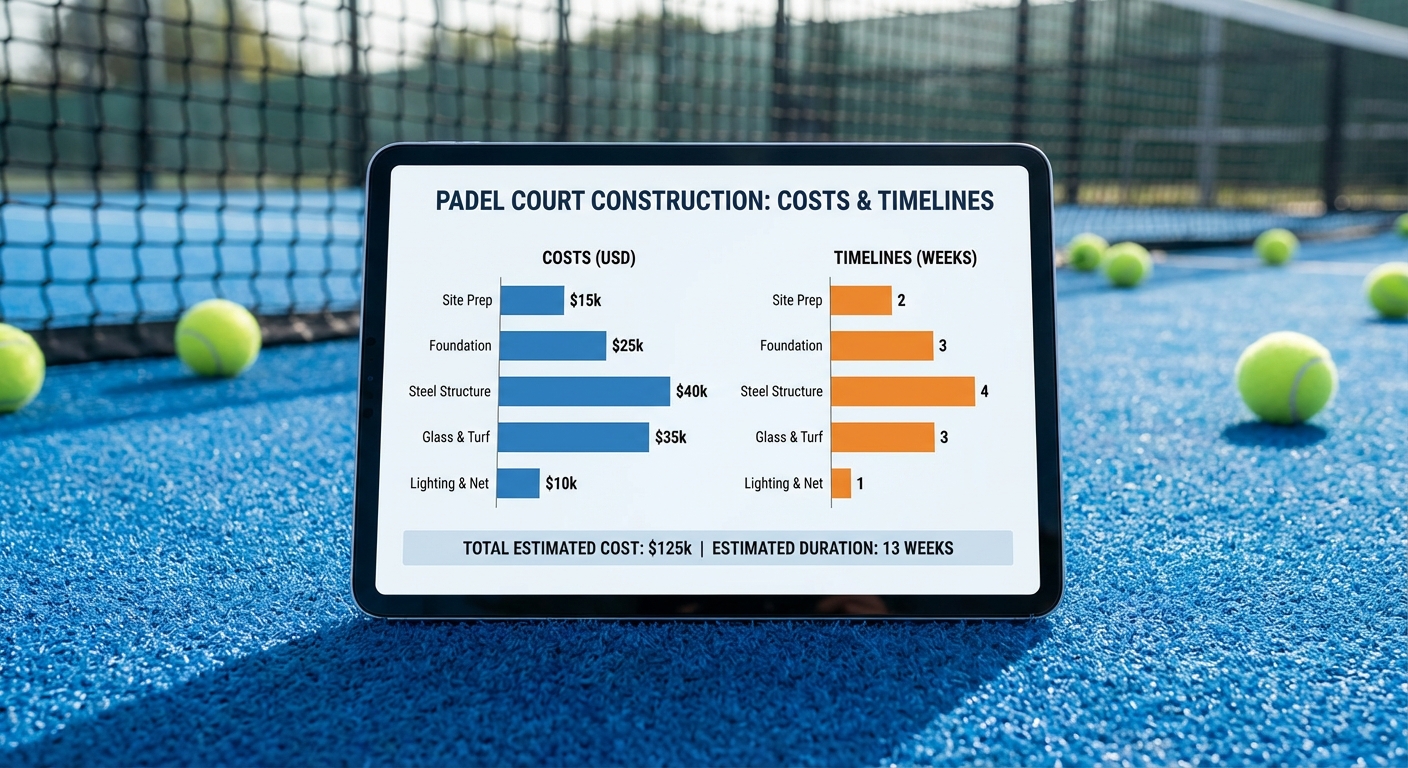
The total investment required to build padel court kits typically ranges from €20,000 to €60,000 depending on the court type and customization. Costs are split between the physical court components and the site-specific civil engineering work.
What are the main price drivers?
The choice between a standard, panoramic, or indoor court will significantly alter your budget. High-end panoramic courts use thicker glass and less steel, which increases material costs but provides a superior viewing experience.
Think about it:
- Basic Outdoor: €20,000 – €28,000.
- Premium Panoramic: €28,000 – €35,000.
- Indoor Turnkey: €40,000 – €60,000.
Are there hidden expenses?
Beyond the court kit itself, you must account for ground leveling, concrete foundation work, and electrical installation for LED lighting. Labor costs vary by region but generally represent a significant portion of the total project spend.
Why does this matter?
- Import duties and shipping can add 10-15%.
- Lighting systems require dedicated electrical circuits.
- Site preparation depends on soil stability.
Key Takeaway: Developing a comprehensive budget that includes both factory costs and local installation expenses prevents mid-project financial strain.
| Cost Category | Estimated Range | Note |
|---|---|---|
| Court Kit | €15,000 – €25,000 | Factory-direct pricing varies |
| Foundations | €5,000 – €12,000 | Depends on site soil conditions |
| Professional Install | €3,000 – €7,000 | Specialist labor for glass and turf |
Accurate cost management allows for a predictable ROI timeline, usually achieved within 12 to 24 months of full operation.
Why should you build padel court foundations first?
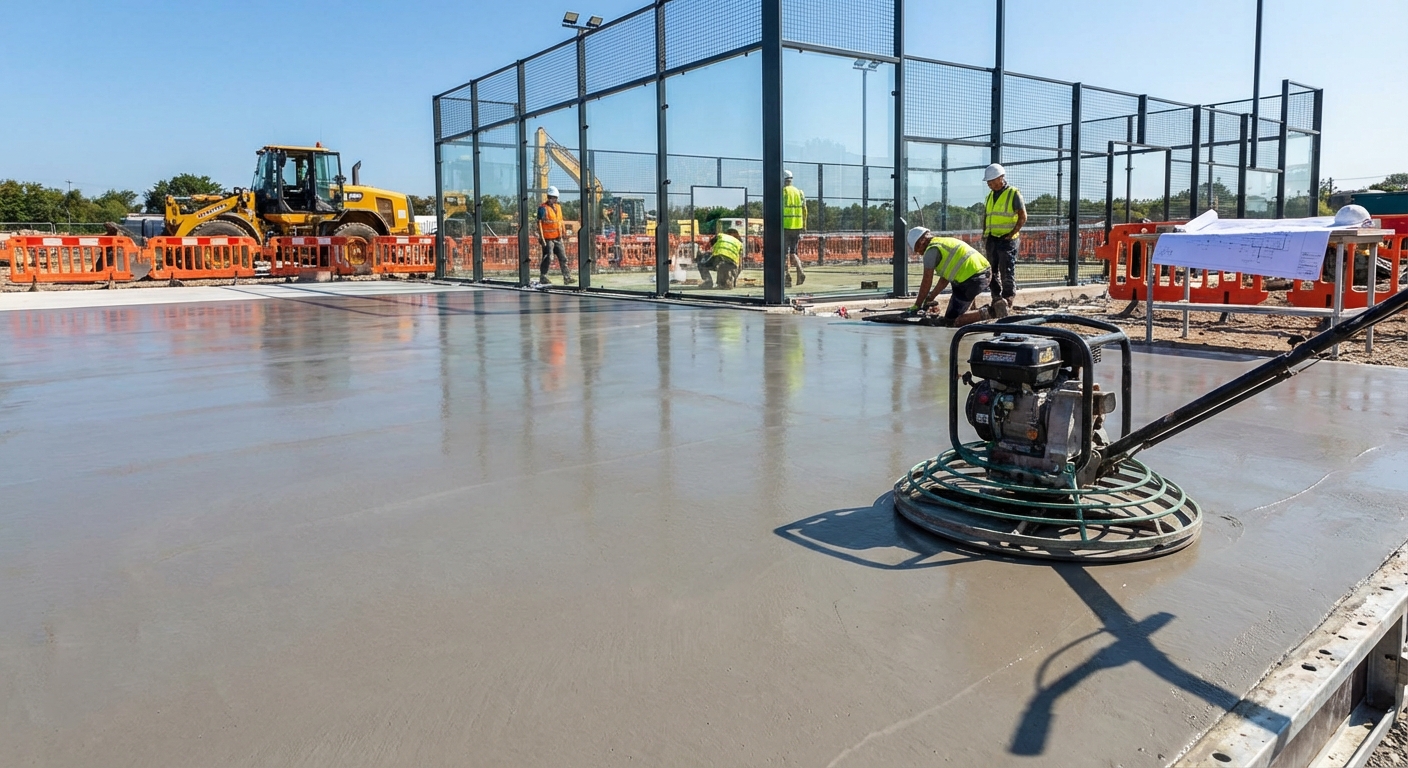
You must build padel court foundations as a solid concrete “ring beam” or a full slab to support the 4-ton structure above it. A stable base prevents the glass walls from cracking due to ground shifting and ensures a perfectly flat playing surface.
What is a ring beam?
A reinforced concrete ring beam is the most common foundation for outdoor courts, providing a level perimeter for the steel frame. It is often combined with a porous sub-base to allow for efficient drainage during heavy rain.
The best part?
- Protects the structural integrity of the glass.
- Reduces the amount of concrete needed compared to a full slab.
- Allows for integrated drainage systems.
Is drainage actually critical?
Proper water runoff is essential to prevent the artificial turf from floating or becoming a slip hazard. The foundation should have a slight slope (1% toward one direction) to guide water away from the playing area.
It gets better:
- Prevents mold growth under the turf.
- Extends the lifespan of the silica sand infill.
- Ensures the court is playable immediately after rain.
Key Takeaway: Investing in professional foundation work is the best insurance policy against structural failure and surface unevenness.
| Foundation Type | Best For | Advantage |
|---|---|---|
| Ring Beam | Outdoor Courts | Cost-effective and excellent drainage |
| Full Concrete Slab | Indoor/High Traffic | Maximum stability and level surface |
| Asphalt | Acrylic Surfaces | Good grip for non-turf options |
Soil testing should always precede foundation pouring to determine the necessary depth of the reinforcement.
How do you build padel court steel frames safely?
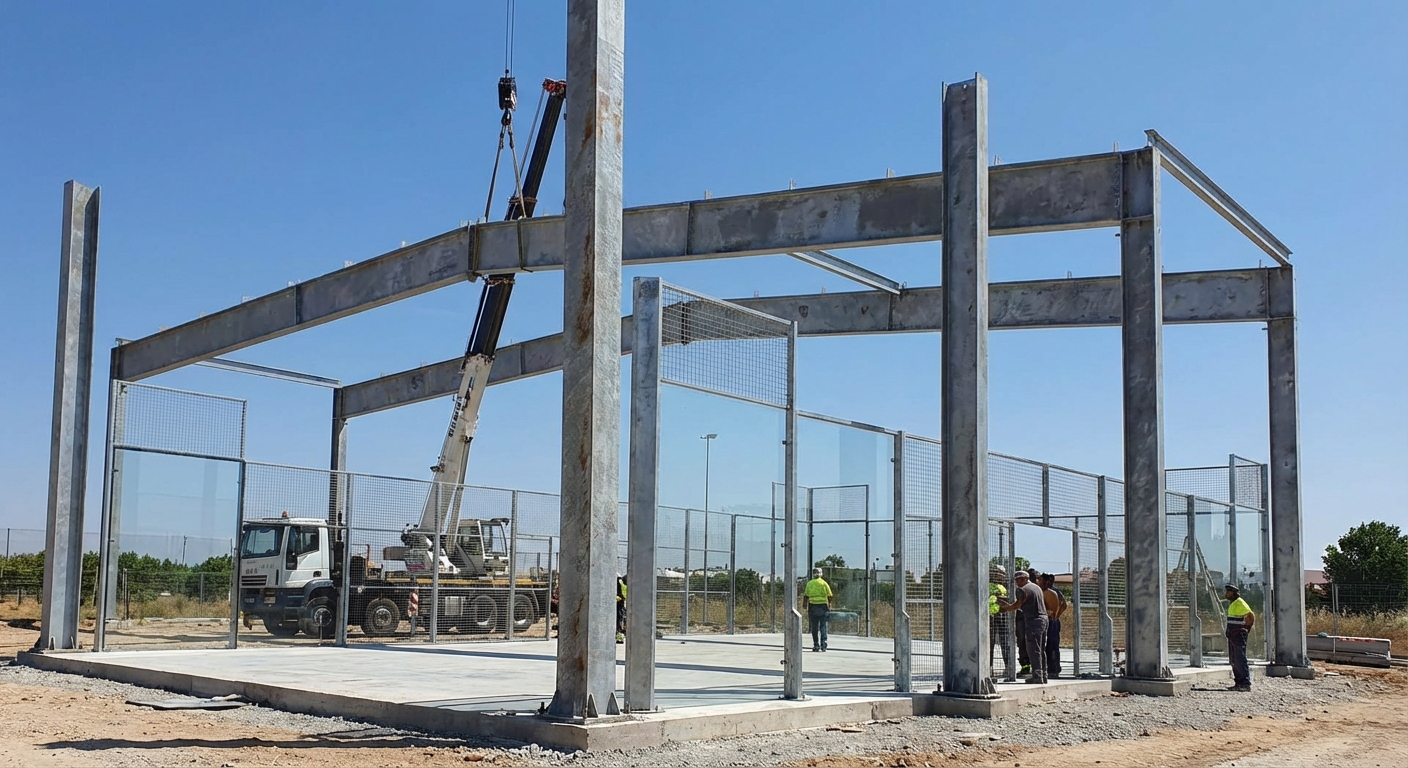
When you build padel court frames, you must use hot-dip galvanized steel posts that are bolted directly into the concrete foundation. This skeleton must be perfectly vertical to allow the glass panels to fit securely without tension.
Why use galvanized steel?
Galvanized steel offers the best protection against corrosion, which is vital for maintaining the aesthetic and safety of the court. The frame must withstand both the impact of players and high wind loads in outdoor settings.
But there’s a catch:
- Standard paint will flake within two years.
- Hot-dip galvanization reaches interior surfaces of tubes.
- Powder coating adds a professional finish and extra UV protection.
How is the frame assembled?
The modular design of modern courts allows for a rapid “screw-mounted” assembly on-site. Every post and mesh panel must be aligned using laser levels to ensure the entire structure is square.
Here’s the deal:
- Posts are typically 80x80mm or 100x100mm.
- Mesh panels must be anti-vibration.
- All hardware should be stainless steel to prevent rust streaks.
Key Takeaway: A robust, galvanized steel frame provides the necessary safety for players and supports the heavy glass panels for decades.
| Frame Feature | Requirement | Benefit |
|---|---|---|
| Material | Hot-dip Galvanized Steel | 20-year rust protection |
| Mounting | M12/M16 Anchor Bolts | Secure foundation connection |
| Finish | Electrostatic Powder Coating | UV resistance and color choice |
Structural integrity is non-negotiable, as the steel frame acts as the primary safety barrier for the entire facility.
What glass is needed to build padel court walls?
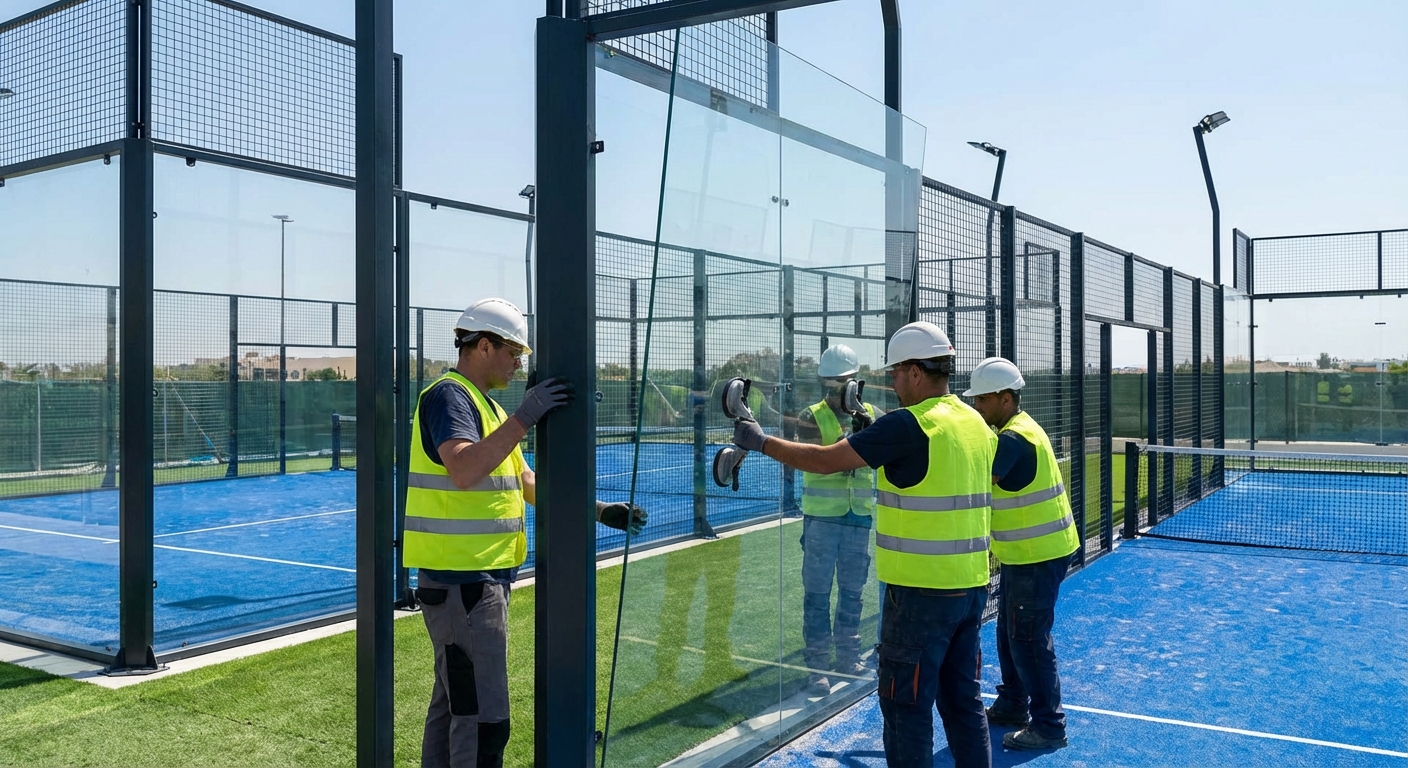
To build padel court walls that are safe for high-impact play, you must install 10mm or 12mm tempered safety glass. This glass is designed to crumble into small, harmless pieces rather than sharp shards if it ever breaks.
10mm or 12mm thickness?
While 10mm glass is standard for many outdoor courts, 12mm glass is recommended for panoramic courts or high-frequency clubs. Thicker glass provides a more consistent ball bounce and a more premium “thud” sound upon impact.
Look at it this way:
- 10mm: Standard durability, lower cost.
- 12mm: Professional feel, higher safety margin.
- Tempered glass must meet EN 12150 standards.
How do you secure the glass?
Glass panels are held in place by specialized fasteners and rubber gaskets that absorb the shock of players running into the walls. It is critical that the glass never touches the steel frame directly to avoid stress fractures.
You might be wondering:
- How many panels are needed? (Usually 14 to 18).
- What size are they? (Typically 2×3 meters).
- Are they easy to replace? (Yes, if the frame is square).
Key Takeaway: Certified tempered glass is the most expensive and critical safety component of the court, defining the player’s rebound experience.
| Glass Property | Standard | Importance |
|---|---|---|
| Thickness | 10mm – 12mm | Bounce consistency and safety |
| Type | Tempered / Toughened | Prevents dangerous sharp breaks |
| Certification | EN 12150 / CE | Compliance with insurance and safety laws |
Using sub-standard glass is the most common cause of project liability and should be avoided at all costs.
How to build padel court turf surfaces for play?
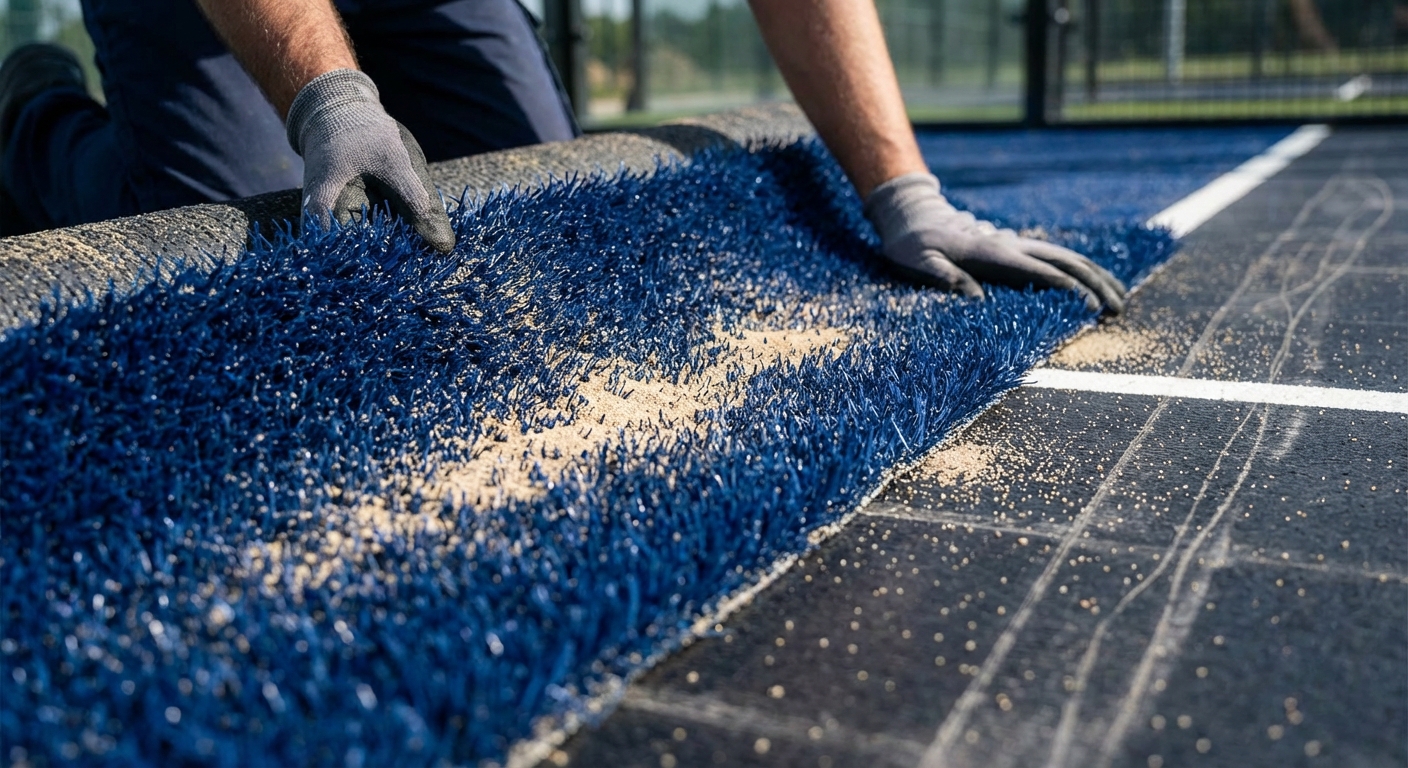
You must build padel court surfaces using specialized monofilament or fibrillated artificial turf filled with fine silica sand. This combination provides the perfect balance of player grip and controlled ball slide.
What is the ideal pile height?
Padel-specific turf usually has a pile height of 10mm to 15mm, which is shorter and denser than football turf. A pile height of 12mm is the industry standard for providing a professional-grade ball bounce.
Here is the kicker:
- High stitch density prevents early matting.
- Textured fibers hold sand in place more effectively.
- Blue is the most popular color for TV and visibility.
Why is silica sand required?
The silica sand acts as a stabilizer for the turf fibers and allows players to slide safely during intense lateral movements. Without the correct amount of sand, the turf will wear out rapidly and ball bounce will become unpredictable.
But wait, there is more:
- Use 0.2mm to 0.5mm rounded silica sand.
- Sand prevents the turf from shifting or wrinkling.
- Regular brushing is needed to keep sand level.
Key Takeaway: The quality of the turf and sand infill determines the “speed” of the court and the comfort level for the players’ joints.
| Turf Feature | Specification | User Benefit |
|---|---|---|
| Fiber Type | Monofilament / Textured | Better aesthetics and durability |
| Sand Load | 12kg – 15kg per sqm | Consistent bounce and slide |
| Color | Blue / Green / Red | Custom branding and visibility |
A well-installed turf surface reduces the risk of knee and ankle injuries, keeping your members coming back to play.
Why install lighting when you build padel court?
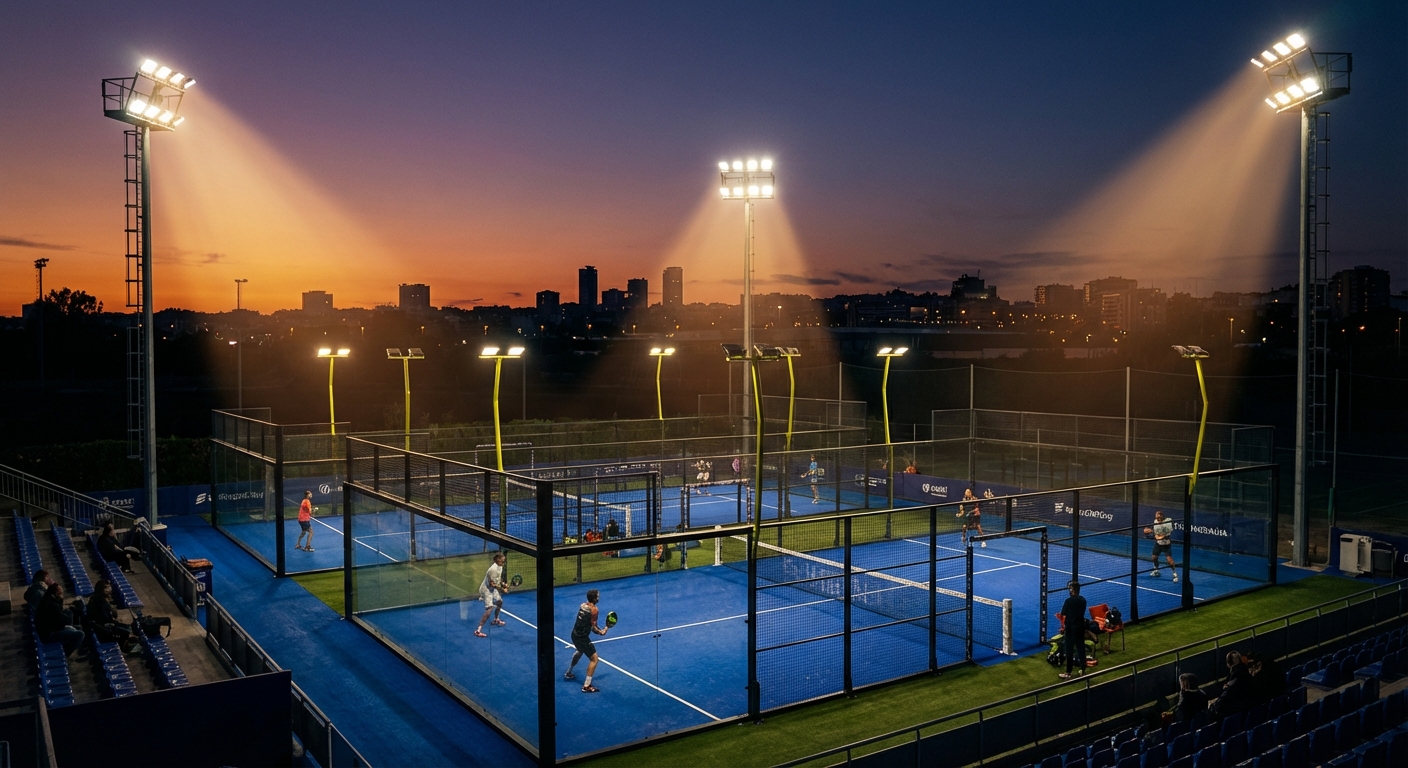
When you build padel court facilities, installing 200W or 300W LED floodlights allows for evening play, which is typically the most profitable time for club owners. Proper lighting must be uniform across the court to eliminate shadows that can distract players.
What are the lux requirements?
For recreational play, an average of 300 lux is sufficient, but professional or televised matches require 500 to 750 lux. The lights should be mounted on eight-meter poles to ensure the light is cast downward at the correct angle.
Think about it:
- LED lights use 70% less energy than old metal halide bulbs.
- Instant-on capability means no warm-up time.
- Flicker-free LEDs are essential for slow-motion recording.
How do you avoid glare?
Asymmetrical lenses on the LED fixtures are used to direct light onto the playing surface while minimizing glare for the players looking up for high lobs. The placement of the light poles is usually at the corners and mid-points of the side mesh.
Why does this matter?
- Poor lighting leads to eye strain and mistakes.
- Glare can be a safety hazard during overhead smashes.
- Energy-efficient LEDs significantly lower monthly overheads.
Key Takeaway: High-quality LED lighting doubles your playable hours and ensures a premium experience during peak evening bookings.
| Lighting Metric | Recommendation | Result |
|---|---|---|
| Power | 4 x 200W or 8 x 200W | Bright, uniform coverage |
| Mounting Height | 6m – 8m | Reduced glare for players |
| Waterproofing | IP66 Rated | Durability in all weather |
Reliable lighting is the simplest way to maximize the revenue potential of every square meter of your facility.
How to build padel court panoramic viewing areas?
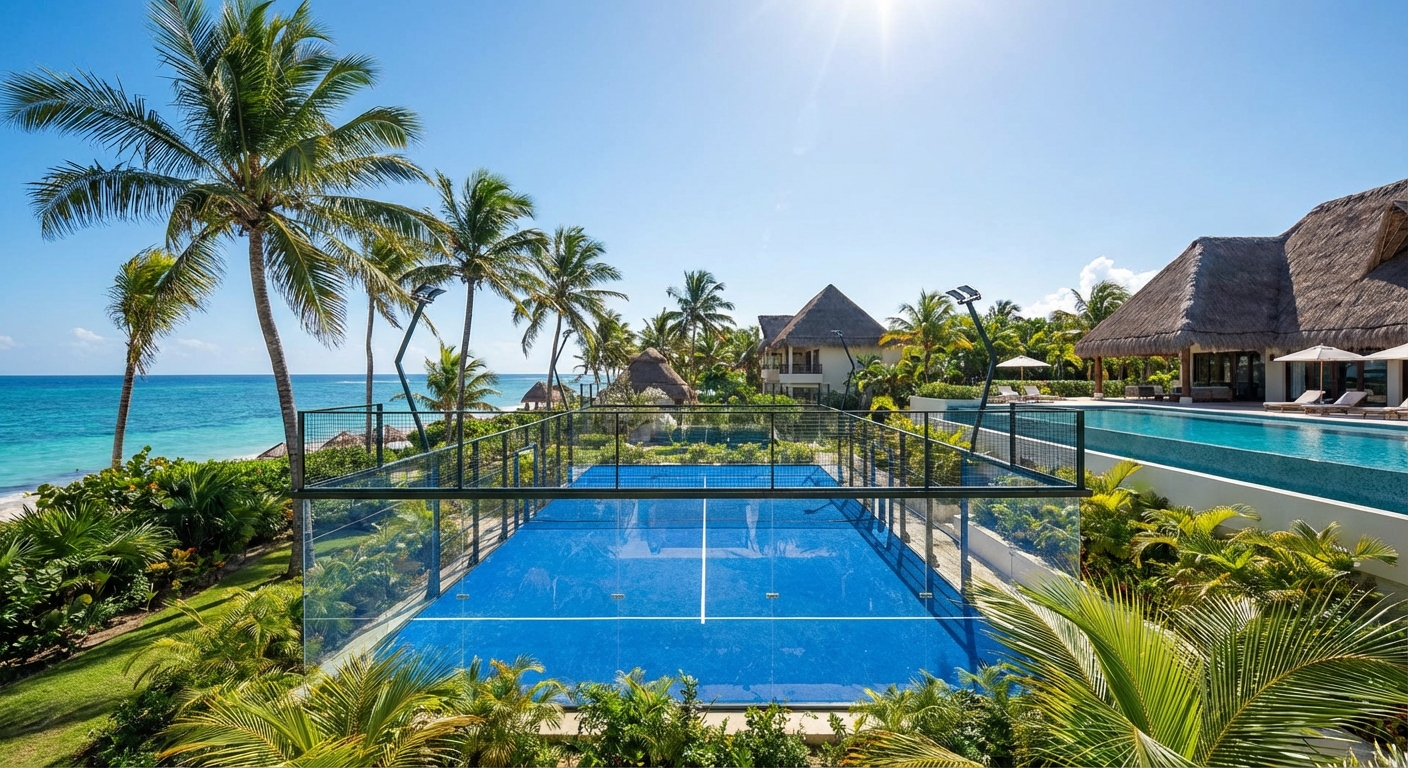
To build padel court panoramic designs, you must remove the vertical steel posts from the back glass walls to create an unobstructed view for spectators. This requires thicker 12mm glass and reinforced corner structures to maintain stability.
What makes it “Panoramic”?
The panoramic model is the gold standard for center courts and high-end resorts because it looks sleek and allows for better filming. It relies on heavy-duty steel beams at the top and bottom to hold the glass in place without middle supports.
The best part?
- Offers a 360-degree viewing experience.
- Commands higher court rental fees.
- Increases the prestige of your sports club.
Is it harder to maintain?
Because there is more glass and less steel, cleaning becomes a more frequent task to keep the court looking “invisible.” However, the structural components are generally over-engineered to ensure the court remains as safe as a standard model.
It gets better:
- Uses the same foundation footprint as standard courts.
- Can be fitted with luxury LED lighting and custom colors.
- Attracts pro-level players who prefer tournament-style courts.
Key Takeaway: Panoramic courts are a powerful marketing tool that sets your facility apart from basic competitors in the local market.
| Court Type | Viewing Angle | Structural Requirement |
|---|---|---|
| Standard | Interrupted by posts | 80mm – 100mm Steel Frame |
| Panoramic | Uninterrupted back wall | 12mm Glass + Heavy Top Beam |
| Super Panoramic | Full glass perimeter | Maximum visibility engineering |
Choosing a panoramic design is an investment in your brand’s image and long-term market positioning.
What space do you need to build padel court kits?
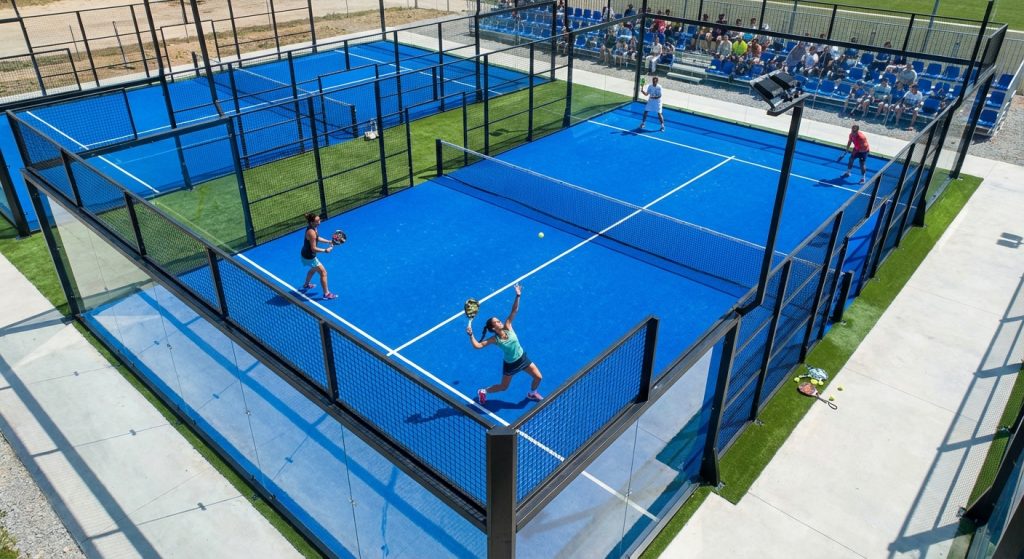
You need a total footprint of approximately 11 meters by 21 meters to build padel court kits comfortably, allowing for a small safety buffer around the exterior. If you plan to install multiple courts, leaving space for player walkways and seating is essential.
Can you fit a court in your backyard?
Padel courts are remarkably space-efficient compared to tennis courts, which require nearly three times the area. If you have a flat area of roughly 231 square meters, you can successfully host a full-sized doubles court.
But there’s a catch:
- You must check local zoning and height restrictions.
- Noise levels from ball impact should be considered for neighbors.
- Access for construction machinery is required during the build.
How do you optimize multi-court layouts?
When building a club, grouping courts in pairs with a shared central walkway maximizes space and creates a social atmosphere. This “cluster” approach also simplifies the installation of electrical and drainage lines.
Here’s the deal:
- Allow 0.5m to 1.0m between individual courts.
- Orientation should ideally be North-South to avoid sun glare.
- Include a 3-meter ceiling height for indoor facilities.
Key Takeaway: The compact nature of padel makes it the most profitable racket sport per square meter of land.
| Space Element | Metric | Purpose |
|---|---|---|
| Internal Dimensions | 10m x 20m | Regulation play area |
| Total Footprint | 11m x 21m | Includes structural base |
| Indoor Height | 6m – 9m | Allows for high lob shots |
Careful site selection and layout planning ensure your facility can scale as the sport’s popularity grows in your area.
How to build padel court interior luxury zones?
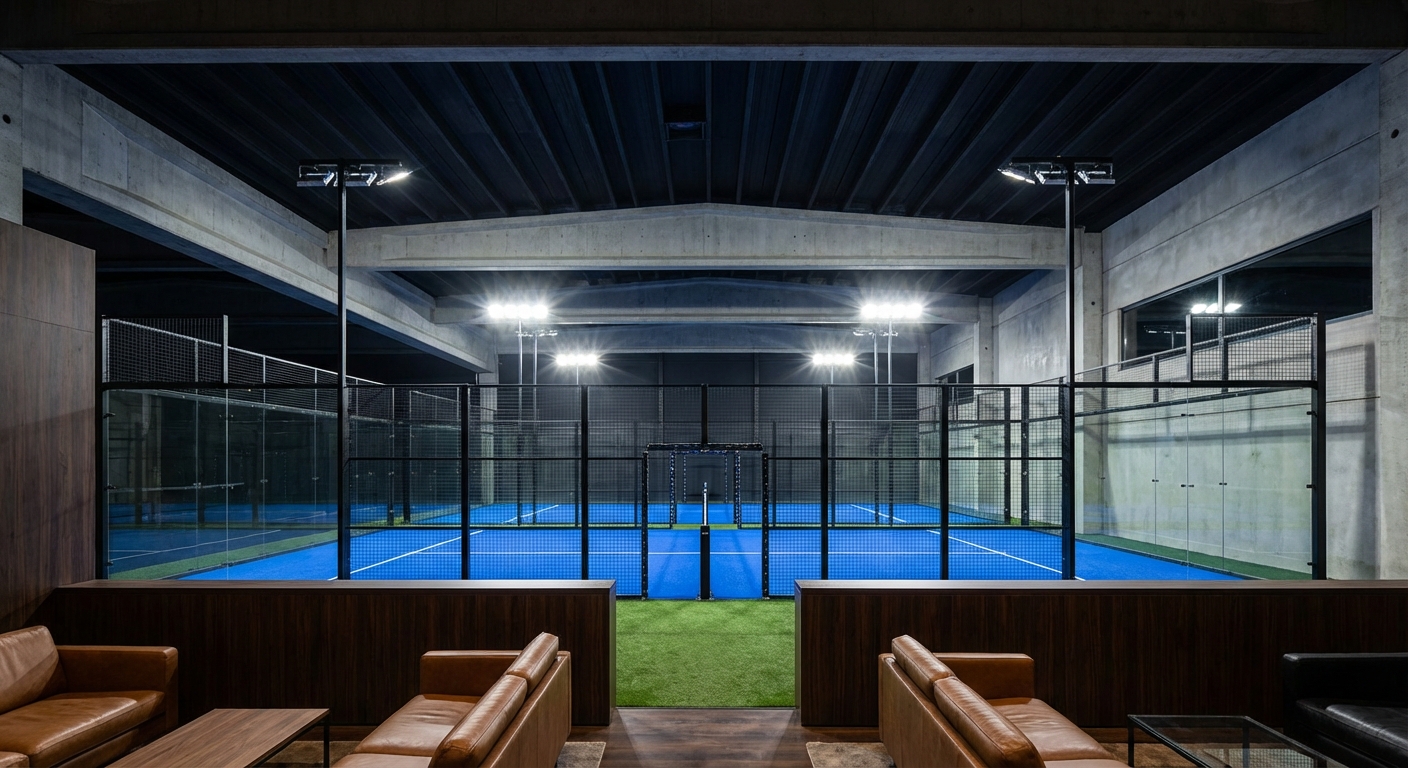
You can build padel court luxury zones by integrating premium seating, high-end materials, and climate-controlled environments for players. Indoor luxury courts often feature custom-branded turf and structure colors to match a high-end gym or resort aesthetic.
What defines a luxury court?
Luxury is defined by the details: seamless glass joins, silent LED fans for indoor air circulation, and comfortable player benches integrated into the court area. Using non-standard colors like black or gold for the structure can elevate the visual appeal.
Look at it this way:
- Increases member retention through comfort.
- Supports premium membership pricing.
- Creates a “destination” feel for the sport.
Is branding worth the investment?
Customizing the court with your logo on the net and the glass creates a professional environment that is perfect for social media marketing. When players take photos and videos, your brand is front and center in every frame.
You might be wondering:
- Can I customize the turf color? (Yes, red and purple are rising trends).
- Are scoreboards necessary? (Digital scoreboards are a luxury must-have).
- Does it require more cleaning? (Yes, to maintain the “factory-new” look).
Key Takeaway: A luxury interior court is not just a sports facility; it is a premium lifestyle amenity that attracts high-value clients.
| Luxury Add-on | Benefit | Impact |
|---|---|---|
| Digital Scoreboard | Professional feel | Higher player engagement |
| Custom Branding | Marketing reach | Strengthened brand identity |
| Comfort Seating | Spectator retention | Increased food and beverage sales |
Focusing on the player’s journey from the lounge to the court ensures your facility remains the top choice in your city.
*
Conclusion: Elevate Your Sports Project Today
Building a professional padel court is a strategic investment that combines high-performance engineering with significant revenue potential. We have explored the critical stages from laying the foundation to selecting the finest 12mm tempered glass and high-density turf. By focusing on factory-direct quality and FIP-compliant standards, you solve the problem of high procurement costs while ensuring a safe, world-class experience for your players.
Our vision is to empower facility owners with the most durable and aesthetically striking courts in the industry. Whether you are launching a new sports club or upgrading a luxury resort, we are here to provide the technical expertise and hardware you need. To receive a custom quotation and start your journey toward a premier sports facility, contact us today and let’s build something extraordinary together.
*
Frequently Asked Questions
Can I build a padel court on a standard tennis court space?
Yes, because a padel court is significantly smaller (10x20m) than a tennis court (approx. 11x24m for the lines alone). You can actually fit two or even three padel courts on the space previously occupied by a single tennis court, maximizing your revenue per square meter.
What is the best way to handle drainage for outdoor courts?
Direct, efficient drainage is best achieved through a porous concrete base or a slight slope in the foundation. This ensures that water doesn’t pool on the surface, keeping the turf playable and preventing sand displacement.
How do I know if my local soil is suitable for construction?
A professional soil test is the only way to be sure, as it determines the load-bearing capacity and stability of the ground. This data allows engineers to specify the correct depth and reinforcement for your concrete ring beam.
Can I customize the color of the steel structure to match my brand?
Yes, because our factory-direct process allows for custom powder coating in any standard RAL color. This customization helps strengthen your club’s brand identity and creates a more cohesive visual environment.
How long does the entire construction process usually take?
Typically, the on-site installation of the court kit takes about 7 to 10 days, but the total project timeline—including foundation curing and permits—is usually around 30 days. Scheduling the foundation work in advance is the key to meeting tight deadlines.