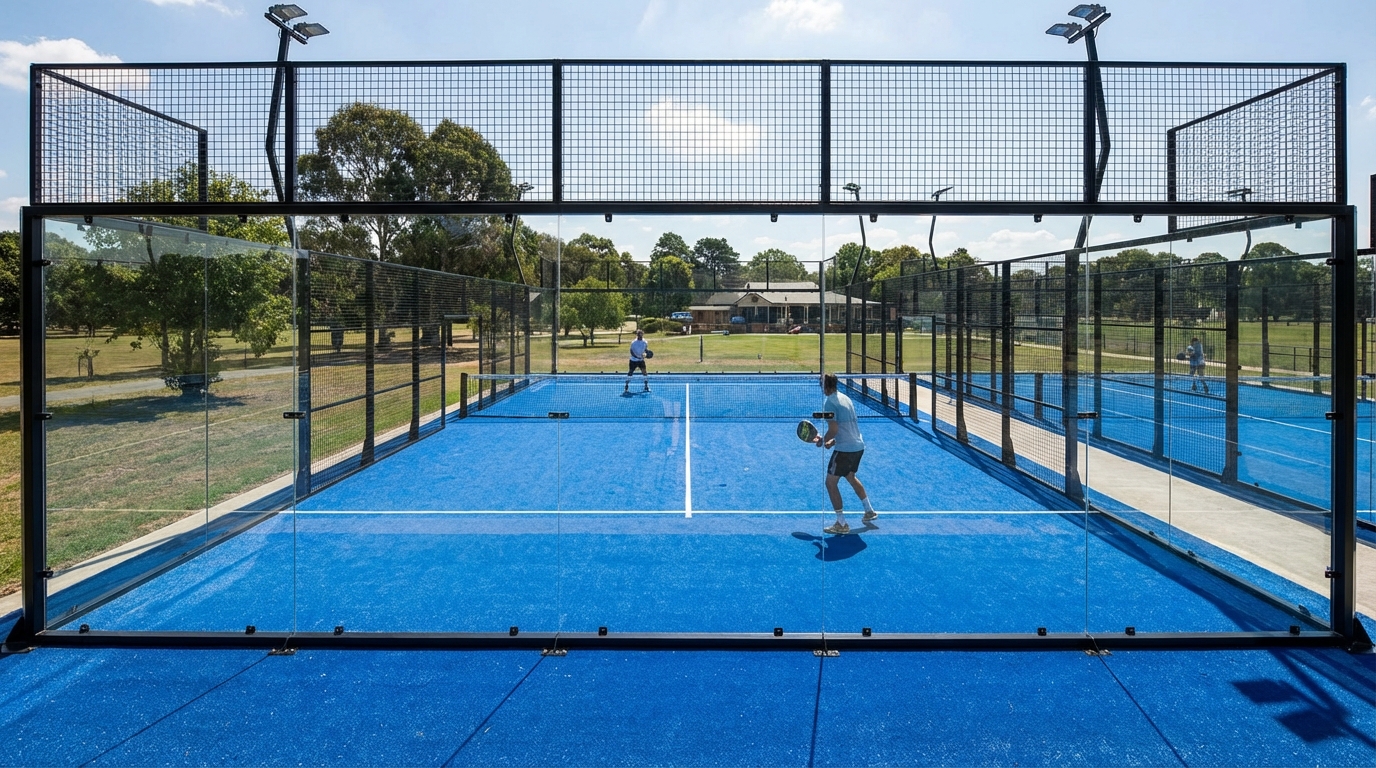
A standard padel court measures 20 meters by 10 meters, whereas a regulation pickleball court is significantly smaller at 13.41 meters by 6.09 meters. Many facility owners struggle with underutilized space or selecting the wrong sport for their specific footprint, leading to lost revenue and poor player engagement. You might find yourself caught between the high-octane glass-walled allure of padel and the rapid, accessible growth of pickleball without knowing which fits your land better. By understanding the padel vs pickleball court size requirements and technical builds, you can maximize your square footage and ensure a high return on investment for your athletic facility.
What is the standard padel vs pickleball court size?
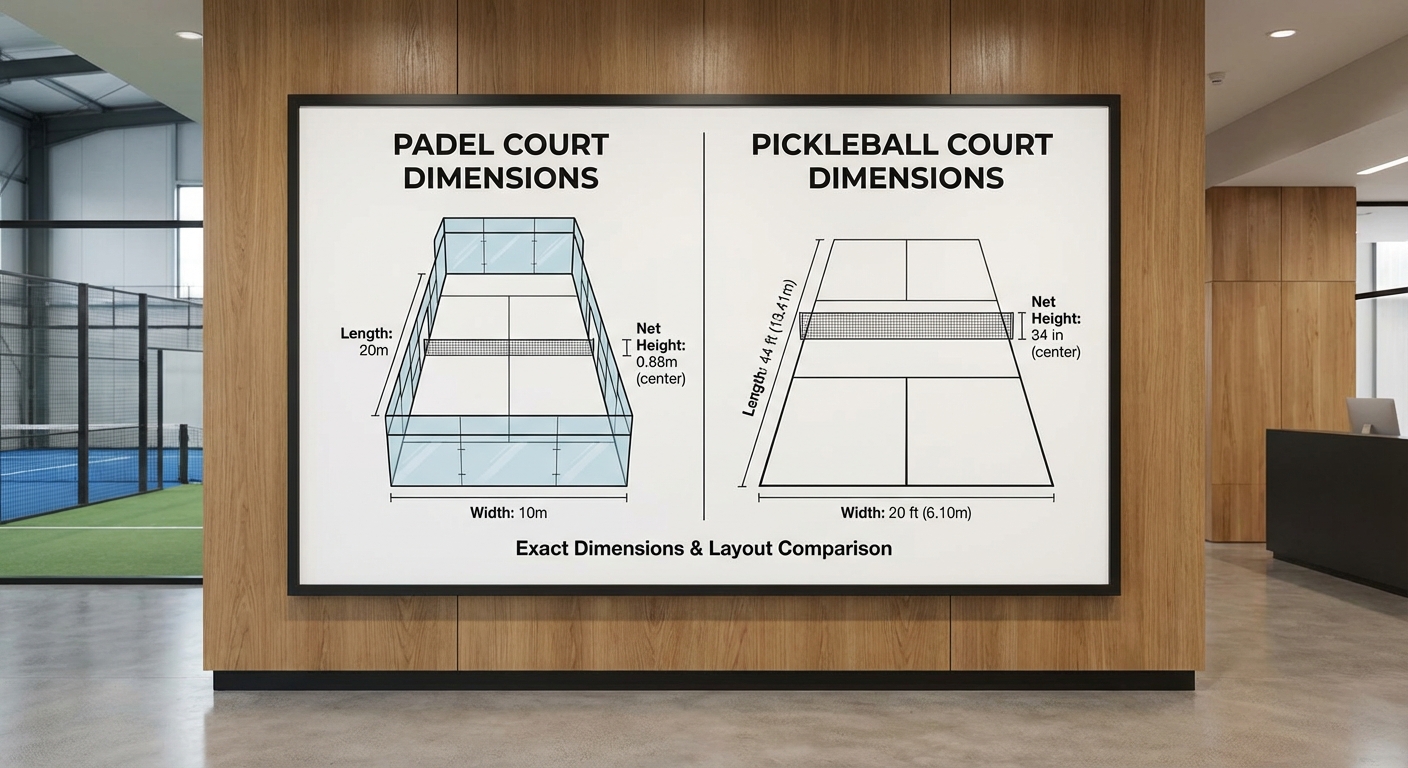
The primary difference in padel vs pickleball court size is that a padel court occupies 200 square meters of playing area, while a pickleball court requires only about 81.75 square meters. This means a single padel court is nearly two and a half times larger than a pickleball court. When you are planning a facility, recognizing this massive disparity in footprint is the first step toward a successful layout.
Defining Padel Dimensions
A padel court is a rectangular enclosure that measures 10 meters in width and 20 meters in length. You must account for the fact that these dimensions are for the inner playing area, which is divided into two halves by a central net.
The truth is:
You cannot just look at the floor; you must look at the walls.
- The back walls must be 3 meters high.
- Side walls usually consist of glass and metallic mesh.
- Service lines are positioned 6.95 meters from the net.
Key Takeaway: Padel dimensions are rigid due to the requirement for glass and mesh enclosures that facilitate rebound play.
Defining Pickleball Dimensions
A regulation pickleball court measures 20 feet wide by 44 feet long, which translates to roughly 6.1 meters by 13.4 meters. This size is identical to a doubles badminton court, making it one of the most compact racquet sports in existence.
Here is the kicker:
While the playing area is small, you still need significant “out-of-bounds” clearance for safety.
- The total recommended footprint is often 30 by 60 feet.
- Non-volley zones (the kitchen) extend 7 feet from the net.
- Service areas are 15 feet long and 10 feet wide.
Key Takeaway: Pickleball’s small footprint allows for high player density per square foot, making it an efficient use of space.
Comparing Total Playable Area
When comparing the two, you will notice that the total area of a padel court (200 sqm) dominates the pickleball court (approx. 82 sqm). This affects everything from the amount of surfacing material you need to purchase to the complexity of the sub-base preparation.
Believe it or not:
You can actually fit approximately three pickleball courts into the space required for one padel court plus its required safety margins.
- Padel: 200 sqm playing surface.
- Pickleball: ~82 sqm playing surface.
- Ratio: 2.45 to 1 in favor of Padel’s size.
Key Takeaway: Space efficiency is the deciding factor for many urban developers choosing between these two sports.
| Feature | Padel Court | Pickleball Court |
|---|---|---|
| Length | 20 Meters | 13.41 Meters |
| Width | 10 Meters | 6.10 Meters |
| Total Area | 200 Sq. Meters | ~82 Sq. Meters |
| Enclosure | Glass & Mesh Walls | Open (Fencing Optional) |
The significant difference in total area suggests that padel is a more expansive, infrastructure-heavy sport, while pickleball is optimized for maximum density in limited spaces.
How do padel vs pickleball court size ratios compare?
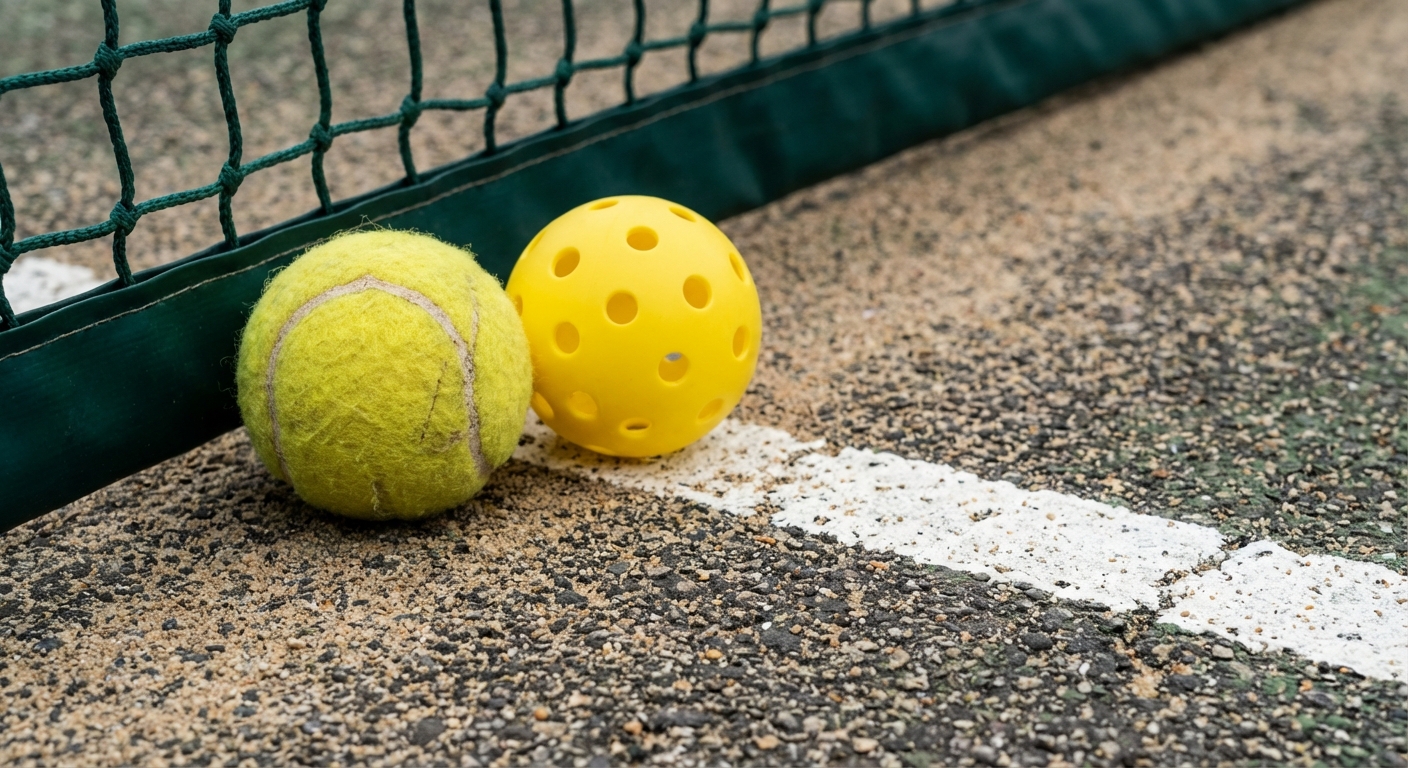
The area ratio for padel vs pickleball court size sits at approximately 2.4:1, meaning you must plan for a much larger initial land investment for padel. This ratio is critical when calculating potential revenue per square meter for a commercial club. If you have a fixed plot of land, this mathematical reality will dictate your entire business model.
Land Utilization Ratios
For every single padel court you install, you could alternatively host nearly three pickleball courts in the same area. This ratio is why pickleball is often seen as a “high-volume” sport for municipal parks and community centers.
Make no mistake:
The land you save on pickleball can be used for spectator seating or amenities.
- Padel requires 2,152 sq ft.
- Pickleball requires 880 sq ft.
- Land ratio per player is roughly 538 sq ft (Padel) vs 220 sq ft (Pickleball).
Key Takeaway: Pickleball offers a superior player-to-land ratio, which can lead to higher turnover during peak hours.
Volume and Capacity Analysis
In a commercial setting, the size ratio means you can accommodate 12 pickleball players in the same footprint that holds 4 padel players. This high capacity allows you to scale your membership or booking fees more aggressively.
Think about this:
Increased player capacity often leads to higher ancillary spending at your pro shop or café.
- 3 Pickleball courts = 12 players simultaneously.
- 1 Padel court = 4 players simultaneously.
- Net revenue potential is often higher with multiple pickleball units.
Key Takeaway: High-density layouts favor pickleball for facilities focused on throughput and community engagement.
Structural Footprint Comparisons
Beyond the horizontal dimensions, the vertical ratio is also a major consideration in your build. Padel requires a minimum height of 6 meters for indoor play, whereas pickleball is often played in standard gymnasiums with lower ceilings.
It gets better:
Outdoor pickleball courts have almost no vertical requirements, making them easier to place under trees or power lines.
- Padel: Vertical cage/glass structure is 3-4m high.
- Pickleball: Typically flat with a 36-inch net.
- Overhead clearance for Padel: 6m minimum (8m preferred).
Key Takeaway: Padel’s structural requirements introduce a vertical dimension that complicates site selection compared to the flat profile of pickleball.
| Metric | Padel (1 Unit) | Pickleball (3 Units) |
|---|---|---|
| Players | 4 | 12 |
| Area Used | ~200 sqm | ~246 sqm |
| Vertical Build | High (Walls) | Low (No Walls) |
| Complexity | High | Low |
While one padel court is smaller than three pickleball courts, the ability to pack more players into a similar total footprint makes pickleball the more “efficient” sport for massive participation.
What space is needed for padel vs pickleball court size?
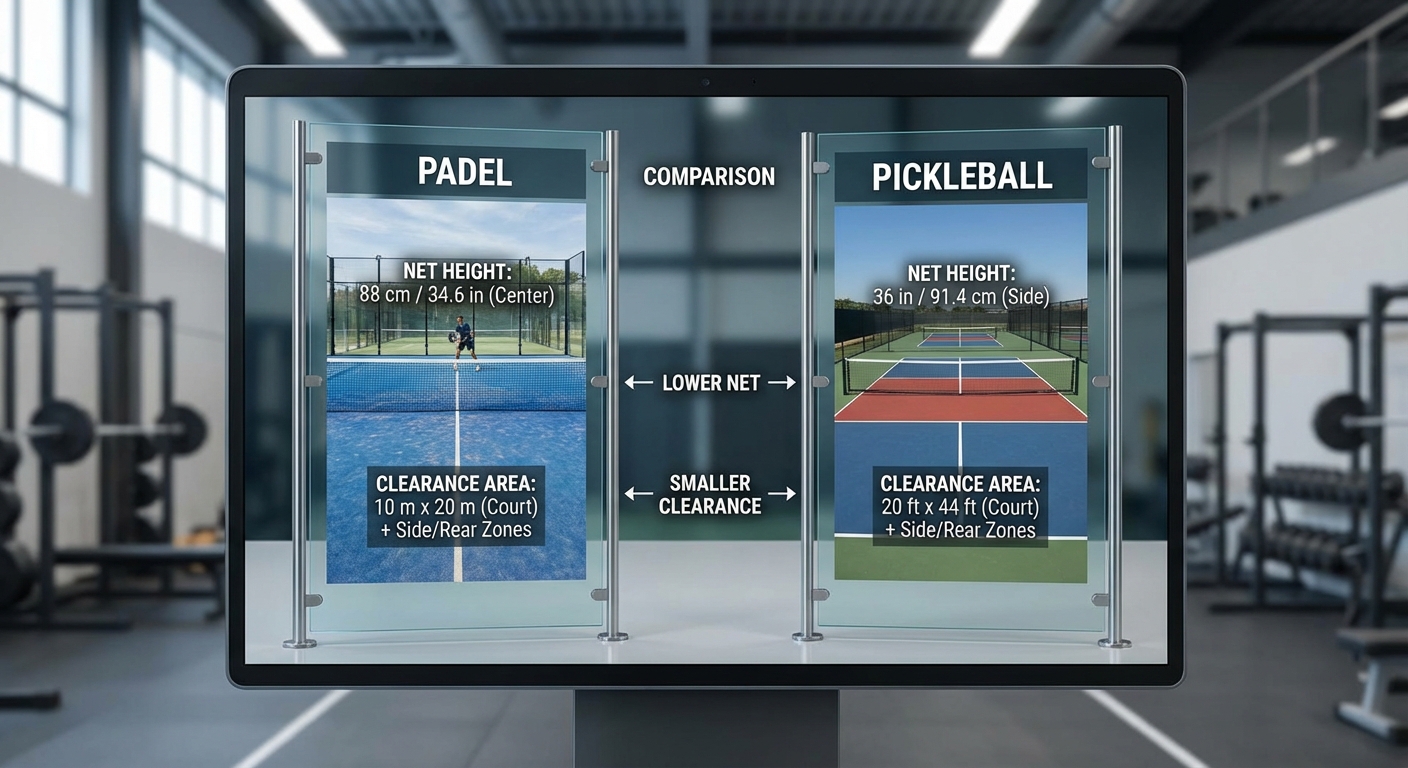
A padel court requires a total clearance area of at least 11 meters by 21 meters, while a pickleball court functions best within a 30-foot by 60-foot (9.1m x 18.3m) zone. This total footprint includes the necessary “out-of-bounds” or safety margins required by international regulations. You must never build exactly to the playing line dimensions, as players need space to move safely beyond the boundaries.
Safety Zones for Padel
The safety zone for padel is unique because players can actually exit the court through the side doors to return a ball. For professional-grade play, you should allow for an additional 2 meters of clear space on either side of the court doors.
Consider this:
Without the extra “out-of-court” zone, you limit the level of play your facility can host.
- Standard footprint: 10m x 20m.
- Recommended footprint: 11m x 21m.
- Professional footprint: 14m x 22m (to allow for exterior play).
Key Takeaway: Padel’s total space needs vary wildly depending on whether you want to host competitive or purely recreational matches.
Run-off Requirements for Pickleball
Pickleball players move laterally and backward with surprising speed, requiring a minimum of 5 feet of clearance on the sides. If you ignore these margins, you risk player injury and legal liability from collisions with fences or other courts.
The kicker is:
Many backyard builds fail because they underestimate the “backward” run-off.
- Minimum side clearance: 5 feet.
- Minimum end clearance: 8 feet.
- Total area needed: 1,800 sq ft for a single court.
Key Takeaway: While the pickleball court is small, the safety buffer nearly doubles the total square footage you must prepare.
Total Facility Footprint
When you are designing a club with multiple courts, you must also factor in walkways, drainage paths, and lighting mast positions. These “utility areas” can add another 15-20% to your total land requirement for either sport.
But wait, there’s more:
Lighting masts for padel are typically integrated into the cage, whereas pickleball masts are separate.
- Walkway width: 1.5 meters minimum.
- Drainage buffer: 0.5 meters around the slab.
- Spectator zones: 2-3 meters depth.
Key Takeaway: Professional layouts prioritize traffic flow and drainage, which increases the gross land requirement beyond the courts themselves.
| Space Type | Padel (Rec) | Pickleball (Rec) |
|---|---|---|
| Playing Lines | 10m x 20m | 6.1m x 13.4m |
| Total Area Needed | ~231 sqm | ~167 sqm |
| Safety Buffer | 1 Meter | 2.4 Meters (Ends) |
| Ceiling Height | 6 Meters+ | N/A (Outdoor) |
A padel facility requires a more significant and structured vertical footprint, whereas pickleball is more forgiving but demands relatively large safety buffers relative to its playing size.
Does padel vs pickleball court size affect construction?
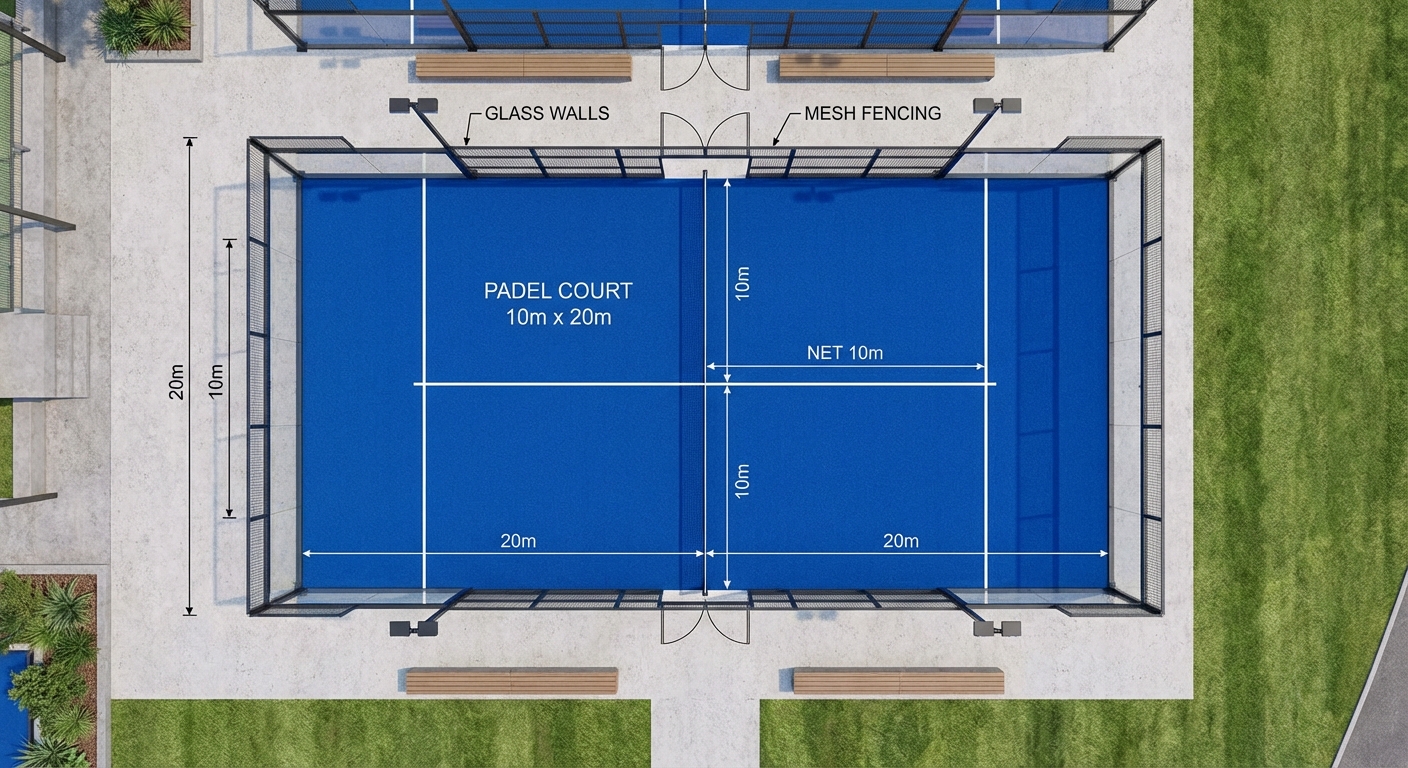
The padel vs pickleball court size directly dictates the thickness and reinforcement of the concrete slab, with padel requiring a more robust foundation to support heavy glass walls. Because padel involves 10mm to 12mm tempered glass panels and a steel cage, the perimeter of the slab must be reinforced to prevent cracking under the localized weight. If you are building for pickleball, the construction is often simpler, focusing primarily on a flat, even surface for optimal ball bounce.
Padel Slab Engineering
Padel courts require a 15cm to 20cm thick reinforced concrete slab with a specific focus on levelness. You must ensure the slab has a slight slope (usually 0.5% to 1%) for drainage, but it must be perfectly even to allow for the installation of the glass panels.
Here is the secret:
The glass panels act as sails in high winds, exerting massive pressure on the anchor bolts.
- Perimeter beams are usually 40cm x 40cm.
- Steel mesh reinforcement is mandatory.
- Laser-leveling is required for glass alignment.
Key Takeaway: Padel construction is a specialized engineering task that requires precise anchor points for the structural cage.
Pickleball Surface Preparation
Pickleball construction is similar to tennis court building but on a smaller scale. You can often use asphalt or concrete, but the key is the acrylic coating which must be applied in multiple layers to provide the correct “grit” for the ball.
The truth is:
Pickleball is much more sensitive to surface “dead spots” than padel.
- Base: 4-inch concrete or 6-inch asphalt.
- Vapor barriers are essential for indoor builds.
- Acrylic surfacing requires 3-5 layers.
Key Takeaway: While the structural load is lower, the precision of the surface finish is paramount for the “dink” game in pickleball.
Installation Timelines
Due to the complexity of the glass and mesh, a padel court takes longer to install than a pickleball court. You can typically have a pickleball court surfaced and ready in a few days once the concrete is cured, whereas padel requires specialized crews for the metalwork.
It gets better:
A modular padel court can be assembled in about 4-5 days if the slab is ready.
- Pickleball surfacing: 2-3 days.
- Padel cage/glass: 4-6 days.
- Total project time: 4-6 weeks (including concrete curing).
Key Takeaway: Padel projects require more specialized labor and longer logistical lead times for heavy material transport.
| Build Factor | Padel Court | Pickleball Court |
|---|---|---|
| Slab Depth | 15-20 cm | 10-12 cm |
| Specialized Labor | Glass/Steel Teams | Paving/Painting Teams |
| Perimeter Load | High (Structural) | Low (Non-Structural) |
| Foundation Type | Reinforced Beam | Standard Slab |
Padel’s heavy structural components demand a higher grade of civil engineering, making the construction phase significantly more expensive and complex than pickleball.
Can you fit multiple units in a padel vs pickleball court size?
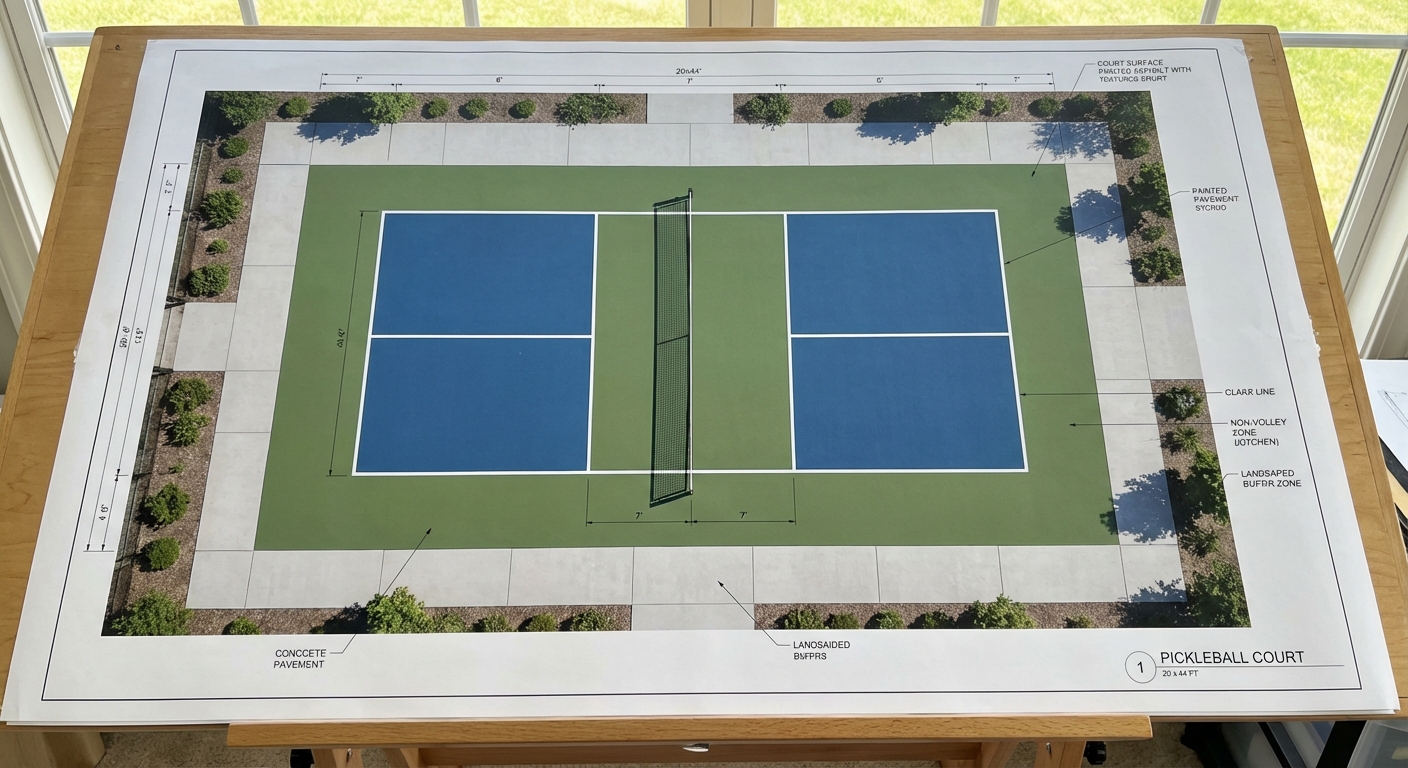
When looking at padel vs pickleball court size for multi-court configurations, you can fit approximately three pickleball courts in a 20m x 30m area, whereas you can only fit two padel courts in that same space. This scalability is the cornerstone of planning for sports clubs that need to maximize membership revenue. You must decide if you want the prestige and higher per-match fee of padel or the high-volume, community-centric model of pickleball.
Multi-Court Padel Layouts
In a professional padel club, you want to leave at least 1 meter between courts for maintenance and 2-3 meters for walkways. If you are building a “stadium” court, you may need even more space for bleachers and cameras.
Think about this:
Shared walls can save space, but they increase noise and reduce the “premium” feel.
- Standard gap: 1 meter.
- Premium gap: 3 meters.
- Total footprint for 2 courts: approx. 500 sqm.
Key Takeaway: Multi-court padel facilities require significant acreage, often moving them toward suburban industrial zones or large rural plots.
Grouping Pickleball Units
Pickleball is extremely social, and grouping courts together creates a “festival” atmosphere. You can share fencing between courts to save on construction costs, but you must ensure players don’t accidentally wander into neighboring matches.
The kicker is:
Angled layouts can sometimes fit more courts into irregular land plots.
- Shared fencing height: 10 feet.
- Padding on posts for safety.
- Color-coding courts for easier booking management.
Key Takeaway: The modularity of pickleball makes it the ultimate “space-filler” for oddly shaped urban developments.
Operational Efficiency
The number of units directly impacts your staffing needs and maintenance schedule. More pickleball courts mean more players to manage, but they are generally lower-maintenance than glass-walled padel courts.
Wait, there’s more:
One person can monitor 8 pickleball courts, but a padel club often needs more hands-on glass cleaning.
- Pickleball: High volume, low maintenance.
- Padel: Lower volume, higher maintenance/premium service.
- Cleaning: Glass needs weekly polishing.
Key Takeaway: Choose pickleball for high-traffic, low-overhead operations and padel for premium, high-margin club models.
| Configuration | 1,000 sqm Plot | Player Capacity |
|---|---|---|
| Padel Units | 4 Courts | 16 Players |
| Pickleball Units | 8-10 Courts | 32-40 Players |
| Revenue Model | Premium Hourly | High-Volume Member |
| Social Vibe | Focused/Intense | Loud/Community |
The sheer density of pickleball allows a 1,000 sqm facility to quadruple the active player count compared to a padel-only facility.
How do net heights vary for padel vs pickleball court size?
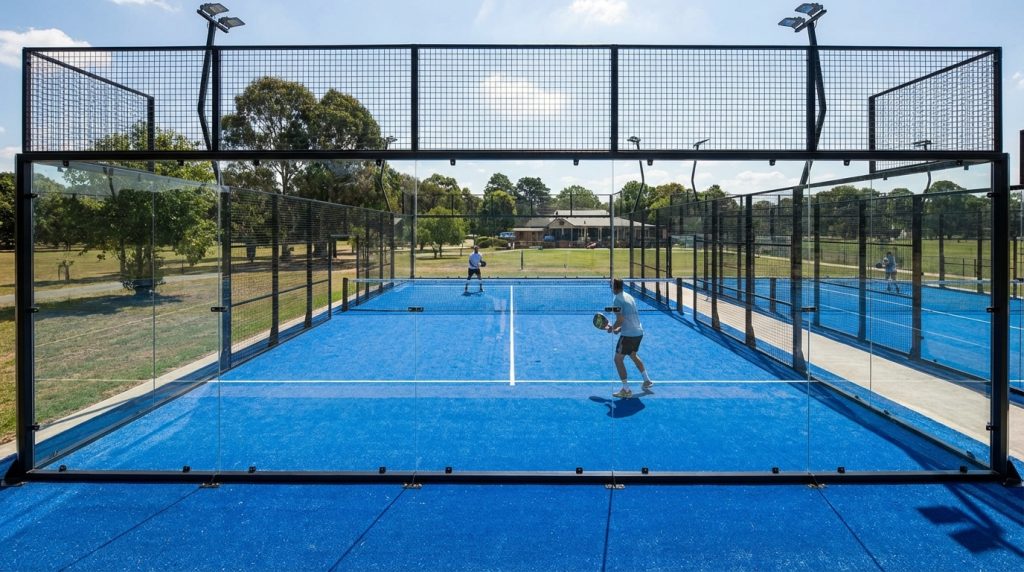
In the padel vs pickleball court size debate, net height is a subtle but vital difference: padel nets are 88cm (34.6 inches) at the center, while pickleball nets are 34 inches (86.4cm) at the center. While they appear similar, the tension and post-mounting systems are entirely different. You cannot easily swap a padel net for a pickleball net without custom modifications to the anchoring systems.
Padel Net Specifications
A padel net spans the full 10-meter width of the court. It is held by two lateral posts that are situated on the court’s outer boundary lines, usually integrated into the cage structure itself.
The truth is:
Padel nets must withstand high-speed impacts from heavy balls and rackets.
- Center height: 88 cm.
- Post height: 92 cm.
- Tensioning: Internal winch system in the post.
Key Takeaway: Padel nets are structural components of the court enclosure, designed for durability and constant tension.
Pickleball Net Requirements
Pickleball nets are slightly lower and wider than the court itself to prevent balls from sneaking around the sides. The net is 36 inches high at the posts and 34 inches at the center, creating a slight “dip” that is iconic to the sport.
Here is the kicker:
Many facilities use portable nets, which can be moved to clear the space for other events.
- Center height: 34 inches.
- Post height: 36 inches.
- Material: Lightweight mesh with a center strap.
Key Takeaway: Pickleball nets offer more flexibility for multi-purpose venues, as they can be semi-permanent or fully portable.
Impact on Playing Style
The net height relative to the padel vs pickleball court size changes the “dip” and “arc” of the ball. In pickleball, the lower net encourages the “dink” shot, while in padel, the net serves as a hurdle for low-trajectory volleys.
Think about this:
A 2cm difference in height changes the physics of a cross-court shot.
- Padel: Encourages aggressive net play.
- Pickleball: Encourages strategic soft shots (dinking).
- Net Cord: Padel allows play off the net cord more frequently.
Key Takeaway: The specific net heights are engineered to complement the ball speed and court dimensions of each respective sport.
| Spec | Padel Net | Pickleball Net |
|---|---|---|
| Center Height | 88 cm | 34 inches (86.4 cm) |
| Side Height | 92 cm | 36 inches (91.4 cm) |
| Post Position | On boundary lines | 12 inches outside lines |
| Portability | Permanent/Fixed | Often Portable |
Though they look identical at a glance, the two inches of extra height at the pickleball posts and the different center heights fundamentally alter the geometry of competitive play.
Is drainage different for padel vs pickleball court size?
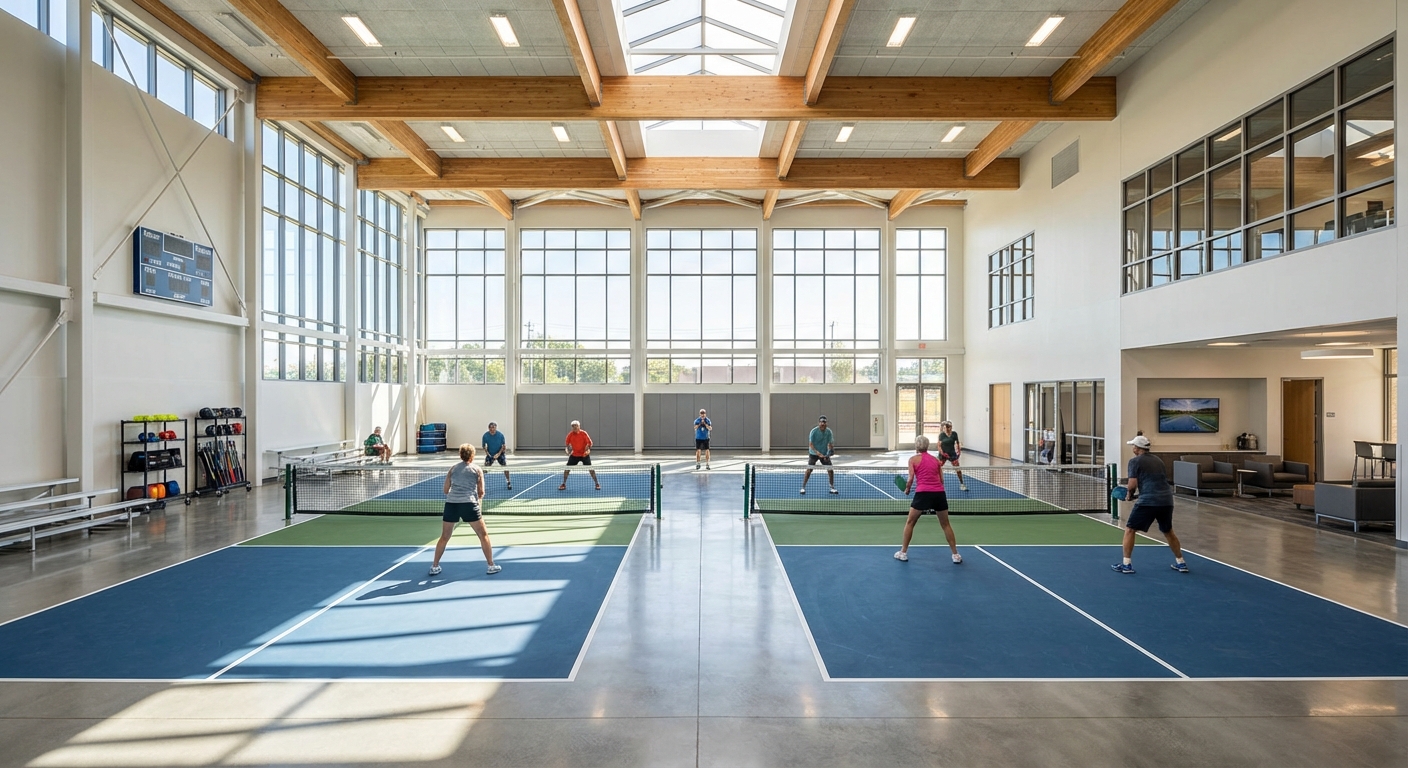
Yes, drainage for padel vs pickleball court size differs because padel courts are often “enclosed,” requiring more sophisticated perimeter channels to prevent water from pooling against the glass walls. In pickleball, water usually drains off the edges of the open slab into a simple gravel surround or grass. If you allow water to sit at the base of your padel glass, you risk the structural integrity of the sealants and the metal cage.
Padel Drainage Engineering
Because of the synthetic turf and sand infill, water must drain through the carpet and then across the slab. You must install a perimeter drain—often called a French drain—around the entire 200 sqm slab to handle heavy rainfall.
It gets better:
A well-drained padel court is playable just minutes after a storm.
- Slope: 0.5% to 1.0% in a single direction.
- Drain type: Channel or perimeter trench.
- Carpet porosity: High-drainage synthetic fibers.
Key Takeaway: Padel drainage is a “systemic” build involving the turf, the slab, and the perimeter trenching.
Pickleball Run-off Solutions
Pickleball courts are typically sloped from the center out or from one side to the other. Since there are no walls, the water simply follows the slope of the acrylic surface into the surrounding area.
The truth is:
“Birdbaths” (standing water) are the enemy of pickleball court longevity.
- Tolerance: No more than a 1/8th inch dip.
- Finish: Planar (flat) with a consistent slope.
- Curbing: Not usually required for single courts.
Key Takeaway: Pickleball drainage relies on the perfection of the slab’s “planar” slope rather than complex plumbing.
Maintenance of Drainage Systems
The smaller pickleball footprint makes cleaning debris from the drainage path easier. For padel, you must ensure that the sand from the turf doesn’t clog your perimeter drains over time.
Consider this:
Clogged drains lead to mold on the turf and slippery glass.
- Pickleball: Squeegee-friendly surface.
- Padel: Requires vacuuming/cleaning of perimeter channels.
- Sand levels: Must be checked after heavy rains.
Key Takeaway: Long-term facility health requires a drainage plan that accounts for the specific materials (sand vs acrylic) used on each court type.
| Drainage Factor | Padel Court | Pickleball Court |
|---|---|---|
| Primary Challenge | Glass/Cage Barriers | Surface “Birdbaths” |
| Standard Slope | 0.8% – 1% | 1% (1 inch per 10 feet) |
| System Type | Perimeter Channels | Sheet Flow Run-off |
| Recovery Time | Fast (Porous Turf) | Moderate (Needs Squeegee) |
Padel’s drainage must be integrated into the structural cage design to protect the glass, while pickleball focuses on surface smoothness to avoid puddles on the acrylic.
What surfacing works for padel vs pickleball court size?
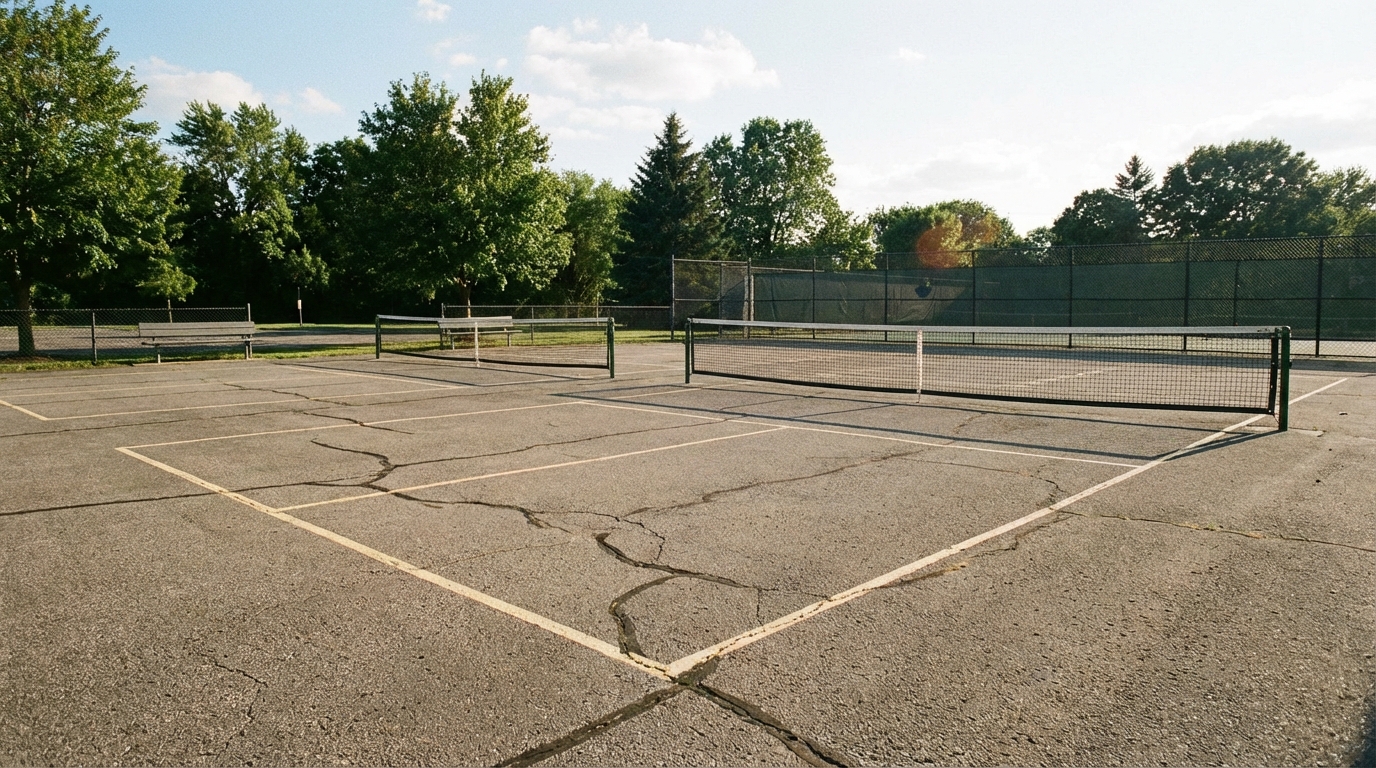
In the padel vs pickleball court size comparison, padel almost exclusively uses sand-filled synthetic turf, while pickleball requires a hard acrylic or cushioned court surface. The choice of surface is non-negotiable, as the ball bounce in each sport is tuned to these specific materials. If you try to play pickleball on a padel turf, the plastic ball will not bounce high enough, and if you play padel on an acrylic surface, the game becomes dangerously fast.
Padel Synthetic Turf Tech
Padel turf is specifically designed with a low pile height (10mm to 12mm) and is filled with kiln-dried silica sand. The sand provides the necessary slide and ensures a consistent ball bounce off the floor before it hits the glass.
The kicker is:
The sand isn’t just for grip; it weights the carpet down so it doesn’t move.
- Fiber types: Monofilament or Fibrillated.
- Color: Usually blue, green, or terra cotta.
- Sand volume: Approx. 3kg to 5kg per square meter.
Key Takeaway: Padel turf is a specialized sports carpet that requires periodic brushing to keep the sand distributed evenly.
Pickleball Acrylic Coatings
Pickleball surfaces are “hard courts” composed of an asphalt or concrete base covered by an acrylic color system. You can opt for a “cushioned” system which adds layers of rubber granules for better shock absorption on your joints.
Think about this:
The friction of the surface determines how much “spin” you can put on the ball.
- Standard: 2-3 layers of color.
- Premium: 5-8 layers including rubber cushion.
- Texture: Fine sand added to paint for slip resistance.
Key Takeaway: Pickleball surfaces are permanent and durable, offering a consistent, high-bounce environment for the plastic ball.
Comparing Wear and Tear
Because of its small size, the pickleball court experiences concentrated wear in the “kitchen” and baseline areas. Padel wear is more distributed, but the sand acts as an abrasive that can degrade the fibers over several years.
Wait, there’s more:
Resurfacing a pickleball court is much cheaper than replacing a padel carpet.
- Padel life: 5-8 years.
- Pickleball life: 7-10 years (before needing a new topcoat).
- Repair: Patching acrylic is easier than patching turf.
Key Takeaway: Acrylic pickleball surfaces have a longer lifespan and lower replacement costs per square meter than padel’s synthetic turf.
| Surface Trait | Padel (Turf) | Pickleball (Acrylic) |
|---|---|---|
| Ball Bounce | Medium/Consistent | High/Crisp |
| Player Impact | Soft (Joint-friendly) | Hard (Unless cushioned) |
| Maintenance | Brushing/Sand refill | Cleaning/Squeegeeing |
| Installation | Unroll and glue | Multi-layer painting |
The textural difference is extreme: padel is a soft, sandy environment that favors sliding, while pickleball is a high-friction, hard-court environment that favors quick stops and starts.
Are zoning laws impacted by padel vs pickleball court size?
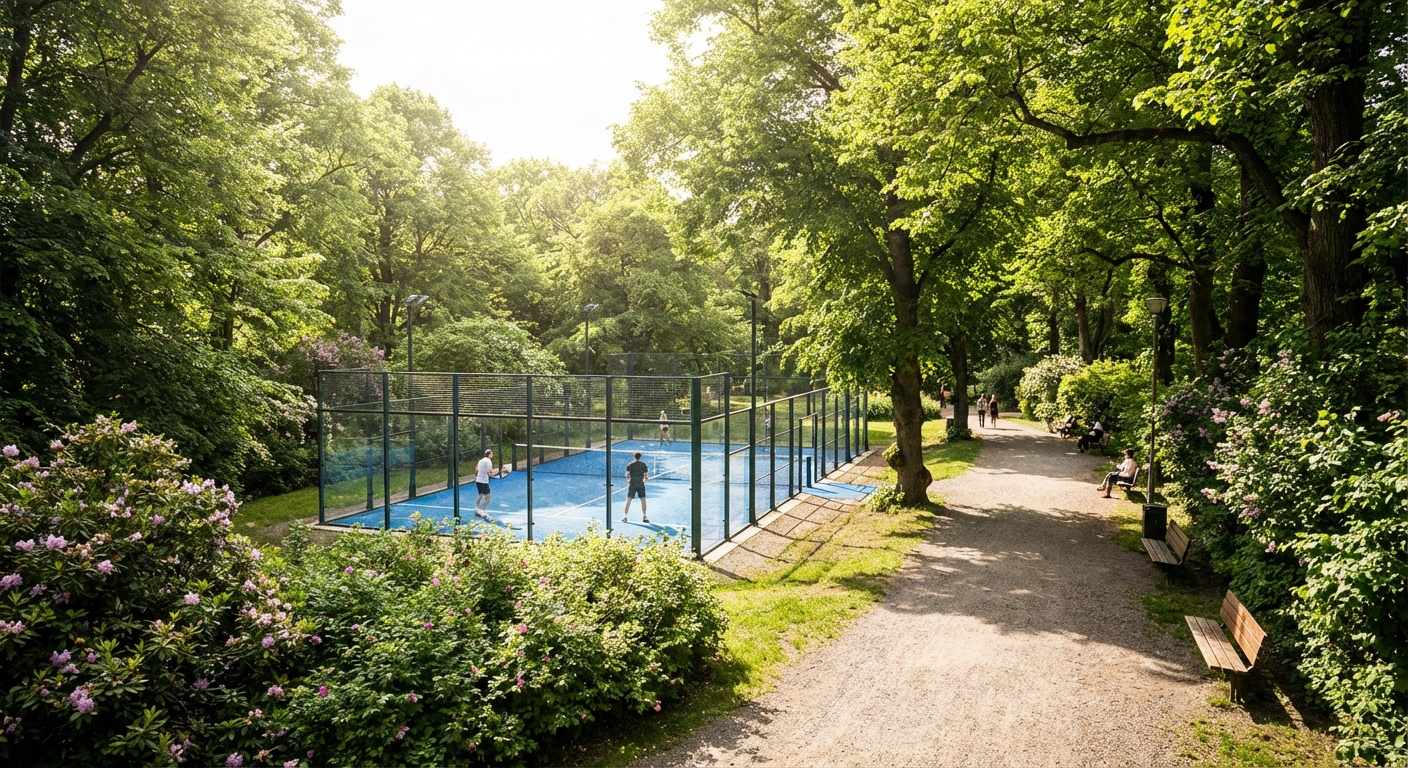
Zoning and planning permissions for padel vs pickleball court size are heavily influenced by noise levels and the height of the structures. Padel’s 3-4 meter high glass walls often require “visual impact” assessments in residential areas, while pickleball’s loud “pop” sound often triggers noise ordinance reviews. You must check your local municipal codes before breaking ground, as the two sports face very different regulatory hurdles.
Padel Structural Permits
Because padel courts have high walls and lighting masts (usually 6m high), they are often classified as “buildings” or “permanent structures” rather than simple landscaping. You may need to provide wind load calculations for the glass panels to ensure they won’t shatter in a storm.
The truth is:
A padel court can be seen as an eyesore by neighbors if not properly screened.
- Lighting: Must use “no-spill” LED fixtures.
- Height: 4-meter cage plus 6-meter lights.
- Setbacks: Often 5-10 meters from property lines.
Key Takeaway: Padel’s height and structural bulk make it a more complex permitting project than a flat pickleball court.
Pickleball Noise Regulations
The primary legal challenge for pickleball is the decibel level. The plastic ball hitting the paddle creates a sharp 60-70 dB sound that carries further than the duller thud of a padel ball.
Here is the kicker:
Some cities have banned pickleball within 100 feet of residential homes due to noise complaints.
- Sound barriers: Acoustic fencing can reduce noise by 10-15 dB.
- Operating hours: Restricted to 8 AM – 8 PM in many zones.
- Paddle tech: “Quiet” paddles are becoming a legal requirement in some clubs.
Key Takeaway: While easier to build, pickleball courts face much higher social and legal pressure regarding noise pollution.
Environmental Impact
The larger footprint of a padel facility means more “impermeable surface,” which can trigger storm-water management fees. If you build multiple courts, you might be required to install a retention pond or swale.
Consider this:
Permeable asphalt is an option for pickleball to avoid drainage taxes.
- Padel: ~230 sqm impermeable slab.
- Pickleball: ~180 sqm impermeable slab.
- Green space: Required ratios vary by city.
Key Takeaway: Local environmental laws may favor the smaller footprint of pickleball to preserve natural groundwater absorption.
| Regulation Factor | Padel Court | Pickleball Court |
|---|---|---|
| Noise Profile | Low/Medium (Thud) | High/Sharp (Pop) |
| Visual Impact | High (Glass/Cage) | Low (Flat) |
| Permit Type | Structural/Building | Land Use/Recreational |
| Neighbor Complaints | Light/Aesthetics | Noise/Volume |
Padel is harder to permit due to its height and glass, whereas pickleball is harder to permit due to the persistent noise of competitive play.
What is the total cost for padel vs pickleball court size?
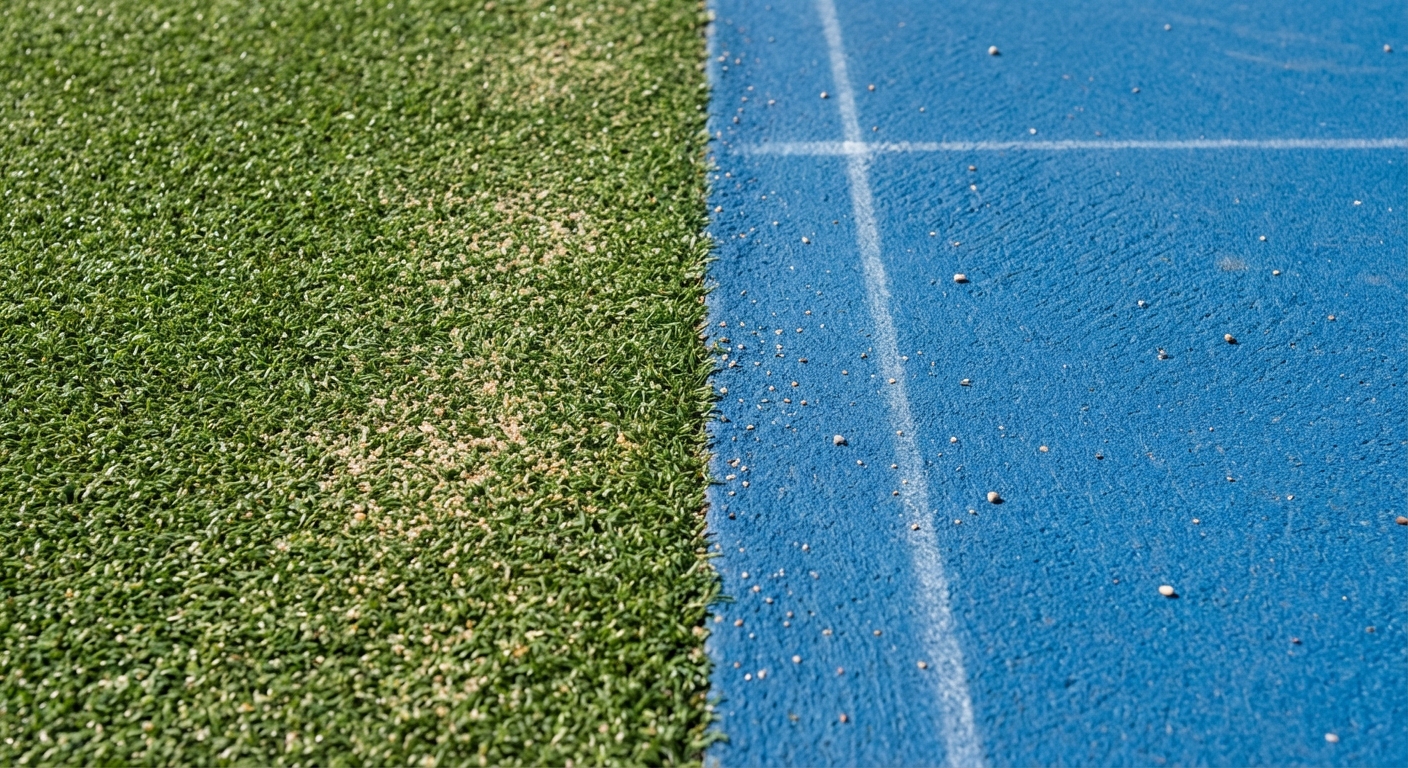
On average, a padel court costs between $25,000 and $50,000 to construct, whereas a professional pickleball court ranges from $15,000 to $25,000. The padel vs pickleball court size is only one factor; the expensive tempered glass and steel structure of padel significantly inflate the price. If you are on a tight budget, pickleball offers a much lower entry point for high-quality play.
Padel Capital Expenditure (CAPEX)
Padel’s cost is driven by the 10mm-12mm glass panels, which are expensive to manufacture and ship. Additionally, the specialized synthetic turf and the massive amount of concrete needed for the reinforced slab add to the total.
It gets better:
High-quality padel courts have a better resale value if you ever choose to move the structure.
- Glass/Steel: $15,000 – $25,000.
- Concrete Slab: $8,000 – $15,000.
- Lighting/Turf: $5,000 – $10,000.
Key Takeaway: Padel is a high-investment asset that requires professional installation to protect the value of the materials.
Pickleball Budgeting
The majority of your pickleball budget goes into the concrete or asphalt base and the multi-layer acrylic finish. Because there is no heavy vertical structure, you save immensely on metalwork and glass.
The truth is:
You can build two high-end pickleball courts for the price of one entry-level padel court.
- Asphalt/Concrete: $10,000 – $15,000.
- Surfacing/Painting: $4,000 – $6,000.
- Net/Fencing: $2,000 – $4,000.
Key Takeaway: Pickleball is the most cost-effective way to convert underutilized land into a high-revenue sports facility.
Long-term ROI Comparison
While padel is more expensive to build, it often commands a higher hourly rental rate ($40-$80/hr) compared to pickleball ($20-$40/hr). You must balance the higher initial cost with the premium market positioning of padel.
Think about this:
Pickleball pays back faster due to the high player volume and lower maintenance.
- Padel: 2-3 year payback period.
- Pickleball: 1-2 year payback period.
- Maintenance costs: Padel is roughly 30% higher annually.
Key Takeaway: Choose padel for a high-prestige, high-margin business and pickleball for rapid expansion and quick capital recovery.
| Cost Element | Padel Court | Pickleball Court |
|---|---|---|
| Construction | $25k – $50k | $15k – $25k |
| Maintenance | $1,500/year | $500/year |
| Hourly Revenue | High ($60 avg) | Medium ($30 avg) |
| Installation Time | 4-6 Weeks | 3-4 Weeks |
Padel requires nearly double the initial capital of pickleball, but its ability to serve as a “destination” sport for high-net-worth members often justifies the premium construction costs.
*
Ready to Build Your Elite Racquet Facility?
Navigating the technical nuances of court dimensions and construction is the difference between a thriving club and a costly mistake. We have helped hundreds of facility owners maximize their land value by selecting the perfect mix of padel and pickleball units tailored to their specific demographics. Whether you are struggling with zoning noise complaints, complex drainage requirements, or simply need a turnkey installation that lasts for decades, our team is ready to assist.
Don’t leave your investment to chance; contact us today to receive a custom site analysis and a comprehensive build quote. We solve the problems of space optimization, structural integrity, and long-term surface maintenance so you can focus on growing your community.
Frequently Asked Questions
Can I fit a pickleball court inside a padel court?
Yes. Since a padel court is 10m x 20m and a pickleball court is roughly 6m x 13m, the smaller court easily fits within the glass walls, though the surface requirements differ.
What’s the best way to reduce noise on a pickleball court?
Installing acoustic dampening fences and mandating the use of “quiet-certified” paddles is the most effective way to satisfy local noise ordinances.
How do I know if my soil can support a padel court?
You must conduct a soil compaction test. Padel’s glass walls are extremely heavy and any soil shifting will cause the glass panels to misalign or shatter.
Can I use a tennis net for pickleball?
No. A tennis net is too high and lacks the specific 34-inch center drop required for the pickleball ball to clear the “kitchen” accurately.
What is the minimum ceiling height for an indoor padel court?
A minimum of 6 meters is required, but 8 meters is highly recommended for professional play to accommodate the “lob” shot which is central to the game.