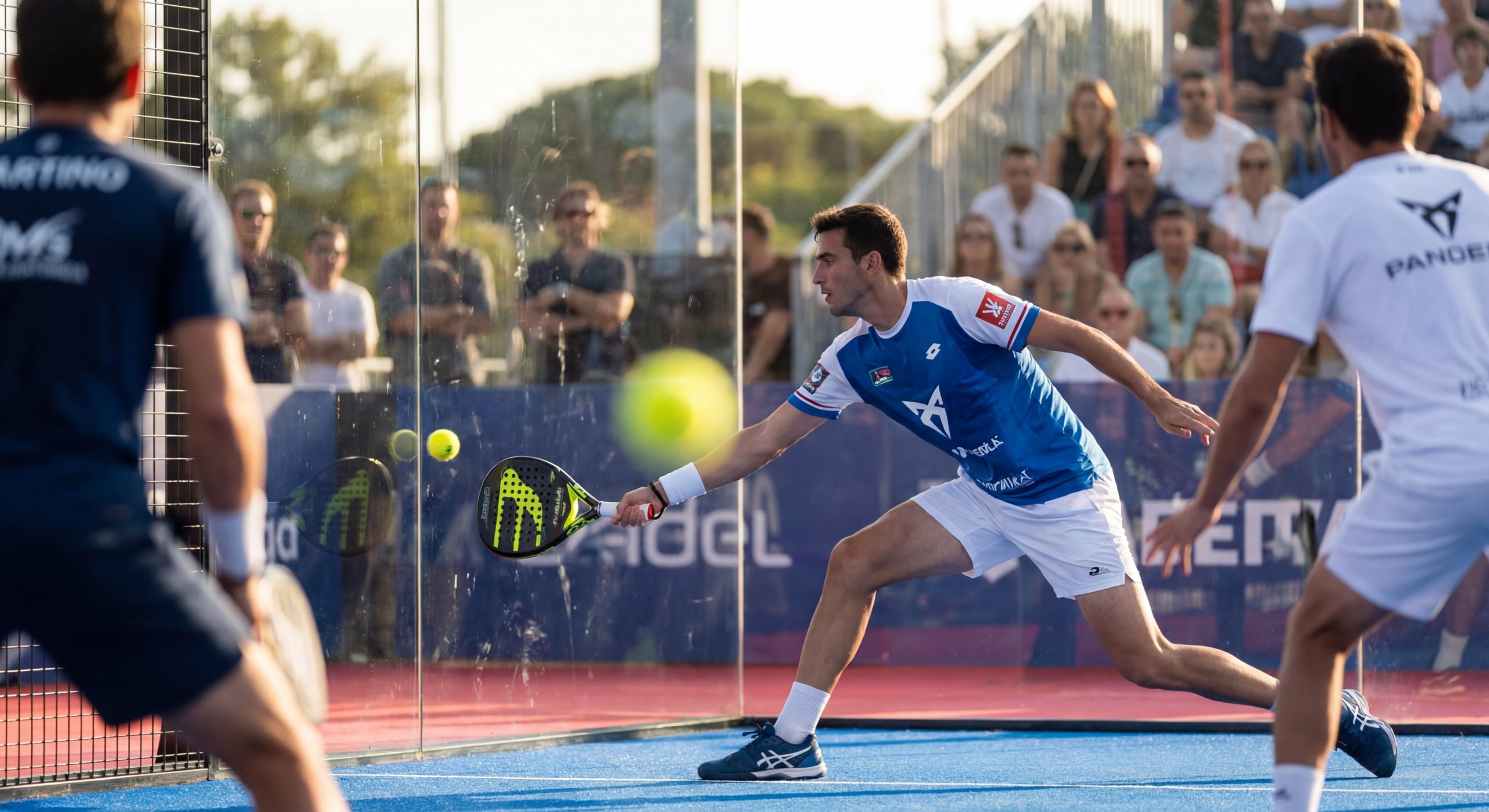
What is the main difference between padel and tennis?
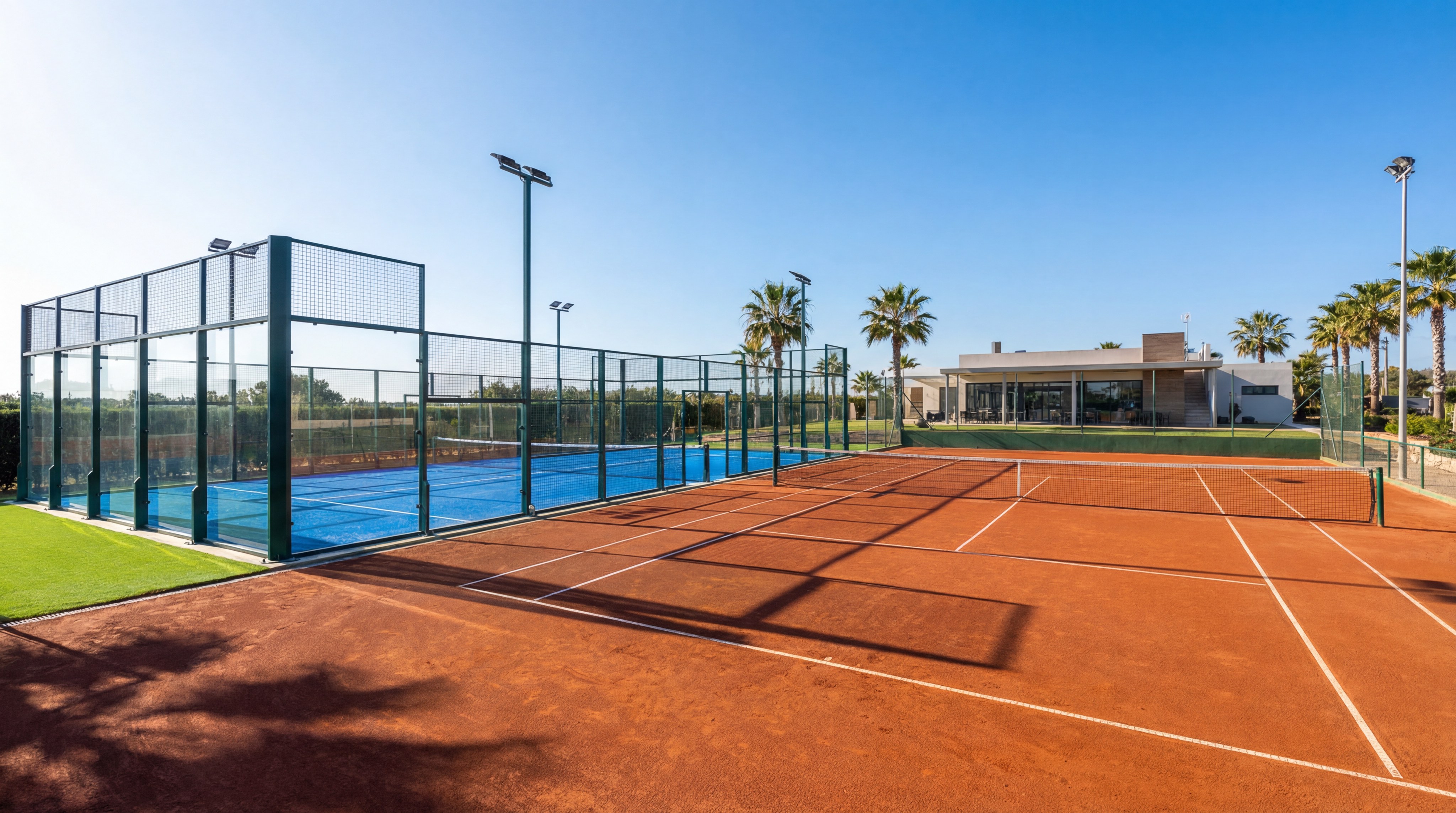
Padel is defined by its enclosed environment and strategic use of glass, whereas tennis relies on expansive open space and power. The difference between padel and tennis creates two distinct playing experiences that appeal to different demographics of athletes.
Defining the Modern Racket Sport Hybrid?
Padel combines the best elements of tennis and squash to create a more accessible social sport. Let’s dive deeper:
- Enclosed glass walls for ball rebounds.
- Compact court dimensions for faster rallies.
- A focus on doubles play and social interaction.
But that is not the best part; the learning curve is significantly shorter than tennis, making it a favorite for club owners.
Quick Comparison: Padel vs. Tennis Table?
The technical divergence starts at the foundation and ends at the equipment used. You need to consider these factors:
- Padel uses solid carbon fiber rackets.
- Tennis requires high-tension stringed frames.
- Padel courts use artificial turf with sand infill.
Why does this matter? Because the infrastructure required for each sport is vastly different.
Key Takeaway
Padel is a social, high-speed sport that maximizes player density in smaller areas, making it a superior choice for urban sports centers.
| Feature | Padel Court | Tennis Court |
|---|---|---|
| Dimensions | 10m x 20m | 10.97m x 23.77m |
| Enclosure | 10mm-12mm Glass & Mesh | Open or Perimeter Fence |
| Racket | Solid (Carbon/Glass Fiber) | Stringed (Graphite/Titanium) |
| Serve | Underarm only | Underarm or Overarm |
| Foundation | Reinforced Concrete Ring | Full Slab |
The data confirms that padel offers a more compact and enclosed technical profile compared to the open-air nature of tennis.
How does court size show the difference between padel and tennis?
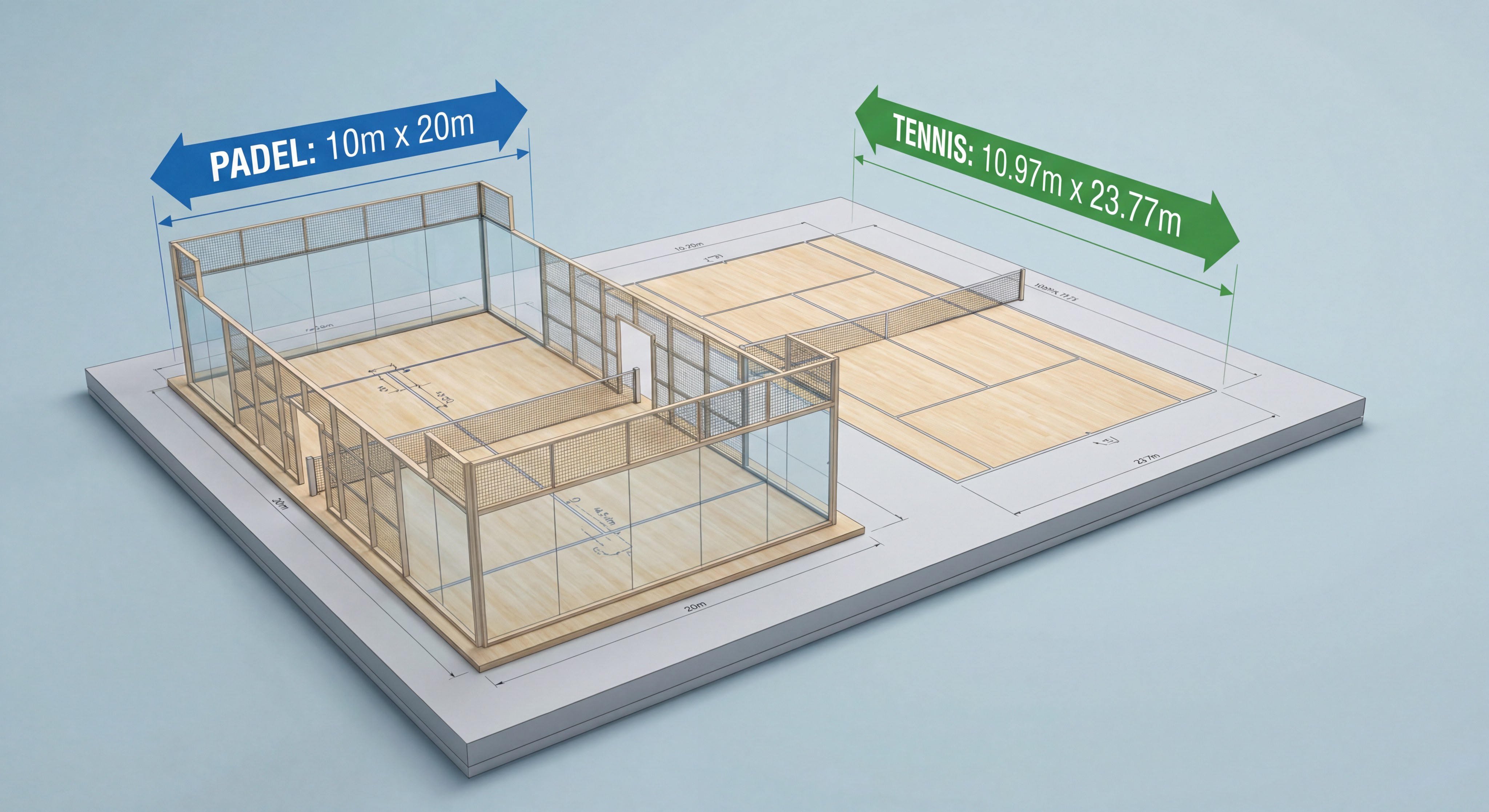
A padel court is exactly 10×20 meters, which is roughly 25% smaller than a standard tennis court. This specific difference between padel and tennis allows you to fit three padel courts in the space of a single tennis court.
Standard Padel Court Dimensions (20m x 10m)?
The 200-square-meter footprint of a padel court is designed for intense, close-quarters doubles action. It gets even better:
- Requires less total land for installation.
- Easier to fit into existing indoor warehouses.
- Higher revenue per square meter for facility owners.
You will find that the smaller size promotes a much more social atmosphere during play.
The Massive Footprint of a Tennis Court?
Tennis courts require at least 600 square meters including the safety run-off zones. Think about it:
- Large “out” areas are mandatory for safety.
- Requires extensive asphalt or clay surfacing.
- Single-court maintenance costs are higher relative to player count.
But here is the kicker: that extra space often goes unused during casual recreational matches.
Key Takeaway
Padel’s smaller footprint significantly reduces land acquisition costs while increasing the number of active players your facility can host.
| Dimension Metric | Padel Court | Tennis Court |
|---|---|---|
| Total Area | 200 sqm | 600+ sqm |
| Internal Length | 20 Meters | 23.77 Meters |
| Internal Width | 10 Meters | 10.97 Meters |
| Safety Run-off | 0m (Enclosed) | 3.6m – 6.4m per side |
Padel provides a higher player-to-land ratio, which is the most critical metric for modern B2B sports investments.
Which gear reveals the difference between padel and tennis?
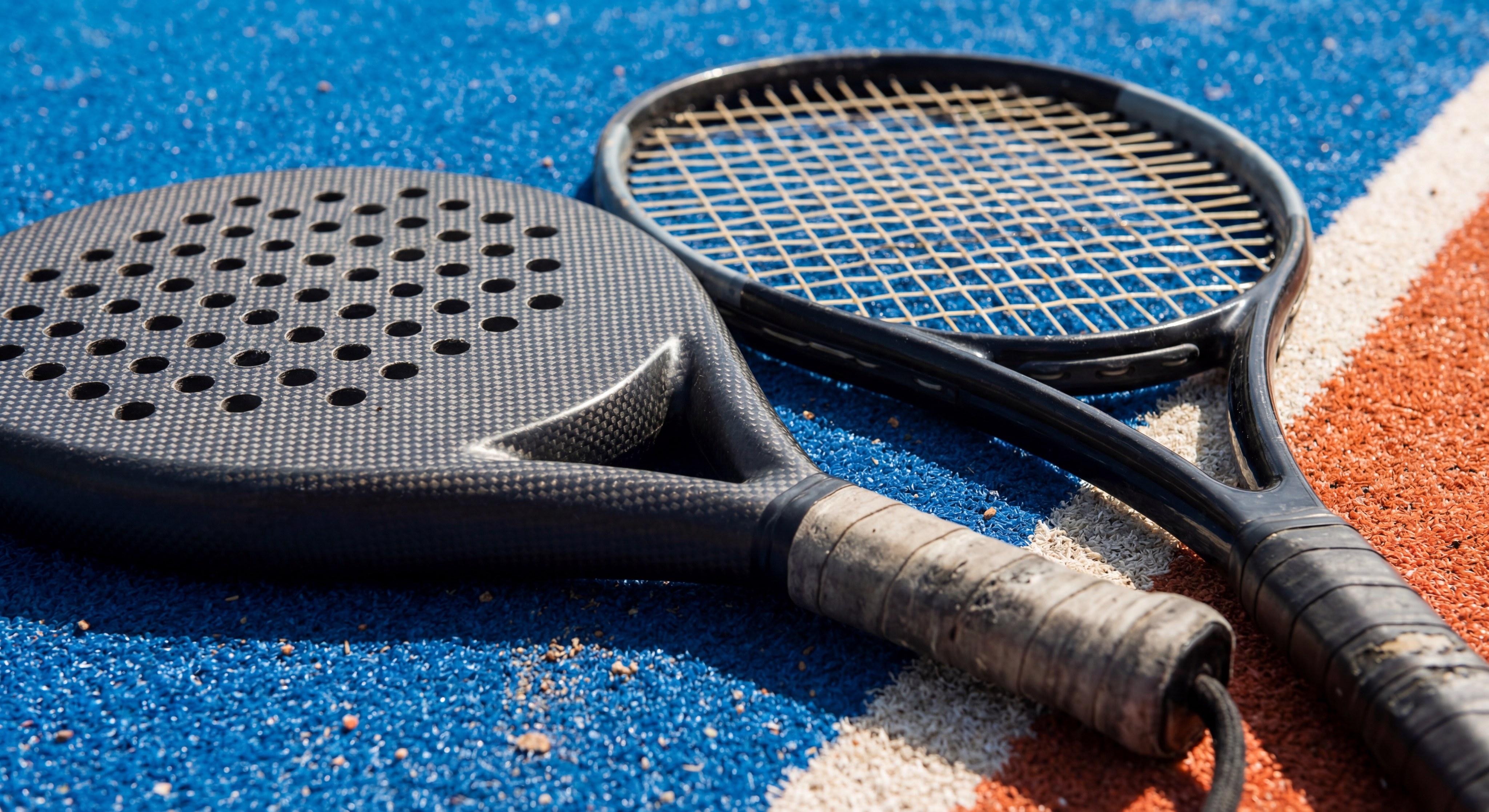
Padel equipment consists of a solid, perforated racket and low-pressure balls, while tennis uses stringed rackets and high-pressure balls. This hardware difference between padel and tennis fundamentally alters how force is applied to the ball.
Solid Foam Rackets vs. Stringed Frames?
Padel rackets are made from carbon fiber or glass fiber with a core of EVA foam. Consider these differences:
- No strings to break or restrike.
- Short handles for better maneuverability and control.
- Perforated surface to reduce air resistance.
Let’s be honest, the solid racket makes the game much more forgiving for beginners.
Ball Pressure and Diameter Variations?
Padel balls look like tennis balls but have a lower internal pressure to accommodate the smaller court. Why does this matter?
- Reduces the bounce height for better wall play.
- Ensures the ball stays within the 20m court length.
- Extends the duration of rallies by slowing down the game.
The result is a game that relies more on tactical placement than raw hitting power.
Key Takeaway
The specialized equipment in padel is engineered for control and longevity, reducing the ongoing cost of gear for club rental programs.
| Equipment | Padel | Tennis |
|---|---|---|
| Racket Type | Solid / Perforated | Stringed Frame |
| Racket Weight | 360g – 375g | 280g – 340g |
| Ball Pressure | 10psi – 11psi | 14psi – 15psi |
| Learning Curve | Low / Immediate | Moderate / High |
The mechanical differences in gear emphasize padel’s focus on touch and strategy over the high-velocity requirements of tennis.
How do rules define the difference between padel and tennis?
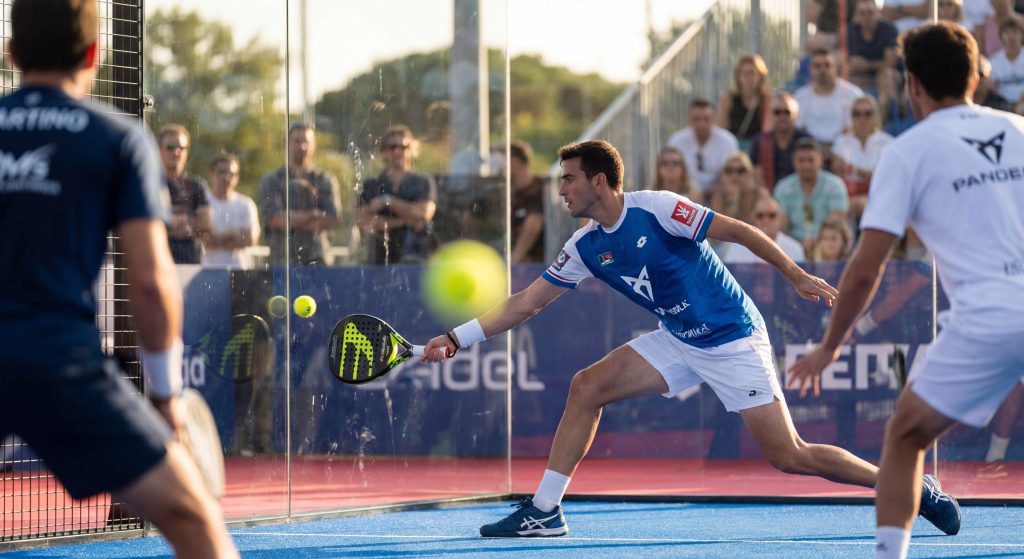
Padel rules mandate an underarm serve and allow the ball to be played off the walls, whereas tennis uses an overarm serve and any contact with the perimeter is a dead ball. This tactical difference between padel and tennis is what makes padel feel like “chess on a court.” You can learn more about the structure of these environments by exploring a classic padel court layout.
The Underarm Serve vs. Overarm Power?
In padel, you must hit the ball at or below waist level after a bounce, which keeps the serve from being a dominant weapon. Here is the kicker:
- Eliminates the “ace” culture of tennis.
- Ensures almost every point starts with a rally.
- Reduces shoulder strain for aging players.
This rule shifts the focus from power to placement right from the first hit.
Playing Off the Glass Enclosure?
The most unique rule in padel is the ability to hit the ball after it strikes the glass walls. Why does this matter?
- Points last much longer than in tennis.
- Defensive players have more time to react.
- Angles become the most important part of the strategy.
It turns a losing position into a counter-attacking opportunity almost instantly.
Key Takeaway
Padel rules are designed to prioritize long rallies and strategic thinking, making the game more engaging for casual and competitive players alike.
| Rule Category | Padel | Tennis |
|---|---|---|
| Serve Style | Underarm (Waist Height) | Overarm (High Point) |
| Wall Play | Allowed (After Bounce) | Not Allowed (Out of Bounds) |
| Standard Format | Always Doubles | Singles or Doubles |
| Court Exit Play | Professional level only | Never allowed |
The inclusion of the walls as a “live” element completely transforms the geometry of the sport compared to tennis.
Is scoring a key difference between padel and tennis?
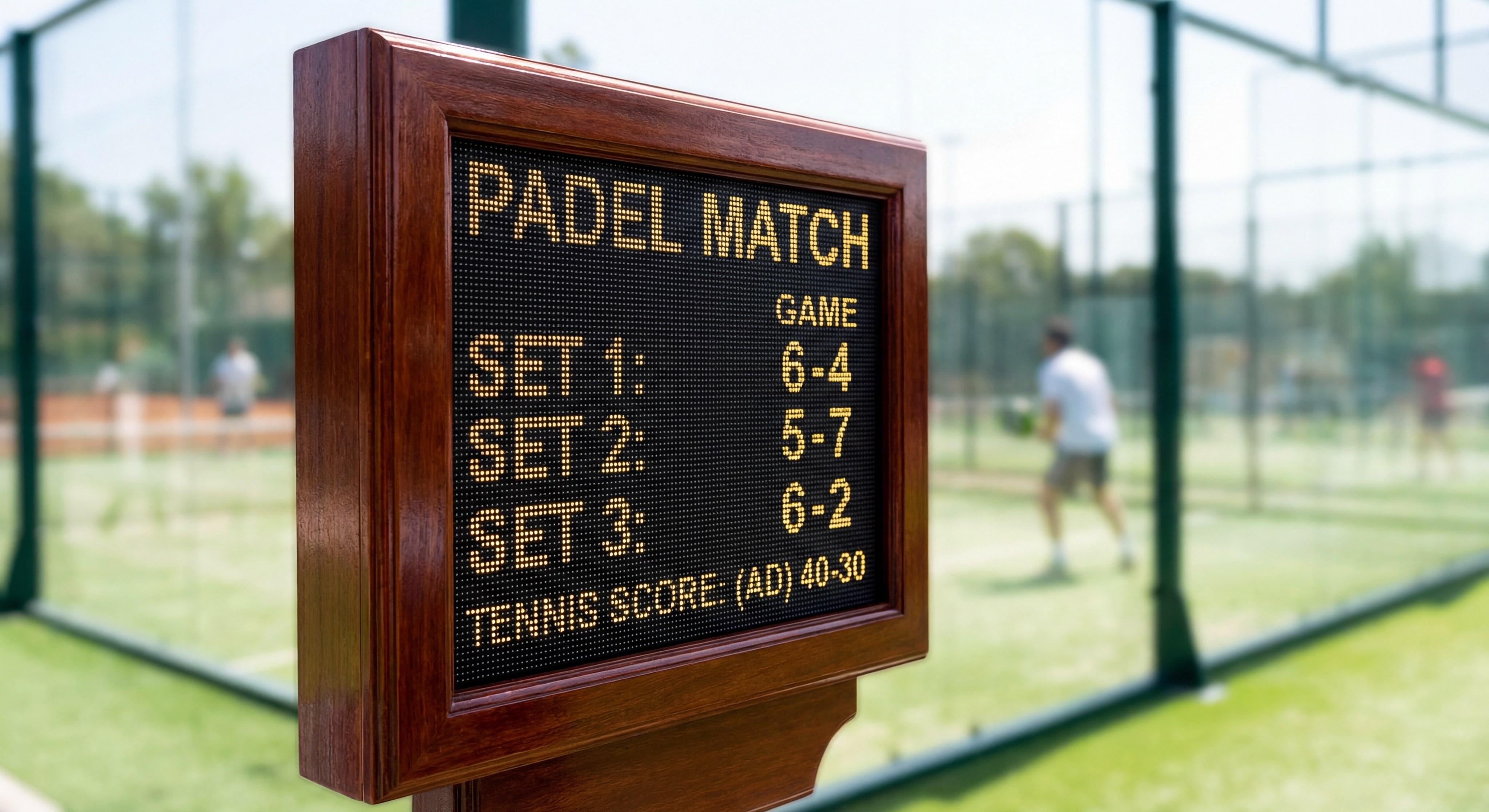
Padel and tennis share the same 15, 30, 40, and game scoring system, though professional padel often employs a “Golden Point” to speed up matches. The scoring difference between padel and tennis is minimal in nomenclature but significant in terms of match duration and intensity.
Both sports utilize sets and games to determine the winner of a match. Let’s look at the similarities:
- Six games win a set (usually).
- Tie-breaks at 6-6 are standard for both.
- Deuce rules apply in most amateur formats.
But there’s more to it than just numbers on a board.
Strategy Over Strength: How Points are Won?
Because padel rallies are longer, the psychological aspect of scoring becomes more prominent. You will notice:
- Fewer unforced errors leading to points.
- A “Golden Point” rule at deuce in World Padel Tour.
- Emphasis on winning the “net position” to close out games.
This means you need to maintain focus for longer durations compared to the quick points often seen in tennis.
Key Takeaway
While the scoring language is identical, padel’s “Golden Point” and longer rallies create a more pressurized and exciting spectator experience.
| Scoring Metric | Padel | Tennis |
|---|---|---|
| Point Progression | 15, 30, 40, Game | 15, 30, 40, Game |
| Professional Deuce | Golden Point (Sudden Death) | Advantage System |
| Set Count | Best of 3 | Best of 3 or 5 |
| Average Rally | 8 – 12 hits | 3 – 5 hits |
The structural similarity in scoring makes it easy for tennis players to transition to padel while enjoying a faster match pace.
How to plan the build difference between padel and tennis?
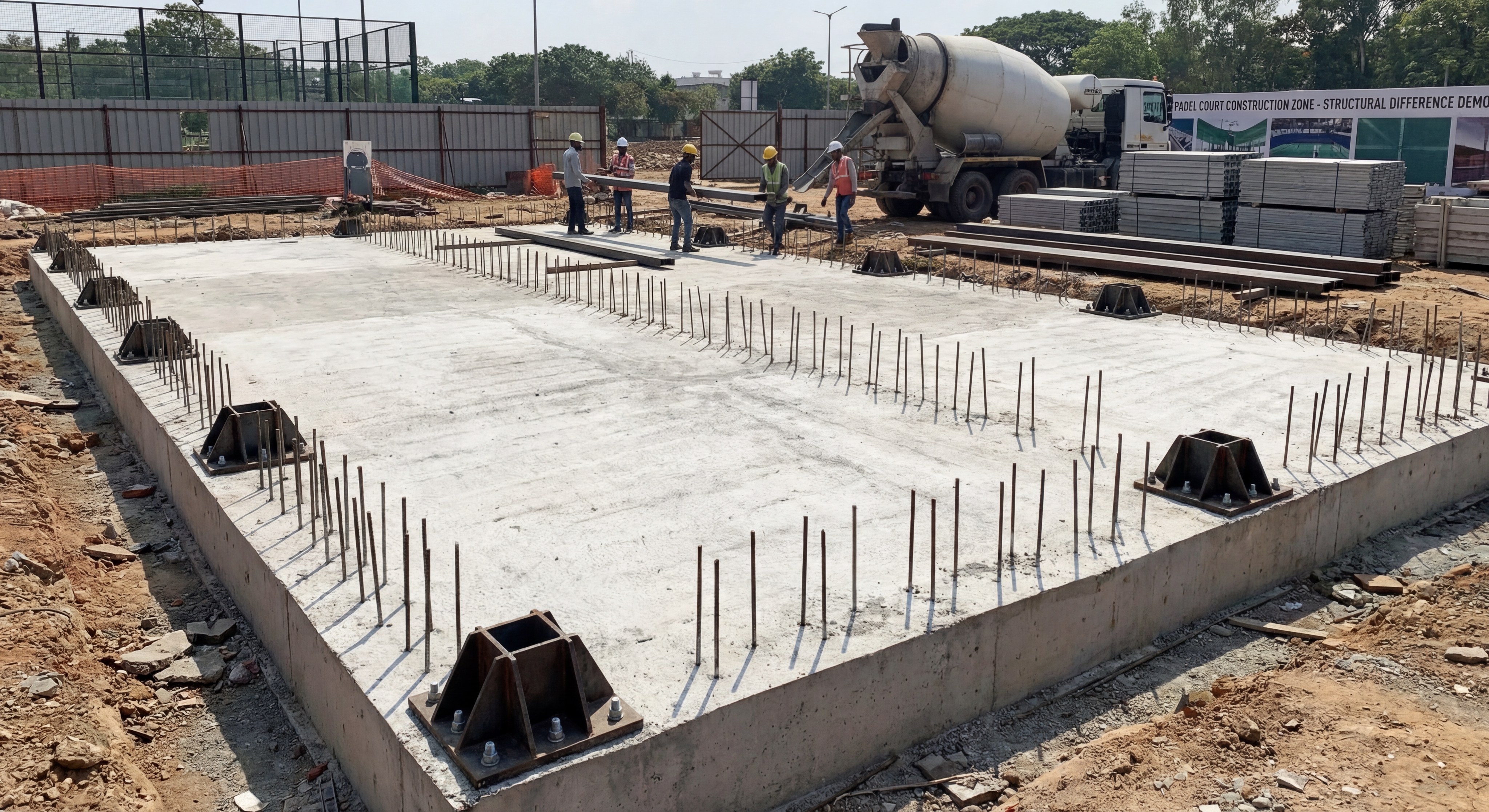
Building a padel court requires a reinforced concrete perimeter to support heavy glass walls, whereas tennis courts usually involve a simpler full-slab asphalt or concrete pour. This engineering difference between padel and tennis is critical for the long-term safety of your facility. If you are planning an all-weather facility, consider adding a roof for padel court structures to protect your investment.
Ground Preparation and Concrete Requirements?
Padel courts exert significant lateral pressure on the foundation due to the weight of the steel and glass. But that’s not all:
- Requires a 20x10m reinforced concrete ring beam.
- The interior slab must be perfectly level for turf.
- Sub-base drainage is more critical due to the mesh enclosure.
Skipping these steps can lead to cracked glass or warped metallic frames.
Structural Integrity for Glass Walls?
The glass in a padel court acts as a structural component, not just a window. Why does this matter?
- Must withstand high-velocity player impacts.
- Wind load calculations are mandatory for outdoor builds.
- Steel pillars must be HDG (Hot-Dip Galvanized) for rust prevention.
You need to ensure that your contractor uses at least 10mm or 12mm tempered safety glass.
Key Takeaway
Structural engineering is the most significant construction hurdle for padel, requiring specialized knowledge that goes far beyond standard tennis court paving.
| Construction Element | Padel Court | Tennis Court |
|---|---|---|
| Foundation Type | Reinforced Ring + Slab | Full Slab (Asphalt/Concrete) |
| Structural Load | High (Glass/Steel) | Low (Fence/Net) |
| Precision Level | +/- 3mm over 3m | +/- 6mm over 3m |
| Drainage System | Integrated Perimeter | Surface Slope |
The requirement for heavy-duty structural support makes padel construction a more specialized civil engineering task than tennis.
What materials mark the difference between padel and tennis?

Padel courts utilize monofilament artificial turf and 12mm tempered glass, while tennis courts commonly use acrylic hard-court surfaces or clay. The material difference between padel and tennis affects everything from player joint health to ball bounce consistency.
Metallic Structures and HDG Steel Standards?
The cage of a padel court is constructed from high-grade steel to ensure it remains rigid over decades. Let’s dive deeper:
- Q235 or Q355 steel is the industry standard.
- Hot-dip galvanization prevents corrosion in humid climates.
- Powder coating provides a professional B2B aesthetic.
This steel frame must support the massive weight of the glass panels without shifting.
Monofilament Turf vs. Hardcourt Surfaces?
Padel is almost exclusively played on artificial grass with a specific amount of silica sand. But here is the kicker:
- Turf allows for controlled sliding, reducing knee injuries.
- Sand infill keeps the grass fibers upright for a true bounce.
- Tennis hardcourts are much more abrasive on shoes and joints.
The turf also allows for faster play immediately after rain compared to clay or acrylic.
Key Takeaway
Padel’s use of artificial turf and glass provides a premium, low-impact playing surface that attracts a wider age range of players.
| Material | Padel Court | Tennis Court |
|---|---|---|
| Main Surface | Monofilament Artificial Turf | Acrylic / Clay / Grass |
| Enclosure Material | Tempered Glass & Steel Mesh | Chain-link Fence |
| Structural Frame | Galvanized Steel Pillars | Aluminum / Steel Posts |
| Infill | Specialized Silica Sand | None (Hardcourt) |
The high-tech materials used in padel ensure a consistent playing experience and lower injury rates for your members.
Does glass show the difference between padel and tennis?
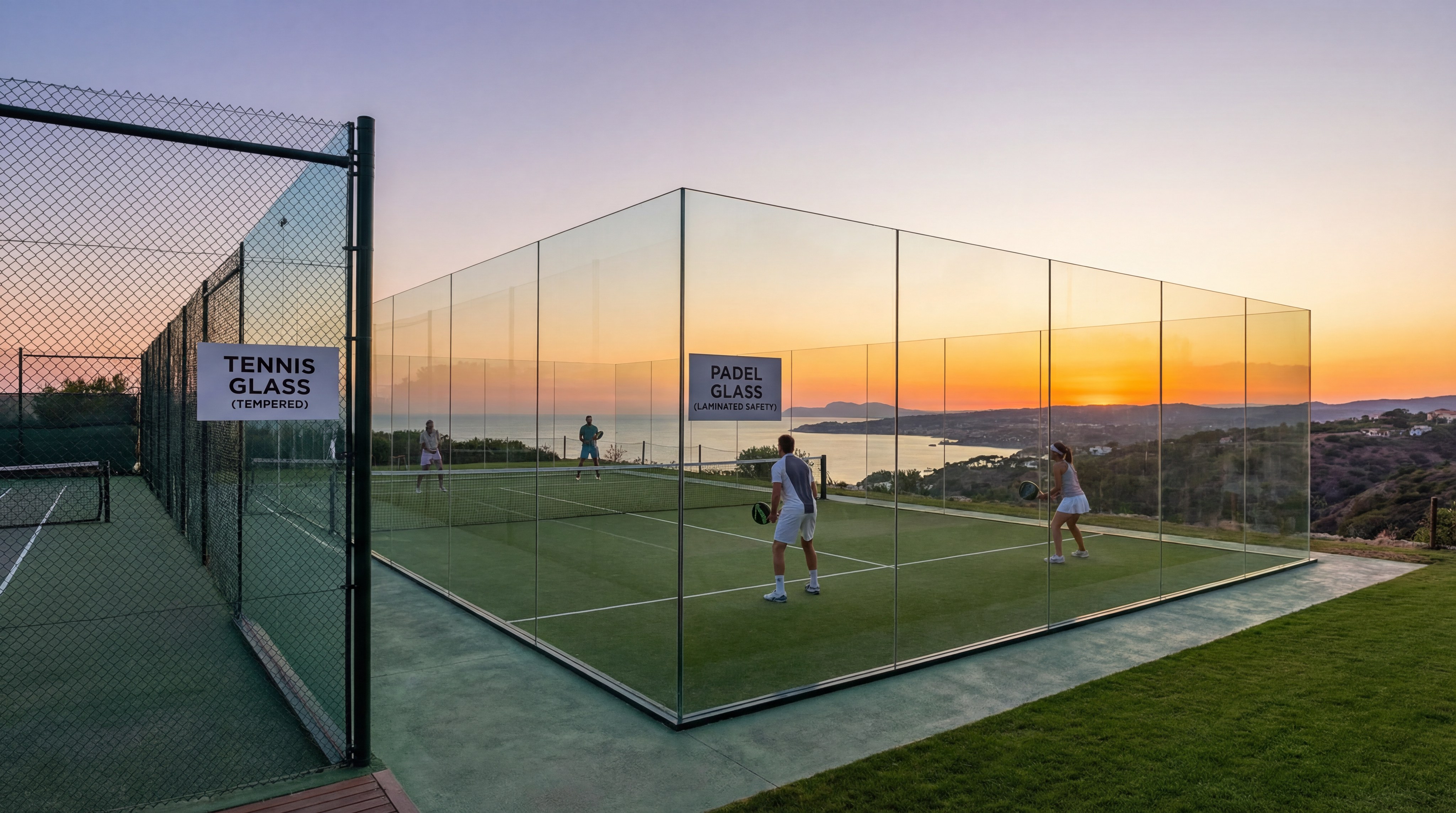
Padel relies on transparent glass walls for both gameplay and spectator viewing, whereas tennis utilizes mesh fencing primarily for ball containment. This visual difference between padel and tennis is most apparent in premium facilities. Investing in high-quality padel court lighting is essential to ensure the glass remains clear and glare-free at night.
Toughened Glass Safety and Thickness?
The glass in a padel court must be tempered to EN12150 standards to ensure player safety. Why does this matter?
- 12mm glass offers a more consistent ball bounce.
- Tempered glass shatters into small grains if broken.
- Increases the structural weight of the court to over 3 tons.
Using thinner glass might save costs initially but increases the risk of breakage during intense play.
The Panoramic Viewing Experience?
Modern padel courts often feature “Panoramic” or “Super Panoramic” back walls without steel pillars. It gets even better:
- Provides an unobstructed view for spectators and cameras.
- Creates a high-end, luxury feel for your club.
- Increases the broadcast quality for tournaments.
This architectural feature is something tennis courts simply cannot replicate.
Key Takeaway
Glass is the soul of a padel court, serving as both a playing surface and a window that makes the sport a visually captivating spectacle.
| Glass Specification | Standard Padel | Panoramic Padel |
|---|---|---|
| Thickness | 10mm or 12mm | 12mm (Mandatory) |
| Support Structure | Steel Pillars every 2m | 18mm Glass Fins or Open |
| Visibility | High | Maximum |
| Impact Rating | High (Tempered) | Ultra-High (Laminated) |
The evolution from mesh to panoramic glass has made padel the most spectator-friendly racket sport in the world.
How is lighting a difference between padel and tennis?
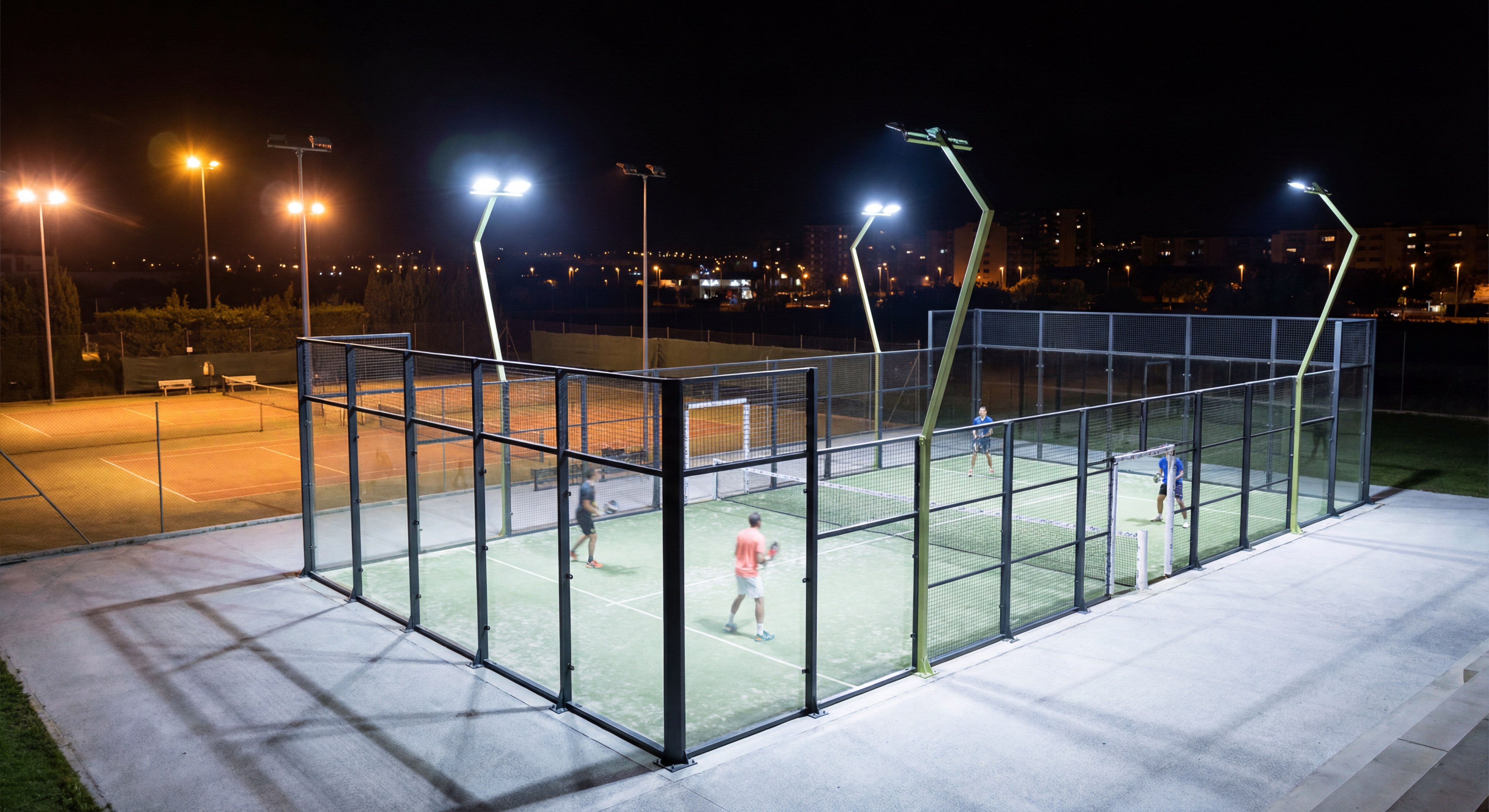
Padel lighting must be anti-glare and positioned precisely to avoid reflecting off the glass walls, while tennis lighting focuses on broad coverage of a much larger area. This technical difference between padel and tennis lighting ensures that players don’t lose the ball in the shadows during high-lob shots.
Anti-Glare LED Technology for Enclosures?
Because padel involves looking up and toward the walls frequently, the lights must not blind the players. Consider these factors:
- Asymmetric lenses direct light downward.
- LEDs reduce energy consumption by up to 60%.
- Instant-on capabilities are vital for club management.
Let’s be honest, poor lighting can ruin the experience of an otherwise perfect court.
Uniform Brightness and Lux Requirements?
The small size of the padel court requires very high uniformity to avoid “dead zones” near the corners. Why does this matter?
- Standard play requires 300-500 lux.
- Professional televised matches require over 750 lux.
- Proper positioning prevents shadows on the glass.
Tennis courts, due to their size, often have darker corners which are less critical than in padel.
Key Takeaway
Precision LED lighting is a non-negotiable component of padel construction, ensuring 24/7 playability and safety for all participants.
| Lighting Feature | Padel LED | Tennis Metal Halide |
|---|---|---|
| Average Lux | 300 – 800 | 200 – 500 |
| Energy Efficiency | High (LED) | Low (Traditional) |
| Glare Control | Specialized Optics | Standard Reflector |
| Instant Start | Yes | No (Warm-up required) |
Optimizing your lighting setup ensures that the glass walls do not create distracting reflections during nighttime matches.
Can roofs change the difference between padel and tennis?
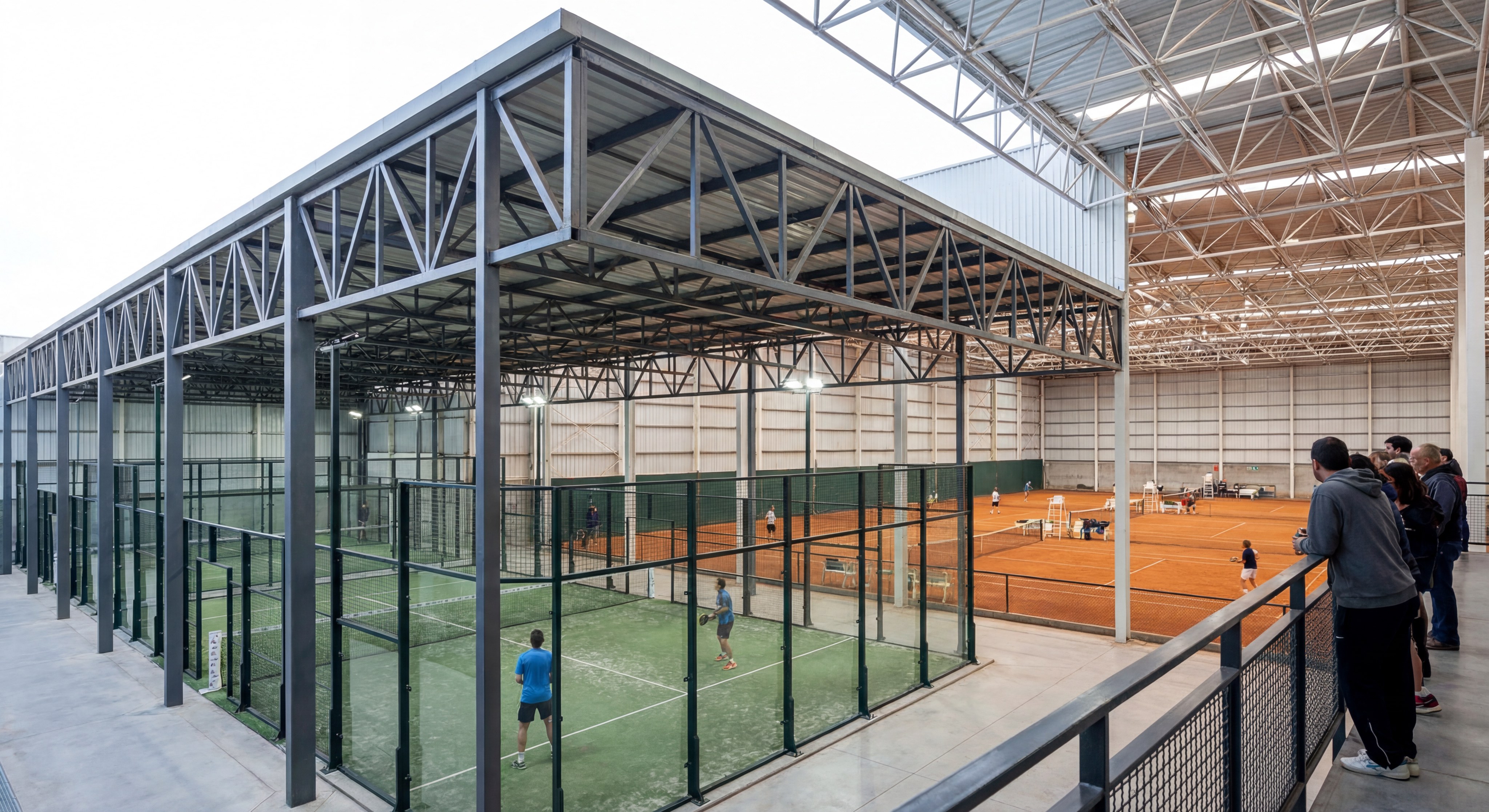
Padel courts are frequently roofed to allow for year-round play in any climate, whereas roofing a full-sized tennis court is a massive and often cost-prohibitive engineering feat. This operational difference between padel and tennis allows padel clubs to maintain 100% occupancy regardless of the weather. For the best results, always consult an expert in padel court construction before breaking ground.
All-Weather Playing with Steel Canopies?
A padel roof can be integrated directly into the court’s steel structure or built as a standalone canopy. Think about it:
- Protects the turf and glass from UV damage.
- Eliminates rain delays, which are the enemy of club revenue.
- Requires a minimum internal height of 7 to 9 meters.
This height is necessary to accommodate the high lobs that are central to padel strategy.
Integrated Lighting and Weather Protection?
Roofed courts often include integrated lighting and side curtains for wind protection. Why does this matter?
- Creates a “premium indoor” feel even at an outdoor site.
- Reduces maintenance costs by keeping the sand dry.
- Allows you to charge higher hourly rates for “guaranteed” play.
You will see your ROI accelerate when you remove weather as a variable in your business model.
Key Takeaway
The ability to cost-effectively roof a padel court makes it a more resilient B2B investment compared to outdoor-only tennis facilities.
| Facility Type | Outdoor Padel | Roofed Padel | Indoor Tennis |
|---|---|---|---|
| Operational Days | Weather dependent | 365 Days | 365 Days |
| Construction Cost | Moderate | High | Very High |
| Height Requirement | N/A | 7m+ | 12m+ |
| Ventilation | Natural | High (Open sides) | HVAC Required |
Choosing a roofed solution ensures your facility remains the go-to destination for players throughout the winter months.
Strategic Conclusion
Building a successful sports facility requires more than just land; it requires a deep understanding of how infrastructure drives player retention. By identifying the technical difference between padel and tennis, you can optimize your square footage, reduce injury risks with superior surfaces, and maximize your revenue through higher player density. At Superb Padel, we specialize in high-performance padel court construction, providing everything from panoramic glass to anti-glare lighting. We help you solve the challenges of space constraints and structural safety, ensuring your club stands out as a premium destination. Don’t leave your investment to chance—contact us today to start your professional court installation.
Frequently Asked Questions
Can I play padel on a tennis court?
No, because padel requires specific glass and mesh walls to be part of the game and the court dimensions are much smaller.
Is padel easier to learn than tennis?
Yes, padel is significantly more accessible due to the underarm serve and the ability to play the ball off the walls.
How much space do I need for a padel court vs tennis?
You need approximately 200 square meters for a padel court, whereas a tennis court requires over 600 square meters.
Can I use tennis balls for padel?
No, you should not use them because tennis balls have higher pressure, which makes them bounce too high for a padel court.
What’s the best glass for a professional padel court?
12mm tempered safety glass is the gold standard, as it provides the most consistent bounce and maximum structural durability.