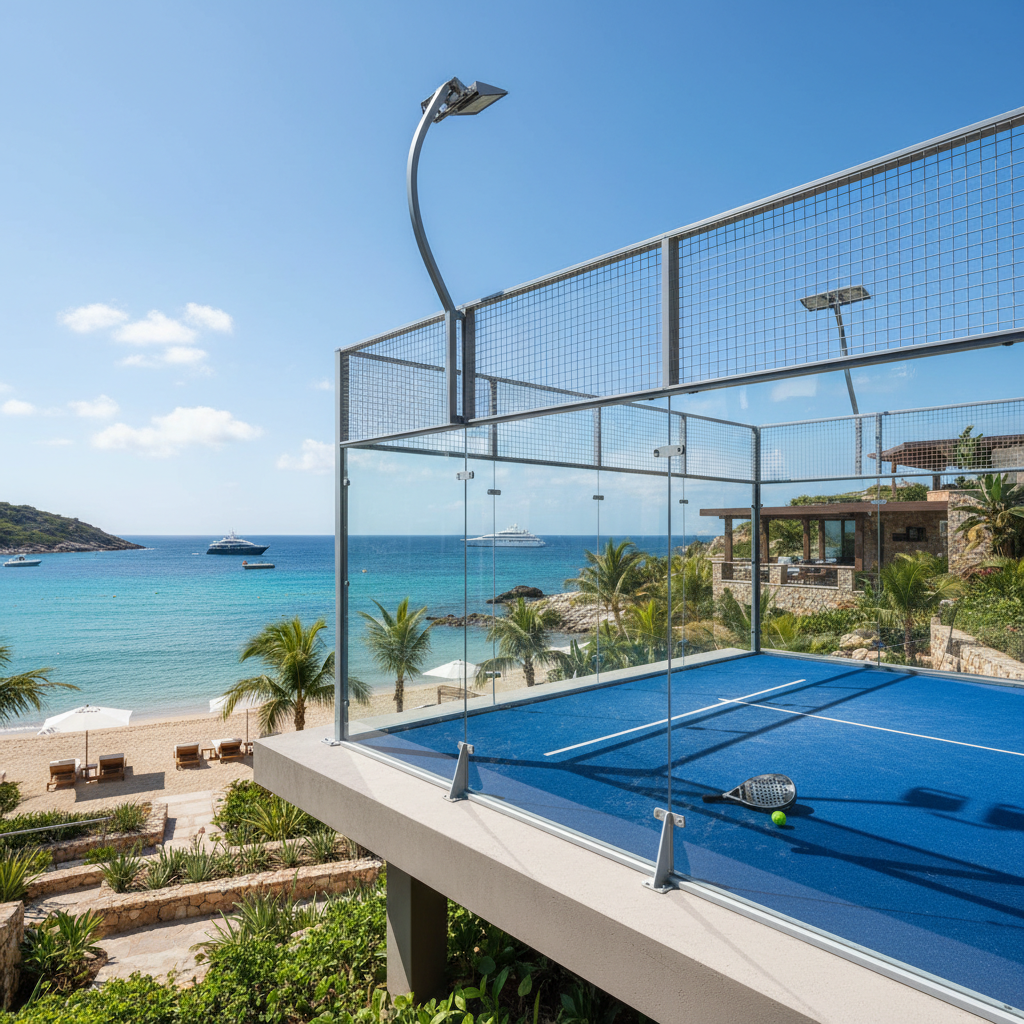
Many facility owners struggle with underutilized space while traditional sports witness declining engagement levels across local demographics. Stagnation causes significant revenue loss plus high maintenance costs for aging tennis courts drain your operational budget quickly. By installing a high-performance bay padel facility, you triple player density and foster a vibrant community hub. Our expert engineering team has delivered five hundred successful projects globally while maintaining the highest industrial standards for B2B clients.
1. What defines the modern bay padel experience?
How does the court layout facilitate play?
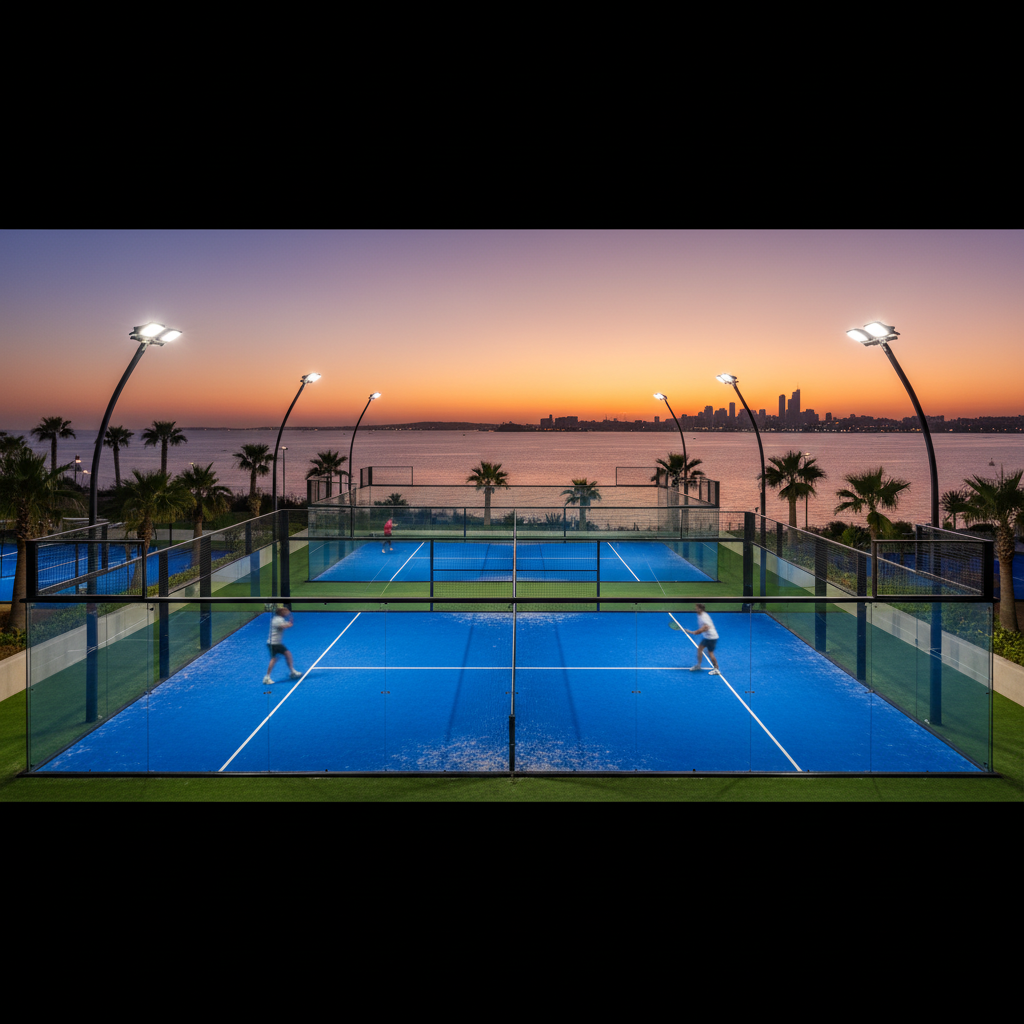
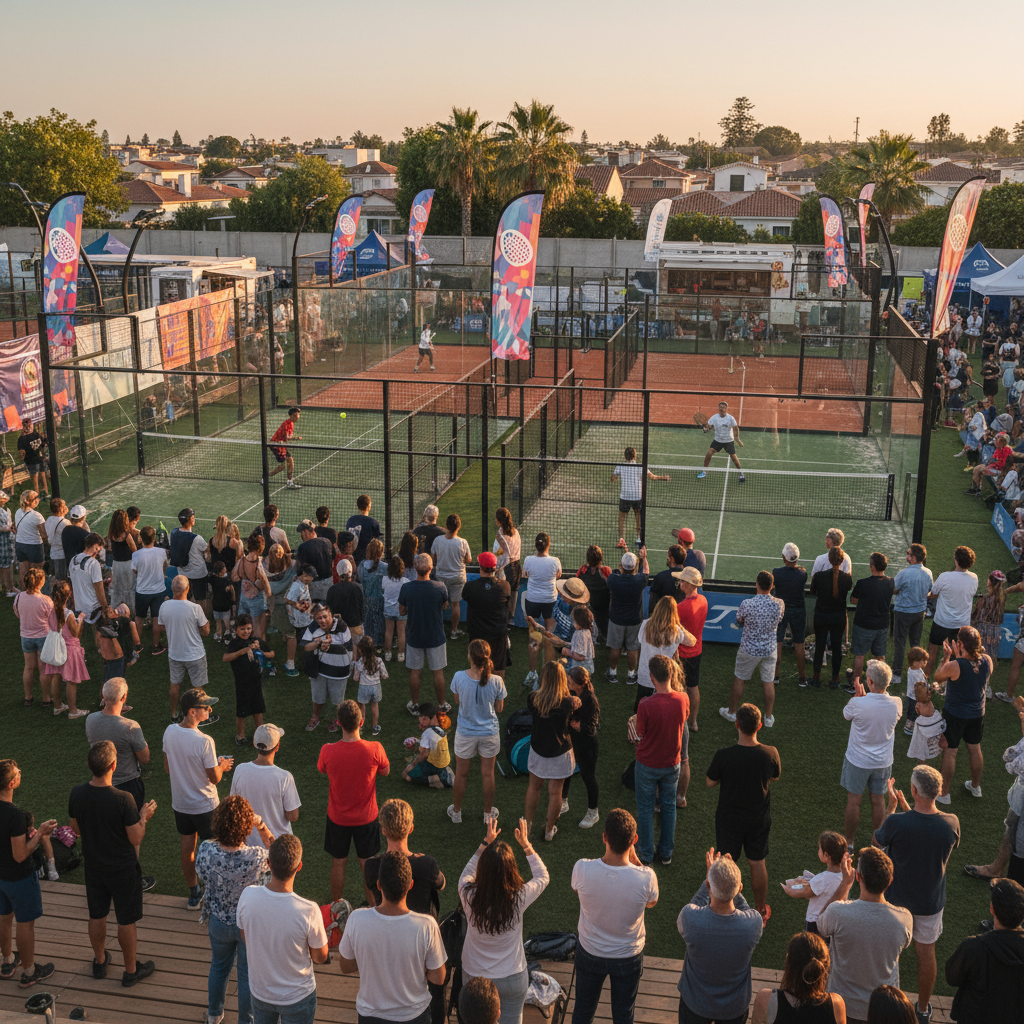
This social racket sport utilizes a compact ten by twenty meter glass enclosure where doubles teams compete with foam rackets. Strategic design prioritizes interaction over raw power because the small footprint keeps all four participants in constant proximity throughout matches. Ready for the good part? Players enjoy longer rallies since the ball remains active after striking the tempered glass walls located behind each baseline area. Low-compression balls ensure predictable bounces on synthetic turf and this accessibility attracts diverse age groups looking for engaging exercise options. You will find that the smaller arena reduces physical strain while increasing the total number of ball contacts per minute significantly.
Why do the wall rules change the game?
Wall play introduces a tactical layer where participants use the glass to return difficult shots and regain their court positions. This is where it gets interesting. Mastering the rebound off the rear panels allows smaller athletes to defeat powerful hitters through clever positioning and consistent ball placement. You can hit the ball against your own glass wall to send it over the net but it must land inside the lines. These unique mechanics foster a deep learning curve for competitive players yet beginners find the basic rules extremely easy to grasp. Every match feels like a dynamic puzzle where geometry matters more than overhead strength and teamwork remains the primary key to victory.
Key Takeaway: Modern courts combine social doubles play with active wall mechanics to create a high-density sports environment that welcomes all skill levels.
| Feature | Specification | User Benefit |
|---|---|---|
| Enclosure | 10m x 20m Glass | High visibility and social play |
| Wall Material | 12mm Tempered Glass | Predictable rebounds and safety |
| Format | Four Players (Doubles) | Maximum social engagement |
The combination of structural glass and simplified mechanics makes this the fastest growing racket sport for commercial clubs looking to maximize member retention.
2. Why is bay padel a smart business investment?
How does player turnover boost profit?
Operating a bay padel facility allows you to accommodate twelve paying customers in the same space occupied by one standard tennis court. This massive increase in player density triples your hourly rental revenue while minimizing the total land area required for high-yield sports. Here is the deal. Higher turnover rates drive secondary spending at your on-site cafe or pro shop since more people cycle through the building. You can implement automated booking systems to manage these rotations and this efficiency reduces your need for permanent administrative staff on site. Frequent matches encourage players to stay for social drinks after their sessions and this behavior boosts your food and beverage margins.
What is the projected market growth?
Global demand for specialized courts is surging as urban developers seek premium lifestyle amenities to attract high-value residential or commercial tenants. Investors are moving toward high-density racket sports because the occupancy rates stay consistently higher than traditional gym alternatives during off-peak hours. What is the real story? Early adopters currently witness their initial construction costs recouped within twenty-four months of operation due to intense local demand for social play. You will notice that social media visibility for these clubs remains exceptionally high and this organic marketing reduces your customer acquisition costs. Market data suggests that the player base expands by twenty percent annually while the number of professional facilities continues to lag behind demand.
Key Takeaway: High player density and rapid market expansion ensure that these facilities deliver superior returns compared to traditional large-scale sports assets.
| Revenue Stream | Primary Driver | Financial Impact |
|---|---|---|
| Court Rentals | Hourly Booking Fees | Steady monthly cash flow |
| F&B Sales | Post-match Socializing | High-margin secondary income |
| Memberships | Monthly Subscriptions | Reliable recurring revenue |
The financial viability of these courts stems from their ability to generate multiple income streams within a remarkably small urban or suburban footprint.
3. What materials are needed for bay padel courts?
Which glass type ensures player safety?
Professional builders must utilize twelve millimeter tempered safety glass that complies with international impact standards to protect participants during high-speed collisions. These heavy panels serve as both a structural frame and an active playing surface so they must remain perfectly flat for consistent bounces. But here is the kicker. Inferior glass often cracks under thermal stress or player impact and this failure creates dangerous conditions plus expensive repair downtime for your club. You should verify that your supplier provides certified anti-explosion panels that shatter into harmless fragments if a catastrophic failure occurs during a match. High-quality gaskets must separate the glass from the steel frame to absorb vibrations while maintaining the structural integrity of the entire cage.
Why is turf density a performance factor?
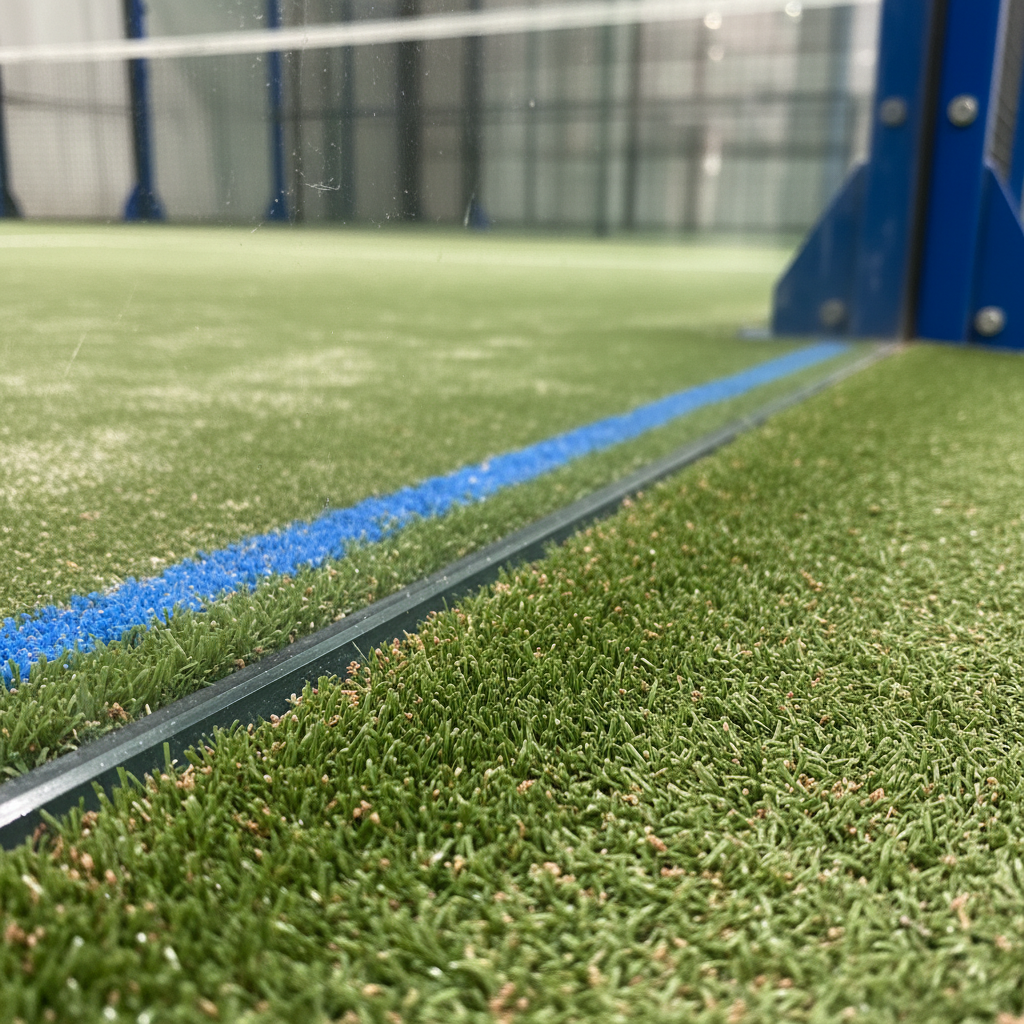
The playing surface requires high-density monofilament synthetic turf designed to hold a specific volume of silica sand for player traction and ball speed. You might be wondering. Does the fiber shape affect the longevity of your court under heavy daily use by professional or amateur club members? Fibrillated fibers offer excellent sand retention but monofilament options provide superior wear resistance for facilities with high booking volumes and constant player movement. You must choose a pile height between twelve and fifteen millimeters to ensure the ball reacts predictably across every square inch of the court. Specialized blue or green turf offers the best visual contrast for the ball and this visibility helps athletes react faster during intense rallies.
Key Takeaway: Utilizing 12mm tempered glass and high-density monofilament turf is mandatory for building a professional facility that minimizes long-term maintenance costs.
| Component | Industry Standard | Functional Role |
|---|---|---|
| Framework | Galvanized Steel | Rust prevention and stability |
| Wall Panels | 12mm Tempered Glass | Safety and active rebound |
| Surface | Monofilament PE Turf | Traction and consistent bounce |
Investing in premium raw materials during the initial construction phase prevents structural degradation and ensures your facility remains a top-tier destination for years.
4. How do you find a site for a bay padel court?
Does wind load affect your placement?
Finding a site for a bay padel facility requires a level two hundred square meter area with stable soil that supports heavy concrete foundations. Coastal locations offer breathtaking views for players but these sites demand advanced engineering to resist the lateral force of wind against large glass panels. Ready for the good part? Specialized structural calculations allow you to install stunning seaside courts that remain perfectly stable even during severe weather events or high-speed storms. You must conduct a geotechnical survey to ensure the ground will not shift under the weight of the steel pillars and glass. Windbreaks or strategic positioning can reduce the stress on the enclosure while providing a comfortable playing environment for your club members.
How much clearance do you need?
Your chosen location must provide at least six to eight meters of vertical clearance to allow for the high tactical lobs that define the sport. This is where it gets interesting. Insufficient height ruins the competitive experience because players cannot execute defensive shots without hitting the ceiling or overhead utility lines during active rallies. You should also allocate space for circulation paths around the exterior of the cage so spectators can watch matches without interfering with the athletes. Proximity to existing electrical utilities is vital for powering the high-output LED lighting systems required for profitable evening play and late-night bookings. Leveling the site perfectly is the most important step because even a slight incline causes the ball to roll and bounce inconsistently.
Key Takeaway: Optimal sites combine stable soil with ample vertical clearance and advanced engineering to handle local environmental factors like high wind loads.
| Requirement | Metric | Purpose |
|---|---|---|
| Total Area | 11m x 21m | Includes safety and walking zones |
| Internal Height | 8 Meters | Mandatory for professional lobs |
| Base Surface | Reinforced Concrete | Prevents structural shifting |
Selecting a site with high visibility and scenic views allows you to justify premium hourly rates while attracting a high-end demographic of racket sport enthusiasts.
5. What is the dimensions of a bay padel court?
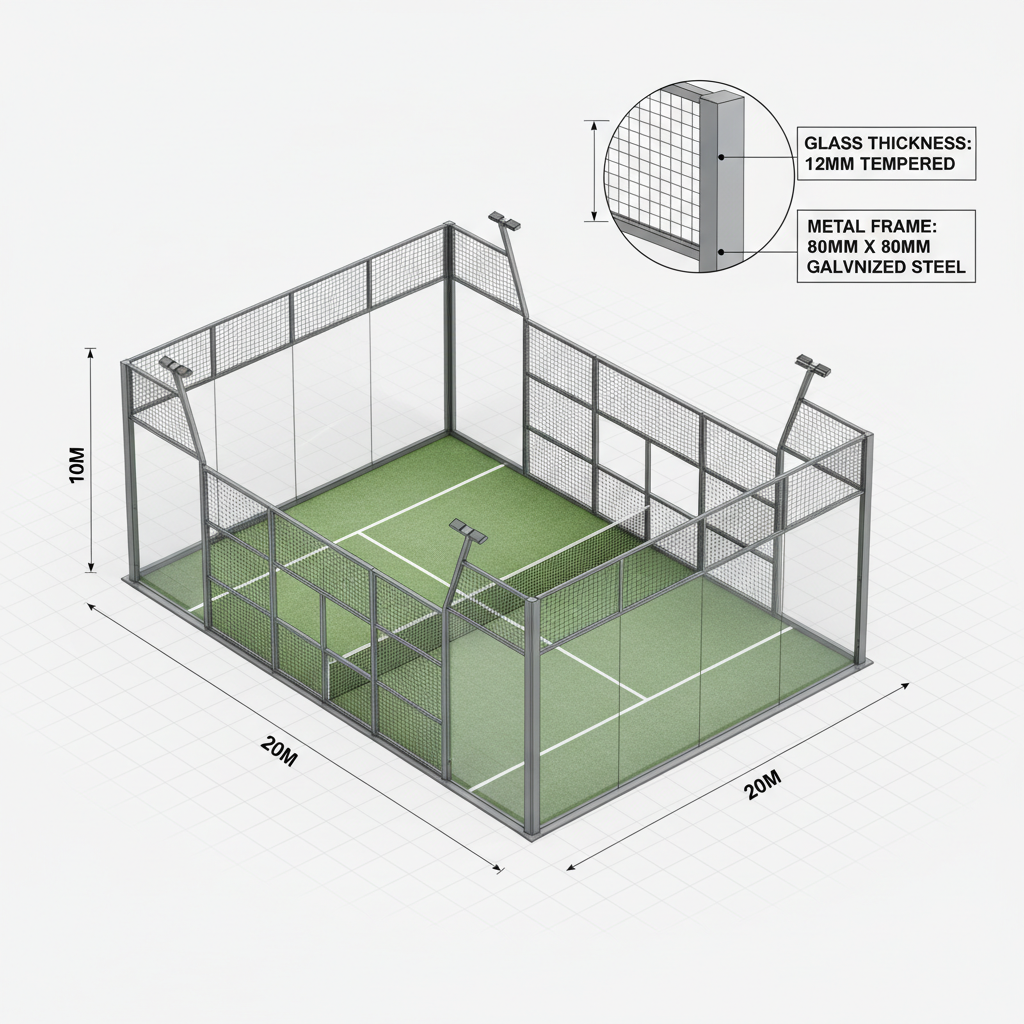
Why is vertical height so important?
The standard playing area measures exactly ten meters wide by twenty meters long and this precise symmetry ensures fair competition for all participants on court. Vertical clearance remains the most overlooked metric in amateur builds but professional clubs demand eight meters to accommodate high-level lobs and tactical overhead shots. Wait, there is more. If your ceiling is too low the ball will frequently strike the roof and this interruption frustrates experienced players who expect tournament conditions. You must verify that no low-hanging lights or structural beams interfere with the flight path of the ball across the entire ten-meter width. Maintaining these dimensions is vital for the reputation of your facility and it ensures that players can transition between different clubs seamlessly.
How do net specs affect the game?
A professional net spans the full width of the court and it must stand eighty-eight centimeters high at the center while reaching ninety-two centimeters at the posts. What is the real story? Improper net tensioning allows the ball to roll over the cord too easily and this inconsistency ruins the competitive integrity of your matches. You should use a high-strength steel cable to maintain the height over long periods of heavy use and intense ball impacts during daily play. Padded side covers protect athletes from injury when they run toward the net to retrieve short drop shots or cross-court volleys. Every marking on the synthetic turf must be exactly five centimeters wide to comply with international regulations and ensure accurate calls by the referee.
Key Takeaway: Adhering to the strict 10x20m footprint and 8m vertical height standard is fundamental for operating a professional commercial racket club.
| Metric | Dimension | Tolerance |
|---|---|---|
| Width | 10.00 Meters | +/- 3cm |
| Length | 20.00 Meters | +/- 5cm |
| Net Center | 0.88 Meters | +/- 1cm |
Precise dimensioning ensures that every athlete experiences a consistent game regardless of their location and this reliability builds long-term trust with your member base.
6. What is the process to build a bay padel court?
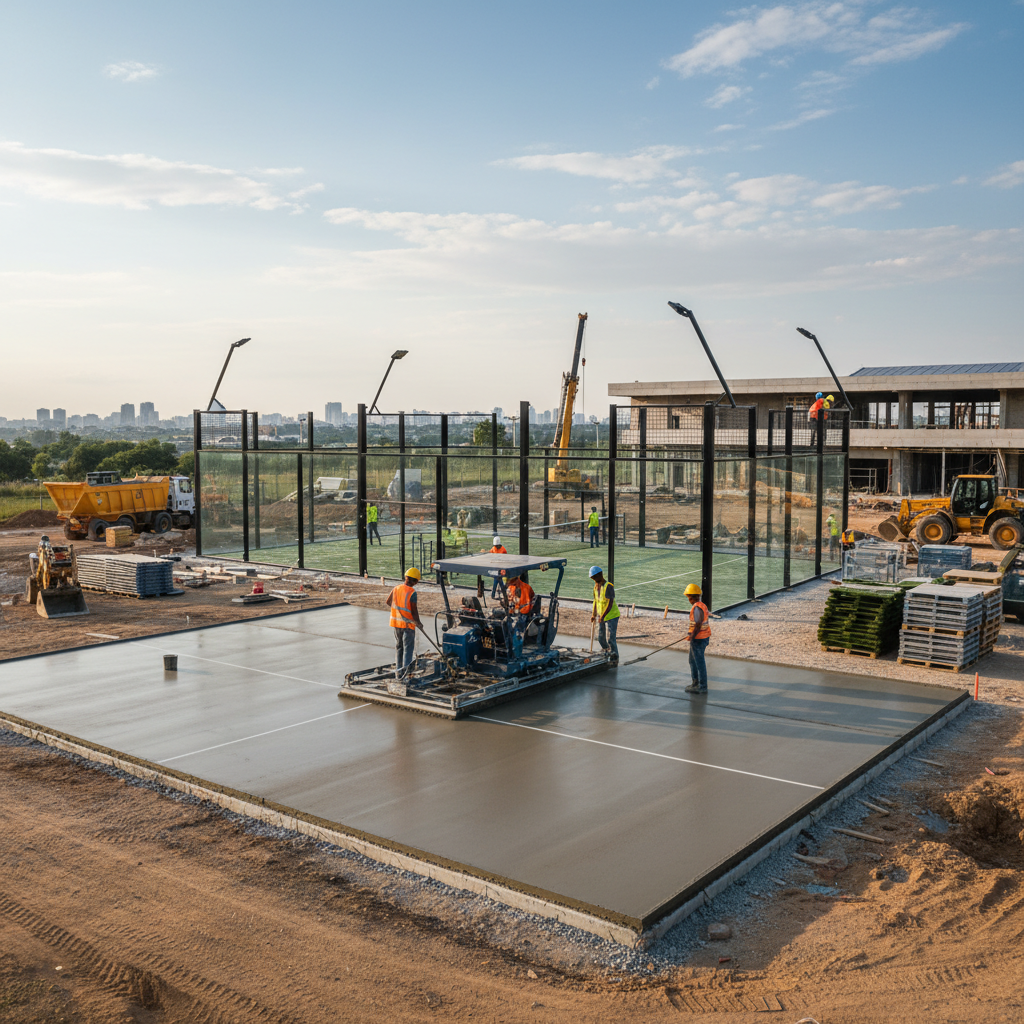
How do you secure the steel frame?
Constructing a bay padel court begins with pouring a fifteen centimeter reinforced concrete slab that serves as the foundation for the heavy steel cage. You must bolt the vertical pillars into this cured base using high-strength chemical anchors to prevent any structural movement during high-intensity matches or storms. Here is the deal. If the foundation is even slightly uneven the glass panels will not align correctly and this stress can cause the walls to shatter. Laser-leveling the concrete during the pour ensures a perfectly flat playing surface that allows the ball to bounce predictably across the entire twenty-meter length. You should allow the concrete to cure for at least seven days before mounting the heavy galvanized steel frame to the anchor points.
What are the glass installation steps?
Installing the twelve millimeter tempered glass requires specialized suction lifting equipment and a team of three professionals to maneuver the heavy panels into place safely. But here is the kicker. You must place UV-resistant rubber gaskets between the steel frame and the glass to absorb the vibrations from player collisions and ball strikes. These buffers prevent the glass from grinding against the metal and this protection is vital for the long-term safety of your club members. Once the panels are secured you can lay the synthetic turf and distribute the silica sand infill using a mechanical brush for even coverage. Final steps include installing the LED lighting poles and tensioning the net to the correct height for immediate play by your first customers.
Key Takeaway: Successful construction requires a laser-leveled foundation followed by a precise assembly of the steel skeletal framework and heavy safety glass panels.
| Phase | Duration | Goal |
|---|---|---|
| Excavation | 3-5 Days | Level ground and drainage |
| Slab Pouring | 2 Days | Structural reinforced base |
| Cage Assembly | 4-6 Days | Steel and glass mounting |
A well-executed building process prevents expensive structural repairs and ensures that your facility remains quiet and stable during the most intense competitive matches.
7. How much budget is needed for a bay padel club?
What are the main cost drivers?
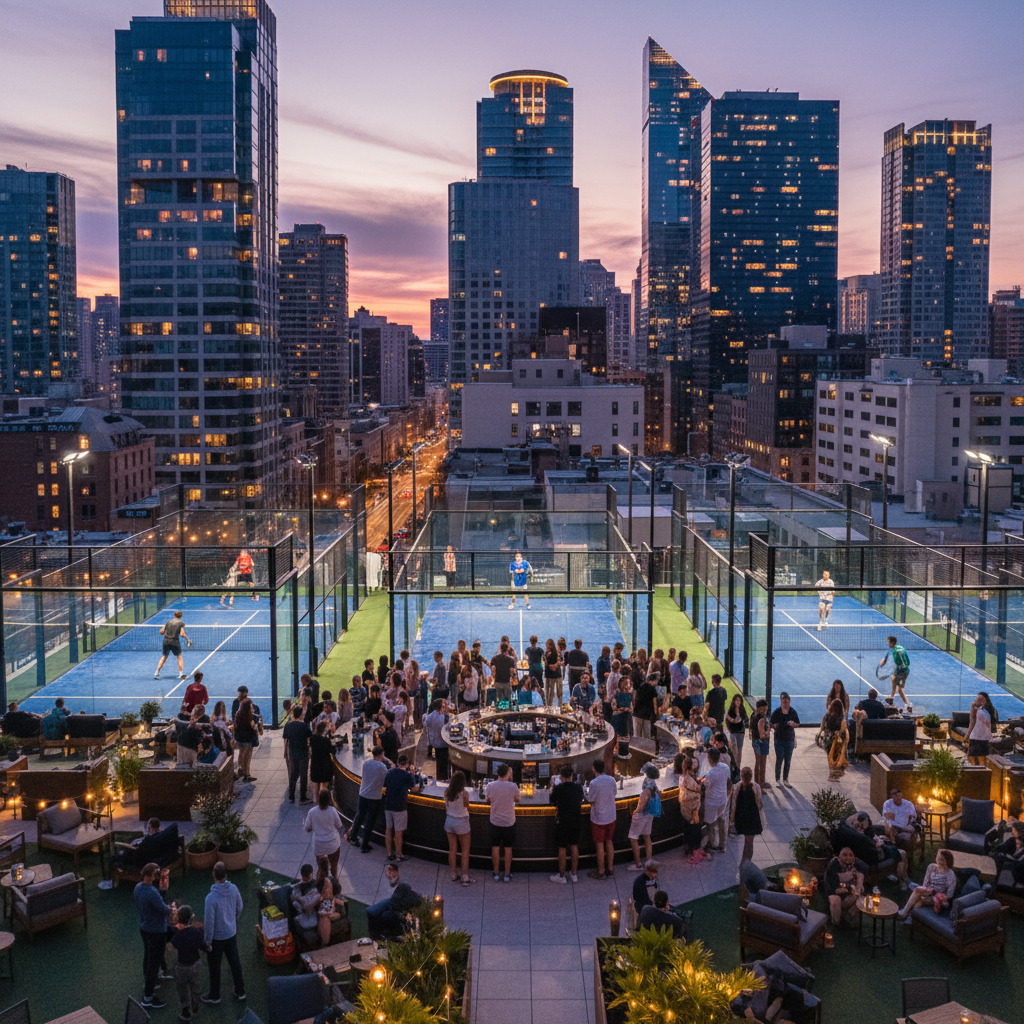
Budgeting for a professional club typically requires between twenty-five thousand and fifty thousand dollars per court depending on the chosen materials and site complexity. The primary expenses include the galvanized steel kit plus the high-quality twelve millimeter tempered glass panels and the specialized synthetic turf surface. Ready for the good part? Investing in premium panoramic designs allows you to charge twenty percent more for court rentals because athletes prefer the unobstructed view and luxury aesthetic. You must also account for site preparation costs like excavation and drainage plus the reinforced concrete slab that anchors the entire structure to the ground. Adding a social lounge or a pro shop increases the initial capital but these amenities accelerate your return by providing extra revenue streams.
How do you calculate your ROI?
You can determine your return on investment by projecting the monthly income from court bookings plus coaching fees and equipment rentals at your facility. This is where it gets interesting. Most urban clubs reach full capital recovery within eighteen to thirty months due to high occupancy rates during evening and weekend peak hours. Low operational overheads like minimal staffing and durable synthetic surfaces help you maintain high profit margins throughout the year regardless of seasonal changes. You should factor in the electricity savings from high-efficiency LED lighting systems since these reduce your monthly utility bills by over fifty percent annually. Building a loyal member base through social tournaments ensures a steady cash flow that justifies the initial investment in high-quality sports infrastructure.
Key Takeaway: While the initial capital requirement is substantial the high occupancy rates and low maintenance costs result in an exceptionally attractive business ROI.
| Expense Item | Est. Cost | ROI Impact |
|---|---|---|
| Court Hardware | $25k – $35k | Durability and prestige |
| Concrete Base | $5k – $12k | Long-term safety |
| LED Lighting | $3k – $6k | Extended billable hours |
Strategic budgeting for high-end features like panoramic glass helps you dominate the local market and attracts a high-spending demographic of professional athletes and families.
8. Which lighting is ideal for a bay padel setup?
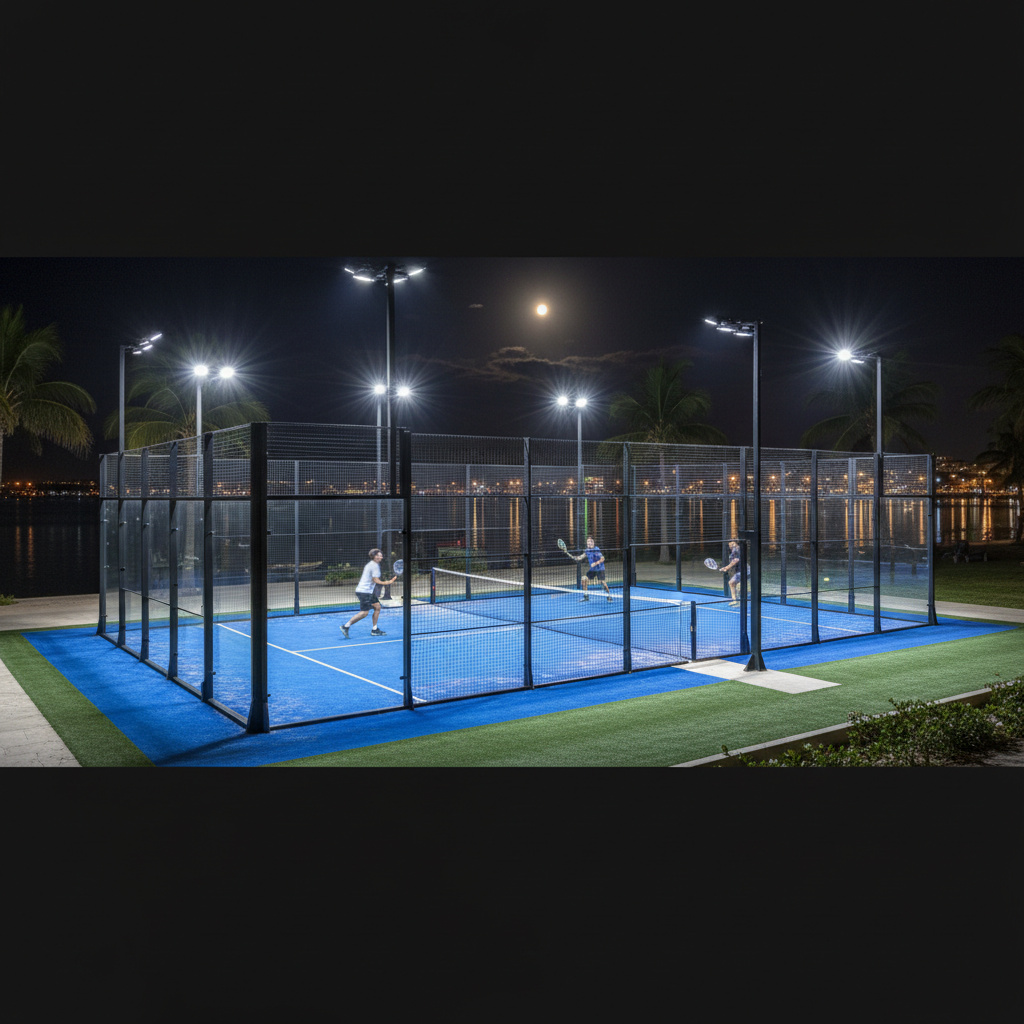
How do you eliminate player glare?
Installing professional LED floodlights is mandatory for a bay padel facility because players need perfect visibility to track the ball during high-speed evening rallies. You must use asymmetric lenses that direct the light strictly onto the turf while preventing glare from blinding athletes during high defensive lobs. You might be wondering. Does the light intensity affect the reaction speed of your players when they compete under artificial illumination during late-night matches at the club? High-lumen systems with anti-flicker technology ensure a consistent playing experience and this quality attracts competitive members who demand professional standards for their games. Proper light placement on six-meter poles eliminates shadows in the corners and this uniformity is vital for fair play and safety on court.
Why is energy efficiency a priority?
Modern LED fixtures reduce your monthly electricity consumption significantly compared to traditional metal-halide bulbs and this saving directly improves your bottom line. What is the real story? These systems offer an instant on-off feature so you do not waste power waiting for bulbs to warm up between scheduled court bookings. You will save thousands in maintenance costs because LEDs last for fifty thousand hours and they do not require frequent bulb replacements at great heights. Choosing IP66 waterproof-rated lamps ensures that your lighting remains reliable during rain or high humidity levels at coastal or rooftop locations. Well-designed night lighting effectively doubles your daily revenue potential by making the courts available for play long after the sun has set on the bay.
Key Takeaway: High-output LED systems with asymmetric lenses provide the most energy-efficient and glare-free environment for profitable evening matches at your facility.
| Light Type | Efficiency | Lifespan |
|---|---|---|
| Professional LED | 150 lm/W | 50,000 Hours |
| Traditional Halogen | 25 lm/W | 2,000 Hours |
| Metal-Halide | 80 lm/W | 10,000 Hours |
Superior lighting creates a professional atmosphere that encourages members to book courts for late-night social matches and this increased occupancy drives your monthly profit.
9. How do you manage ongoing bay padel maintenance?
Why does the turf need brushing?
Maintaining your synthetic turf requires bi-weekly brushing to redistribute the silica sand and keep the grass fibers standing upright for a consistent ball bounce. High-traffic areas like the service boxes compact quickly and this hardening causes the ball to skid or bounce unpredictably during intense matches. Ready for the good part? Regular maintenance extends the life of your turf by three to five years and this saving prevents expensive resurfacing projects in the future. You should use a specialized mechanical brush to ensure the sand remains level and this process also helps with water drainage after heavy rain. Removing organic debris like leaves or twigs daily is vital for preventing algae growth that can make the surface slippery and dangerous for players.
How do you keep glass crystal clear?
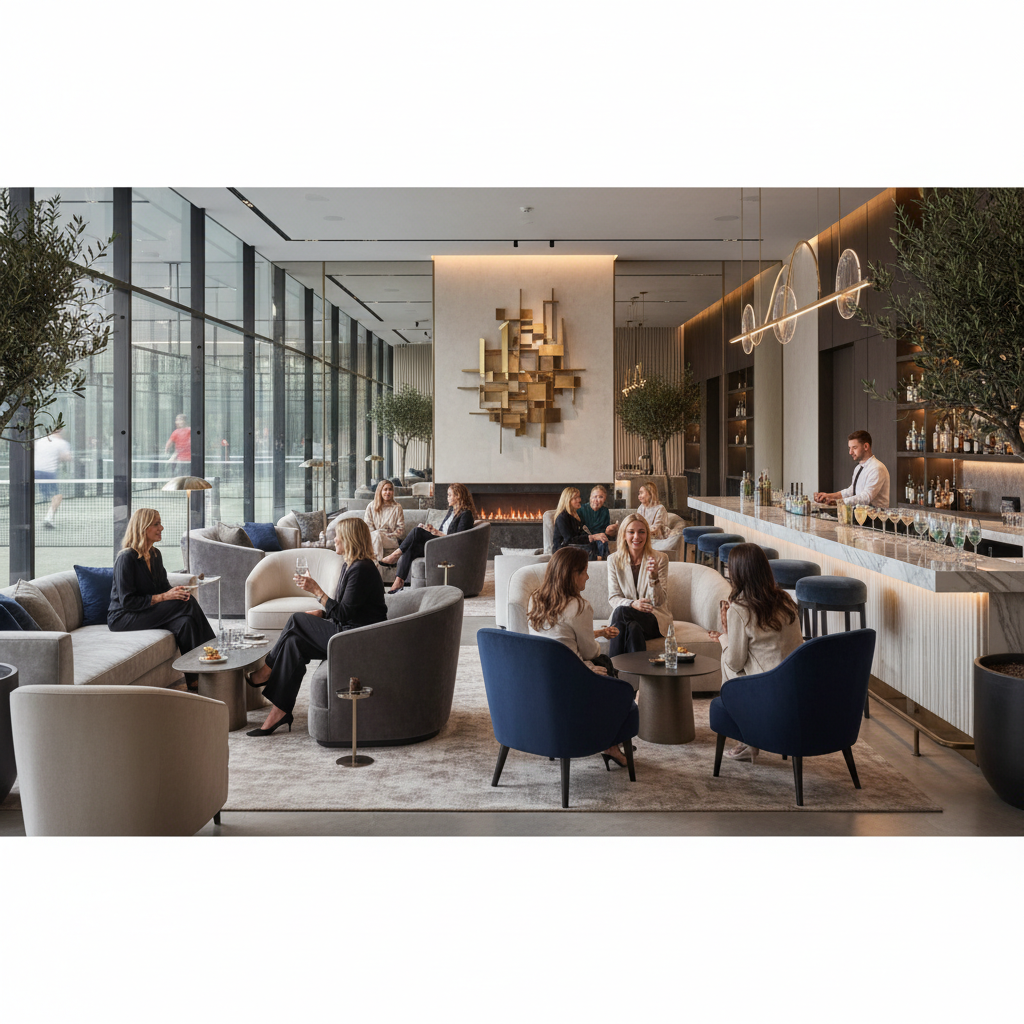
Keeping the tempered glass walls transparent is fundamental for the luxury look of your facility and it ensures that spectators can see the action clearly. Sweat and handprints can cloud the panels over time so you must clean the glass weekly with a mild detergent and a soft squeegee. This is where it gets interesting. Crystal clear walls improve the safety of the club because they allow for better monitoring of the courts from the social lounge or bar area. You should also inspect the structural bolts and rubber gaskets monthly to ensure the glass remains securely anchored to the steel frame during play. Coastal sites require more frequent cleaning to remove salt film that can etch the surface if left untreated for long periods of time.
Key Takeaway: Consistent turf brushing and weekly glass cleaning are the most effective ways to protect your capital investment and maintain a premium brand image.
| Task | Frequency | Duration |
|---|---|---|
| Glass Cleaning | Weekly | 1.5 Hours |
| Turf Brushing | Bi-Weekly | 1 Hour |
| Hardware Check | Monthly | 0.5 Hours |
Routine maintenance schedules prevent small issues from becoming expensive structural repairs and ensure that the courts are always safe and ready for peak-time bookings.
10. What safety rules apply to a bay padel facility?
Why is tempered glass non-negotiable?
Safety regulations for a bay padel facility require the use of twelve millimeter tempered glass to prevent serious injuries during player collisions with the walls. This material is designed to crumble into small blunted fragments if it breaks and this feature protects participants from deep cuts or life-threatening accidents. But here is the kicker. Choosing a supplier with full CE or ISO certifications is the only way to verify that your glass meets these critical performance standards. You must ensure that the glass panels never touch the steel frame directly and the rubber gaskets act as a vital vibration buffer. Structural audits should be conducted annually to check for any signs of stress or fatigue in the anchor points that secure the cage.
What are the wind load standards?
In coastal or high-wind environments the court structure must be engineered to withstand lateral forces of at least one hundred and twenty kilometers per hour. What is the real story? The large glass panels act like sails during a storm and the foundation must be deep enough to prevent the entire cage from tipping. You should verify that your pillars are made from hot-dip galvanized steel to prevent rust from weakening the structure over years of exposure. Providing clear signage regarding proper footwear is vital for preventing slips on the synthetic turf and this reduces your business liability for accidents. Every commercial facility should have a first-aid kit and an emergency protocol to handle the minor sprains or injuries common in high-intensity sports.
Key Takeaway: Prioritizing certified 12mm safety glass and regional wind-load engineering protects your athletes and minimizes your long-term commercial business liability.
| Safety Feature | Requirement | Benefit |
|---|---|---|
| Glass Standard | EN 12150 Certified | Injury prevention |
| Frame Finish | Hot-dip Galvanized | Structural longevity |
| Foundation | Chemical Anchors | Stability in storms |
Following strict safety protocols ensures that your club remains a professional and secure destination for athletes of all ages while protecting your long-term reputation.
Conclusion
Building a professional facility requires a deep commitment to high-quality materials and advanced structural engineering to ensure long-term success. You have the opportunity to transform underutilized urban space into a high-revenue community hub that attracts a loyal demographic of active racket sport enthusiasts. By following the technical roadmap provided in this guide you can create a durable and visually striking destination that delivers significant financial returns. If you are ready to start your next sports development project contact us today for a comprehensive quote and expert consultation. Our vision is to empower you with the most durable and visually striking sports infrastructure available in the modern market today.
FAQ
Q1: Can I build a bay padel court on an existing tennis surface?
Probably not, because most tennis courts lack the fifteen to twenty centimeter reinforced concrete depth required to support the heavy twelve millimeter glass walls.
Q2: What is the best glass thickness for a commercial facility?
Professional clubs should always use twelve millimeter tempered safety glass to ensure maximum impact resistance and provide the most consistent ball rebound for players.
Q3: How do I know if my site has enough vertical clearance?
You must measure from the playing surface to the lowest overhead obstruction and ensure you have at least six to eight meters of clear space.
Q4: Can I install these courts in a high-wind coastal environment?
Absolutely, provided you use hot-dip galvanized steel with specialized marine-grade coatings and engineer the foundation to handle the specific local wind load requirements.
Q5: What is the best way to maintain the playing surface?
Redistributing the silica sand with a mechanical brush every two weeks is the best way to keep the turf level and protect the synthetic fibers.