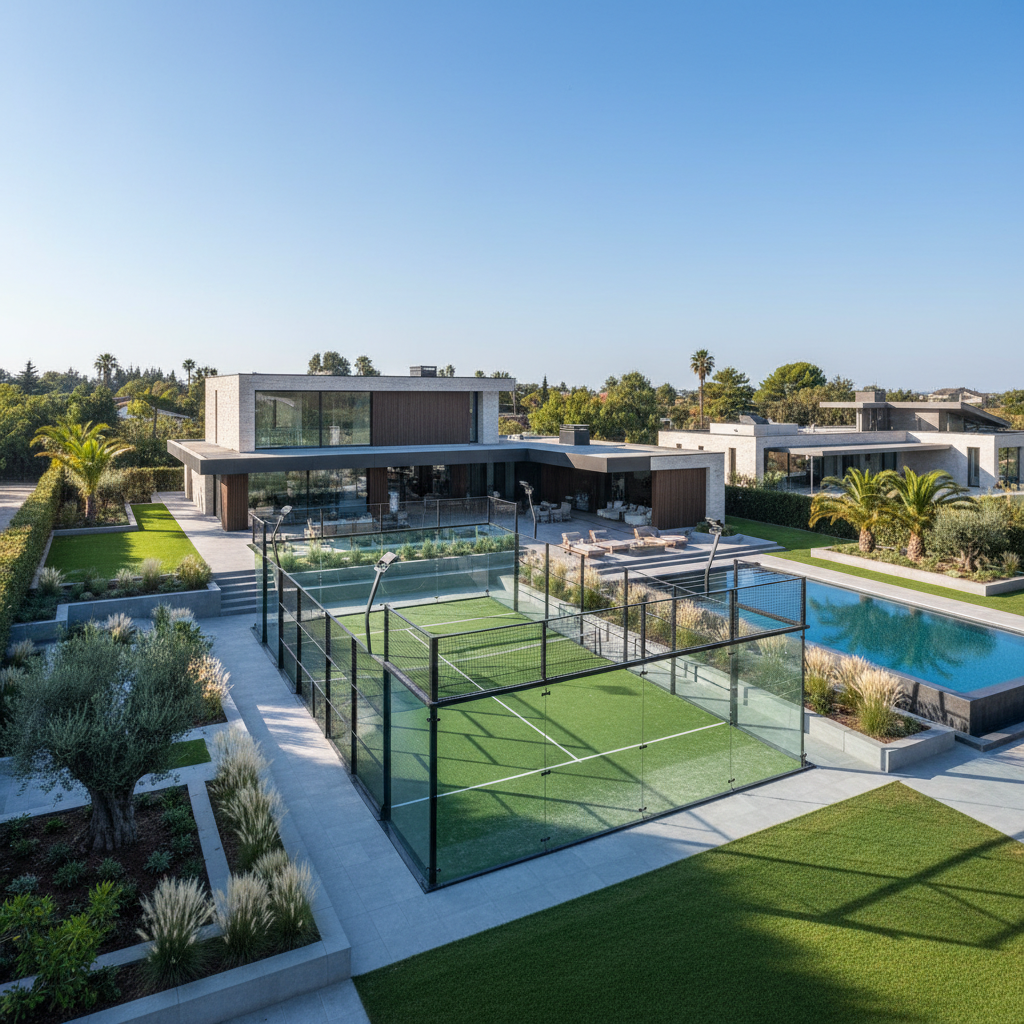
The official padel court size is exactly 20 meters long by 10 meters wide, creating a total playing area of 200 square meters. You might find that choosing between space-maximizing layouts and official federation compliance is a common struggle for facility owners. This lack of precision often leads to “dead zones” and structural failures that drain maintenance budgets and frustrate players. By following this technical blueprint, you will secure a high-performance, FIP-compliant venue that ensures long-term profitability and safety.
What is the official padel court size for doubles?
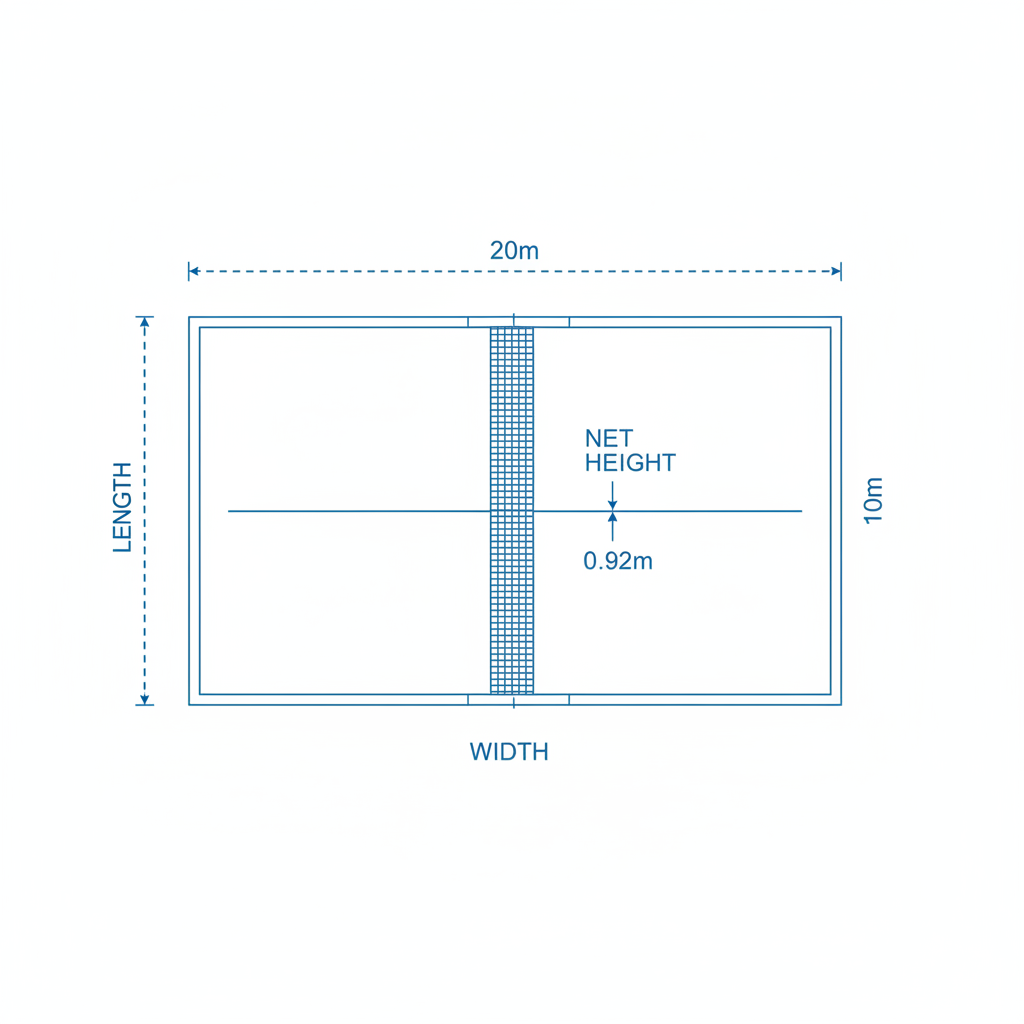
The official padel court size for doubles play is 20 meters in length and 10 meters in width, measured from the internal face of the enclosures. You should consider installing a Standard Padel Court to ensure your project meets these global standards from the first day of construction. These measurements are strictly internal, meaning the glass and mesh must sit outside this specific playing zone.
What are the official length and width?
Here is the deal. You must ensure the 20m x 10m area is completely clear of any structural obstructions. These dimensions allow for a fluid and dynamic game that characterizes modern padel.
- Length: 20 meters.
- Width: 10 meters.
- Tolerance: 0.5% permitted by FIP.
- Internal area: 200 square meters.
How does net placement affect dimensions?
The bottom line is that the net must divide the court into two perfectly equal 10-meter halves. It stretches across the full 10-meter width and stands at a specific height for fair play.
- Net length: 10 meters.
- Center height: 0.88 meters.
- Post height: 0.92 meters.
- Symmetry: Two 10m x 10m squares.
Key Takeaway: The 20m x 10m footprint is the essential global standard that defines the professional doubles experience.
| Specification | Dimension |
|---|---|
| Total Length | 20 Meters |
| Total Width | 10 Meters |
| Net Height (Center) | 0.88 Meters |
| Net Height (Posts) | 0.92 Meters |
Expert Analysis Guide: Verify that your contractor measures from the inner glass face to maintain a true 200sqm playing zone.
How does a singles padel court size compare?
A singles padel court size maintains the standard 20-meter length but reduces the width to exactly 6 meters. This configuration is fantastic for urban clubs or residential properties where you have limited land square footage. It allows for high-intensity one-on-one training sessions and coaching opportunities.
Why build a narrower court?
Think about it. You can increase your club’s capacity and revenue by utilizing narrow land strips that won’t fit a standard doubles build. These courts are ideal for players looking to improve their technical accuracy.
- Space efficiency: Saves 4 meters of width.
- Training focus: Enhances 1-on-1 sessions.
- Urban fit: Ideal for narrow city lots.
- Revenue: Higher ROI per square meter.
Is the length still 20 meters?
But wait, there is more. Even though the court is narrower, the 20-meter length remains identical to a doubles court to preserve the flight mechanics of the ball. This ensures players maintain their timing and shot depth across different court types.
- Consistency: 20-meter length.
- Standardization: Same glass back walls.
- Gameplay: Preserves long-game dynamics.
- Build quality: Uses the same structural materials.
Key Takeaway: Singles courts provide a space-saving 20m x 6m alternative that is perfect for coaching and training-centric facilities.
| Comparison Factor | Doubles Court | Singles Court |
|---|---|---|
| Width | 10 Meters | 6 Meters |
| Length | 20 Meters | 20 Meters |
| Total Area | 200 Sqm | 120 Sqm |
| Ideal Use | Tournaments | Training/Coaching |
Expert Analysis Guide: Utilize singles courts as revenue fillers for narrow property margins that cannot accommodate a full 10m width.
What indoor height fits the padel court size?
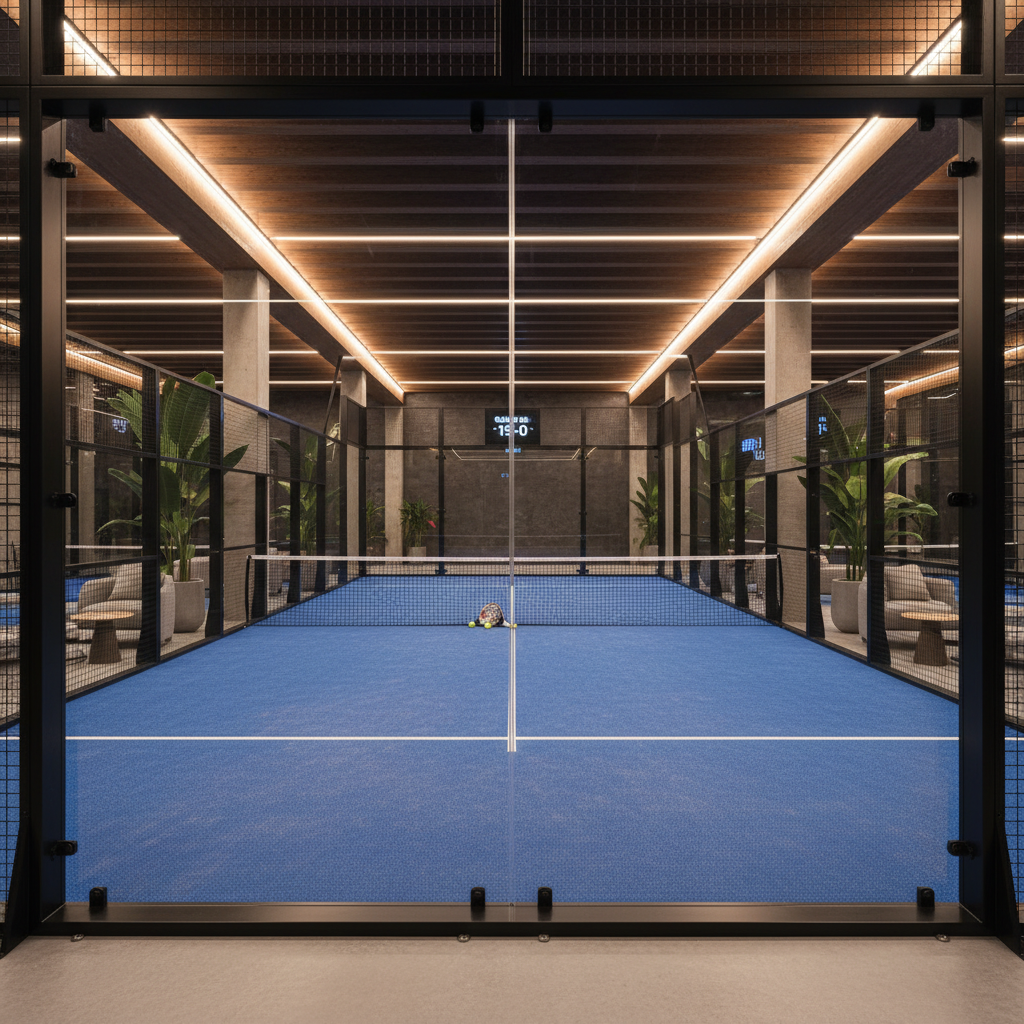
A professional indoor padel court size requires a minimum clear ceiling height of 6 meters, though 8 meters is highly recommended for elite play. If you are building an all-weather facility, a Roofed Padel Court provides the necessary clearance while protecting your investment from the elements. This vertical space is critical for lobs, which are a fundamental tactical element of the sport.
Is 6 meters enough for pro play?
Keep this in mind. While 6 meters is the legal minimum required by the International Padel Federation, it often feels restrictive for high-level competitive athletes. Any ball striking a light fixture or beam at this height results in a lost point.
- FIP Minimum: 6 meters.
- Restriction: High lobs may hit ceiling.
- Compliance: Essential for sanctioned play.
- Clearance: Must be free of all objects.
Should you plan for higher ceilings?
The best part is that moving to an 8-meter height significantly improves the “playability” and marketability of your club to pro players. High ceilings allow for advanced strategic maneuvers and better light distribution throughout the facility.
- Pro Standard: 8 meters.
- Visibility: Better light distribution.
- Strategy: Allows for deeper, higher lobs.
- Future-proofing: Meets upcoming pro standards.
Key Takeaway: While 6m is the regulated minimum, 8m is the industry-standard recommendation for premium indoor facilities.
| Facility Type | Minimum Height | Recommended Height |
|---|---|---|
| Recreational | 6 Meters | 7 Meters |
| Professional | 6 Meters | 8 Meters |
| Tournament | 8 Meters | 9+ Meters |
Expert Analysis Guide: Measure to the lowest hanging obstruction like HVAC ducts or lights, not just the roof peak.
What land is needed for a padel court size?
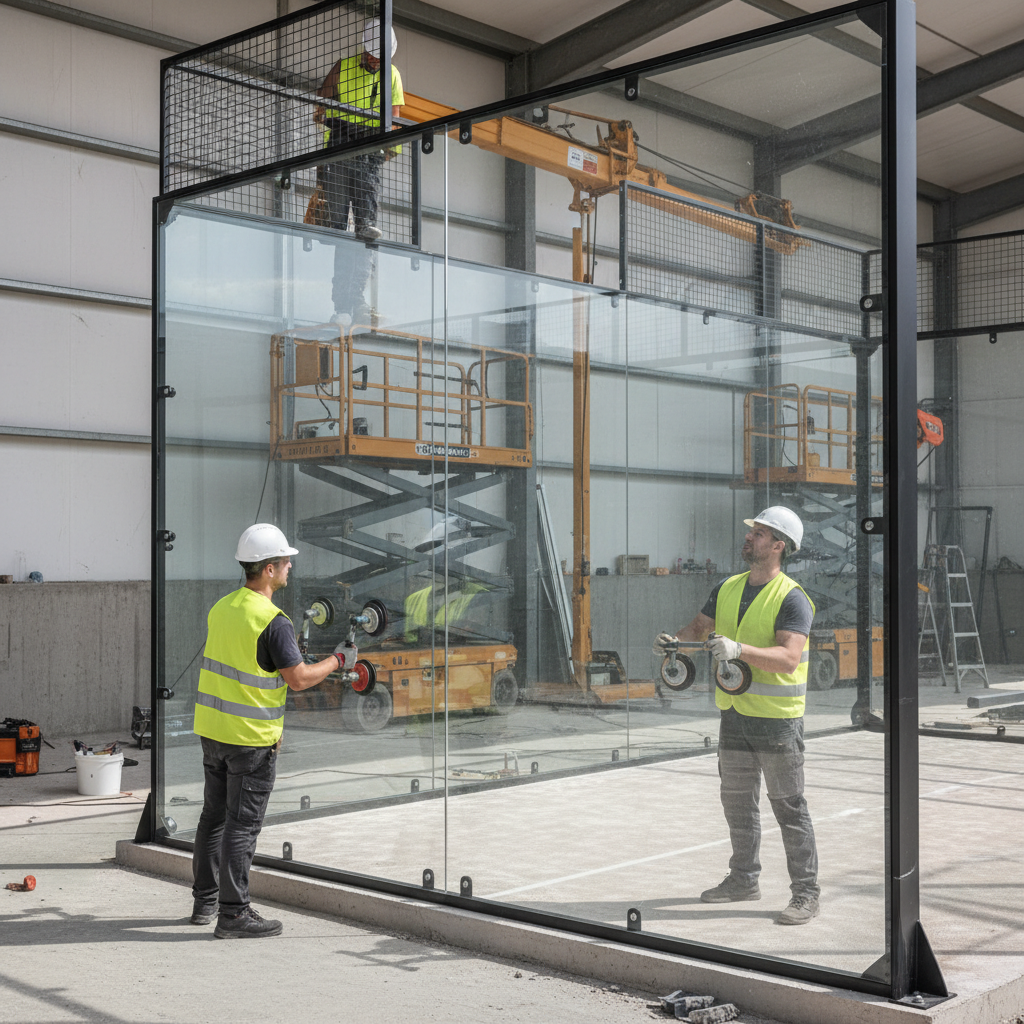
You need a minimum land area of 21 meters by 11 meters to install a standard padel court size with proper safety buffers. This additional space ensures the structural posts have a solid foundation and players can move safely around the perimeter. Without this buffer, you risk structural instability and potential injury during high-intensity matches.
Do you need a safety buffer?
Now, let’s dive deeper. You cannot build right up to the edge of your property line because the structural posts and glass panels require external anchoring. A buffer also prevents players from running into exterior walls or fences during rallies.
- Safety: Prevents perimeter collisions.
- Access: Easy maintenance and cleaning.
- Installation: Room for anchoring bolts.
- Standard: 0.5m minimum buffer.
How big should the concrete slab be?
It gets better. Your concrete slab should ideally extend beyond the court dimensions to provide a solid foundation for the heavy steel pillars. We recommend a slab of at least 20.5m x 10.5m to distribute the structural weight evenly.
- Slab size: 20.5m x 10.5m.
- Thickness: Usually 15cm to 25cm.
- Reinforcement: Mesh-reinforced for glass weight.
- Precision: Must be perfectly level.
Key Takeaway: Total land planning must exceed the 20m x 10m court footprint to account for foundations and safety buffers.
| Component | Minimum Area | Recommended Area |
|---|---|---|
| Internal Play | 20m x 10m | 20m x 10m |
| Concrete Slab | 20.5m x 10.5m | 21m x 11m |
| Total Clear Space | 21m x 11m | 26m x 16m (Outdoor) |
Expert Analysis Guide: Always consult a soil engineer before pouring the slab to prevent the 12mm glass panels from shifting.
What glass heights match the padel court size?
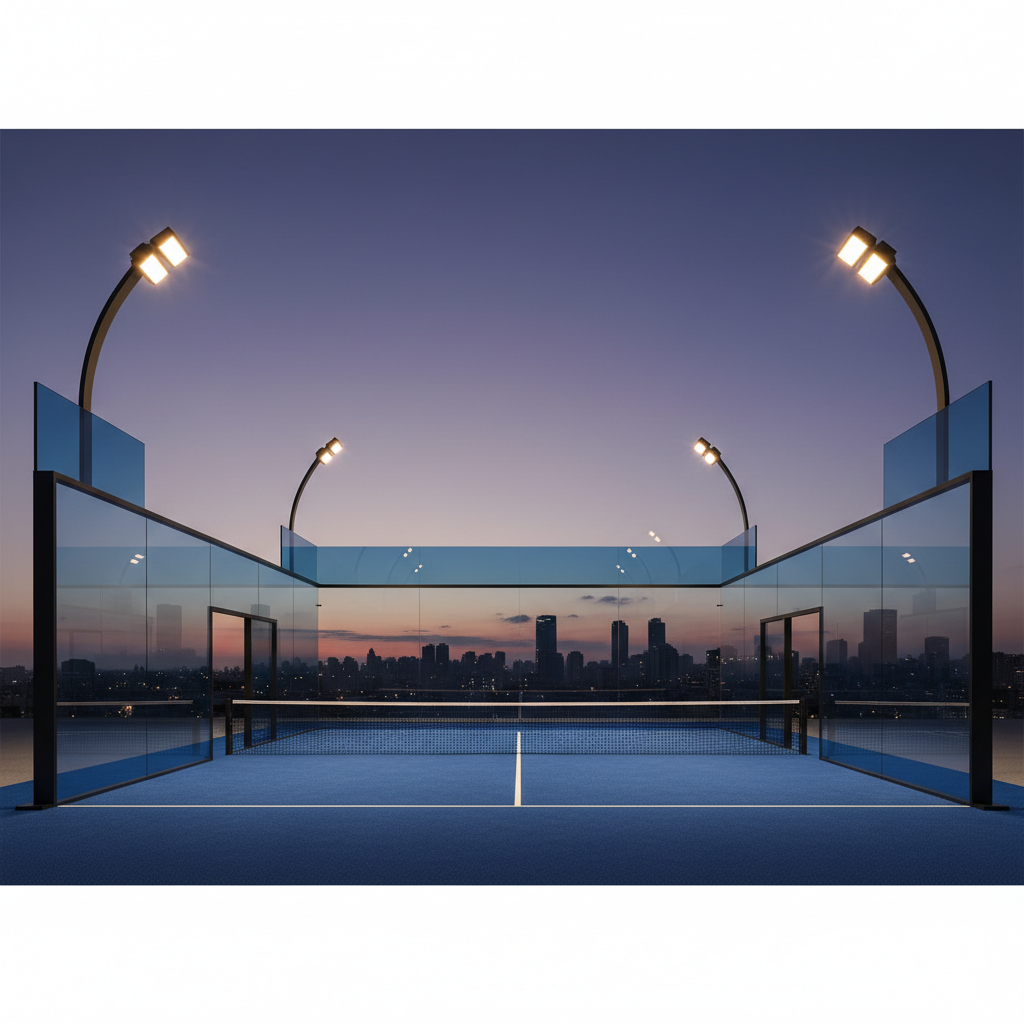
The standard vertical enclosure for a padel court size includes 3-meter-high tempered glass walls at the baselines. To ensure maximum durability and player safety, choosing certified Padel Glass that is 12mm thick is the industry gold standard. These walls are designed to withstand high-velocity ball impacts while providing spectators with a clear view of the action.
How high is the metal mesh?
Case in point. On the back walls, an additional 1 meter of metallic mesh is placed on top of the glass, bringing the total height to 4 meters. This prevents the majority of high-bouncing balls from leaving the playing area during a set.
- Back height: 4 meters total.
- Glass section: Bottom 3 meters.
- Mesh section: Top 1 meter.
- Side transition: Steps down to 2-3 meters.
Is the glass thickness standardized?
You might be wondering. Most professional builds utilize 10mm or 12mm tempered glass to ensure a consistent ball bounce and long-term structural integrity. The 12mm option is preferred for high-traffic commercial clubs where safety is the top priority.
- Standard: 10mm tempered.
- Premium: 12mm tempered.
- Safety: EN12150 certified.
- Mounting: Laser-cut precision holes.
Key Takeaway: Standard enclosures combine a 3m glass base with 1m of mesh to reach a total height of 4m at the baselines.
| Component | Height | Material |
|---|---|---|
| Back Wall (Bottom) | 3 Meters | Tempered Glass |
| Back Wall (Top) | 1 Meter | Metallic Mesh |
| Side Fence | 3 to 4 Meters | Steel Mesh |
| Total Height | 4 Meters | Mixed |
Expert Analysis Guide: Check for EN12150 safety certifications on all glass panels to prevent catastrophic breakage during play.
How do you mark lines on a padel court size?
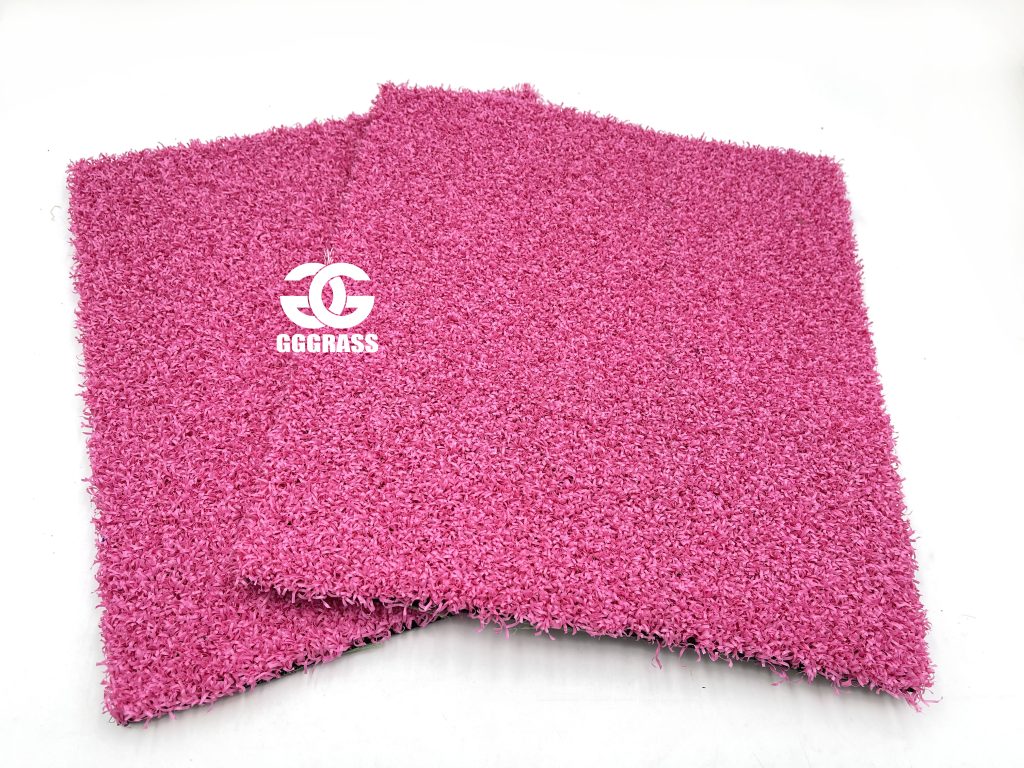
All lines on a standard padel court size must be 5 cm wide and colored to contrast sharply with the synthetic turf. You should use high-quality Padel Grass with integrated lines to ensure they remain stable and visible under heavy foot traffic. The most critical measurement is the service line, which must be placed 6.95 meters from the net on both sides.
Where is the service line located?
Here is the kicker. The service line sits exactly 6.95 meters from the net, which is roughly 3.05 meters away from the back glass wall. This line, along with the central perpendicular line, creates the service boxes where points begin.
- Distance from net: 6.95 meters.
- Distance from back wall: 3.05 meters.
- Line width: 5 centimeters.
- Center line: Perpendicular to net.
What color should the lines be?
Believe it or not. While white is the most common choice, the only actual requirement is that the lines contrast clearly with your chosen turf color. For blue or green courts, white lines provide the best visibility for both players and referees.
- Primary choice: White.
- Secondary choice: Black (for yellow turf).
- Visibility: Must be sharp and clear.
- Application: Integrated into the synthetic grass.
Key Takeaway: Precision line marking, especially the 6.95m service distance, is mandatory for a court to be considered legal for play.
| Line Type | Width | Distance from Net |
|---|---|---|
| Service Line | 5 cm | 6.95 Meters |
| Center Line | 5 cm | Bisects service boxes |
| Boundary Lines | 5 cm | 20m x 10m perimeter |
Expert Analysis Guide: Ensure the white turf lines are tufted into the carpet during manufacturing rather than painted on for longevity.
What safety zones protect the padel court size?
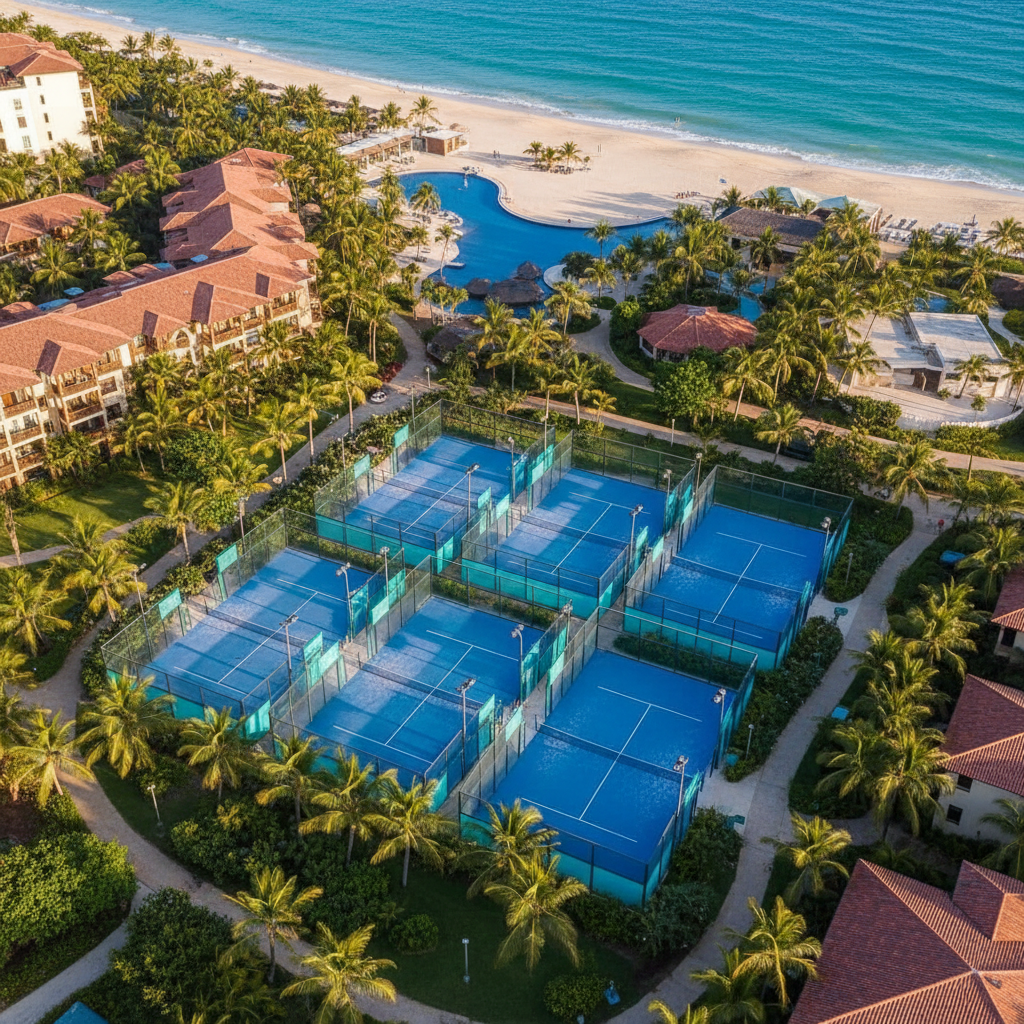
Professional padel court size regulations mandate specific safety zones to allow for “out-of-court” play during tournament matches. If you want to attract high-level players, you should install a Panoramic Padel Court with a clear 2-meter wide zone on both sides of the access doors. This allows athletes to run outside the structure to retrieve balls that have been smashed out over the walls.
Is out-of-court play mandatory?
The reality is. You don’t strictly need these zones for basic recreational clubs, but they are a massive draw for competitive leagues. Pro players are allowed to exit through the side doors to keep a point alive, provided the zone is clear.
- Tournament use: Mandatory.
- Recreational use: Optional but recommended.
- Dimensions: 2m wide x 4m long.
- Clearance height: 3 meters minimum.
How much space between courts is best?
Think about it. If you are installing multiple courts, leaving 4 to 6 meters between them creates a significantly better spectator and player experience. This space allows for comfortable seating, traffic flow, and prevents inter-court noise interference.
- Ideal spacing: 4-6 meters.
- Minimum spacing: 1.5 meters.
- Benefits: Better spectator views.
- Safety: Prevents inter-court interference.
Key Takeaway: Safety zones are not just for protection; they are required for professional certification and out-of-court gameplay.
| Zone Type | Required Width | Required Length |
|---|---|---|
| Standard Buffer | 0.5 Meters | Perimeter |
| Out-of-Court Play | 2.0 Meters | 4.0 Meters |
| Between Courts | 1.5 – 4.0 Meters | Full Side |
Expert Analysis Guide: Verify that your site plan includes a 3-meter height clearance for any “out-of-court” safety zones.
Is tennis bigger than a padel court size?

A standard doubles tennis court is significantly larger than a padel court size, requiring roughly 25% more land area for the playing surface alone. Because padel is more compact, you can often optimize your facility by replacing one underused tennis court with two padel units. This density allows you to accommodate more players in the same footprint, increasing your potential revenue.
Can you fit more courts in?
Here is a secret. You can typically fit three padel courts into the space required for just two tennis courts, including all safety buffers. This efficiency allows club owners to triple their hourly revenue by hosting 12 players instead of 4 or 8.
- Efficiency: 3 padel = 2 tennis.
- Player density: More players per sqm.
- Revenue: Higher profit potential.
- Conversion: Ideal for aging tennis clubs.
Why is padel more space-efficient?
The bottom line is that padel doesn’t require the massive “out” zones that tennis does because the walls are active parts of the game. In tennis, a ball is dead once it passes the lines, requiring huge run-back areas that padel avoids.
- No out-zones: Walls contain the ball.
- Compact play: Faster, closer action.
- Structural play: Rebounds keep ball in.
- Footprint: 200 sqm vs 260+ sqm.
Key Takeaway: Padel’s compact design offers superior land-use efficiency, allowing for more players and higher revenue per square meter.
| Sport | Length | Width | Total Play Area |
|---|---|---|---|
| Padel | 20 Meters | 10 Meters | 200 Sqm |
| Tennis | 23.77 Meters | 10.97 Meters | 260.7 Sqm |
| Padel (Buffer) | 21 Meters | 11 Meters | 231 Sqm |
Expert Analysis Guide: Calculate your ROI based on player density; 4 players per 200sqm makes padel the most profitable racket sport.
What lighting works for this padel court size?
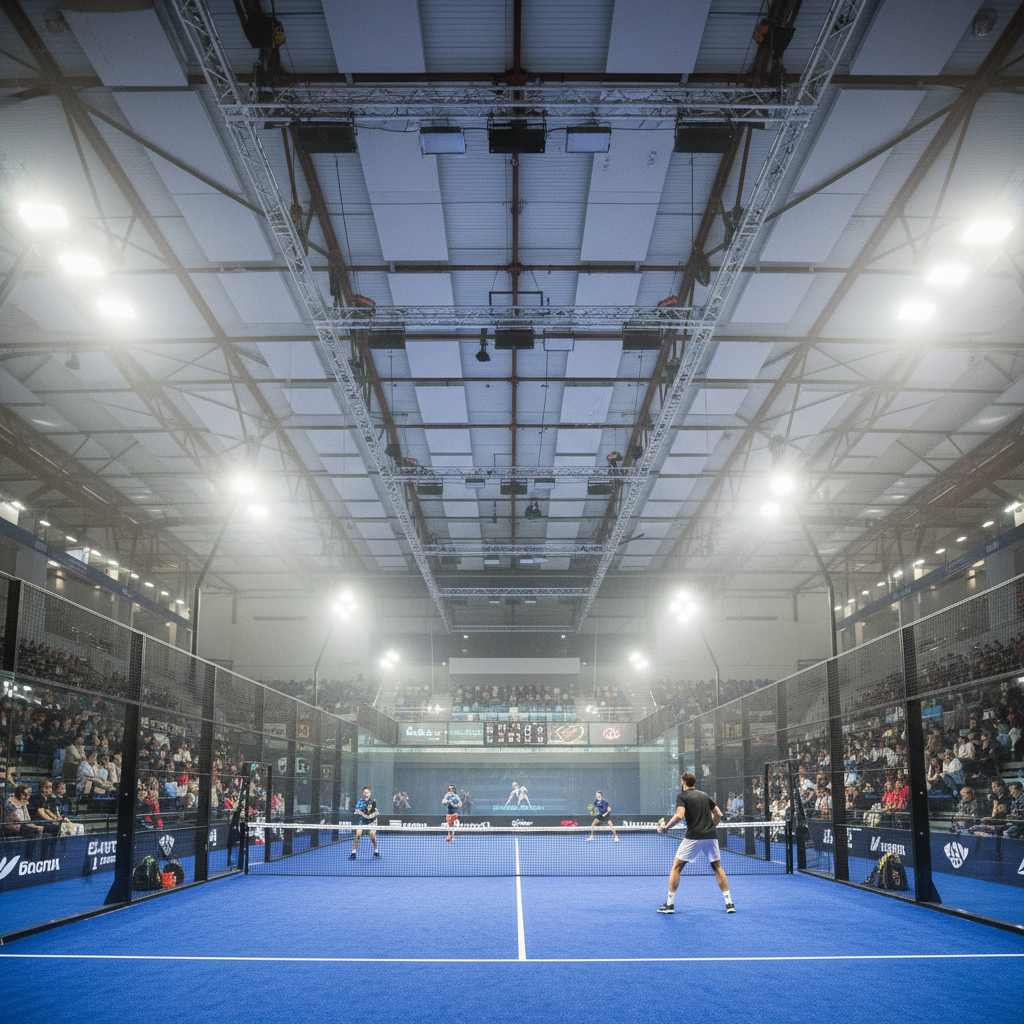
Proper padel court size lighting requires 8 LED floodlights mounted on 4 poles to ensure uniform brightness across the entire playing surface. You should invest in specialized Padel LED Lighting that includes anti-glare lenses to protect players from temporary blindness during high lobs. Amateur play typically requires 300 lux, while televised professional matches need 750 lux or more.
How many poles do you need?
You might be wondering. Most standard installations use four poles placed at the corners of the court, typically standing 6 meters high. For professional venues, we recommend 8-meter poles to widen the light spread and reduce harsh shadows during evening play.
- Standard: 4 poles.
- Placement: Corners or side-center.
- Standard height: 6 meters.
- Pro height: 8 meters.
Is anti-glare technology necessary?
Keep this in mind. You absolutely need anti-glare lenses because players are constantly looking upward to track high-flying lobs against the night sky. Without this technology, the bright floodlights can lead to missed shots and potential safety hazards for athletes.
- Safety: Prevents temporary blindness.
- Performance: Better tracking of lobs.
- Efficiency: Lower power consumption.
- Lifespan: 50,000+ hours.
Key Takeaway: High-quality LED lighting with anti-glare lenses is essential for both player performance and televised event quality.
| Level of Play | Required Lux | Pole Height |
|---|---|---|
| Recreational | 200 – 300 Lux | 6 Meters |
| Competitive | 500 Lux | 6-8 Meters |
| Professional/TV | 750+ Lux | 8+ Meters |
Expert Analysis Guide: Use a lux meter to check for “dark spots” near the net and baselines to ensure uniform light distribution.
How to start building a padel court size?
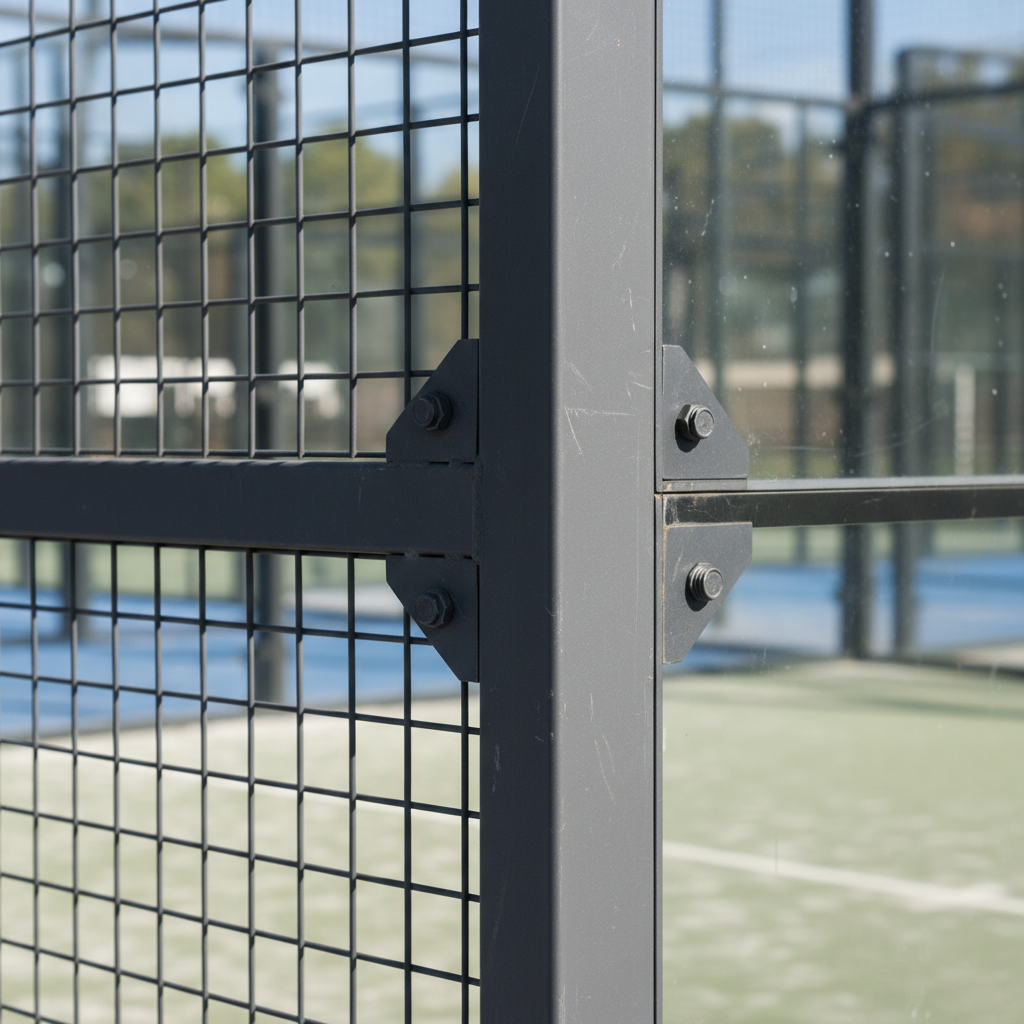
Building a professional facility starts with a detailed site assessment and securing permits for your specific padel court size. It is crucial to build professional courts that meet Padel USA standards to ensure your club is eligible for tournaments. Once you have the permits, you must pour a reinforced concrete foundation to support the weight of the glass and steel structure.
Do you need planning permission?
Here is the deal. In almost every jurisdiction, a padel court is considered a permanent structure because of its concrete slab and tall enclosures. You will likely need permits for civil works and floodlighting to comply with local noise and light pollution laws.
- Legal: Secure local permits first.
- Zoning: Check commercial vs residential.
- Environment: Light and noise impact.
- Safety: Adherence to building codes.
What is the first construction step?
The bottom line is that you must start with a professional soil stability test before pouring any concrete. If the ground shifts under the massive weight of the 12mm glass walls, the panels can shatter, leading to expensive and dangerous repairs.
- Step 1: Soil stability test.
- Step 2: Reinforced concrete slab.
- Step 3: Steel structure assembly.
- Step 4: Glass and turf installation.
Key Takeaway: Professional construction begins with a rock-solid foundation and full compliance with local building and zoning regulations.
| Construction Phase | Key Task | Estimated Time |
|---|---|---|
| Planning | Permits & Soil Test | 4-8 Weeks |
| Foundation | Concrete Slab Pour | 1-2 Weeks |
| Structure | Steel & Glass Install | 7-10 Days |
| Finishing | Turf & Lighting | 3-5 Days |
Expert Analysis Guide: Factor in a 28-day curing time for the concrete slab before anchoring the steel pillars for maximum stability.
Building a world-class padel facility is a strategic investment that requires surgical precision in every dimension. At Superb Padel, we don’t just supply equipment; we provide the engineering excellence and factory-direct reliability needed to transform your vision into a high-performance reality. Whether you are launching a boutique urban club or a massive professional complex, we are committed to delivering the safest, most durable courts in the industry. Let us help you dominate the fastest-growing racket sport on the planet—contact us today to start your project.
FAQ
Can I build a padel court in my backyard?
Yes, provided you have at least 21m x 11m of flat space and local zoning permits for permanent structures and lighting.
What’s the best surface material for this size?
Textured monofilament synthetic turf is the industry standard because it offers superior grip, consistent ball bounce, and excellent drainage.
How long does it take to construct a court?
Once the concrete foundation has fully cured, the actual assembly of the steel structure, glass, and turf usually takes 7 to 10 days.
Is planning permission required for these dimensions?
Yes, in most cases, you will need a permit because the court involves a permanent concrete foundation and high-standing enclosures.
How do I know if my indoor ceiling is high enough?
Measure from the floor to the lowest hanging object; if it is under 6 meters, your court is non-compliant for official play.