Most investors and facility managers struggle when translating international sports regulations into local construction realities. You are likely staring at a set of metric blueprints from the International Padel Federation (FIP) and wondering how these numbers translate to your specific site requirements in the US or UK. A simple conversion error during the foundation pouring stage leads to disastrous compliance failures and expensive retrofitting later. This is where things go wrong for many builders.
But here is the good news…
We have calculated every millimeter of the official specifications to provide you with a definitive imperial guide. By adhering to these precise measurements, you guarantee a facility that meets global competition standards and maximizes player safety. You can build with absolute confidence knowing your layout aligns with our Standard Padel Court specifications.
- What are the official FIP dimensions and tolerances for a standard padel court?
- How much total surface area and perimeter clearance is required for installation?
- What are the specific height regulations for glass walls and metallic fencing?
- How do net height specifications differ between the center and the anchor posts?
- What are the critical safety distances required when installing adjacent courts?
- How does the space efficiency of a padel court compare to a tennis court?
- What are the structural advantages of using fiberglass for court construction?
- How does the hot-dip galvanization process enhance the longevity of iron courts?
- What is the expected lifespan and maintenance schedule for a professional court?
- How do environmental factors influence the choice between iron and fiberglass structures?
1. What are the official FIP dimensions and tolerances for a standard padel court?
The devil is in the details.
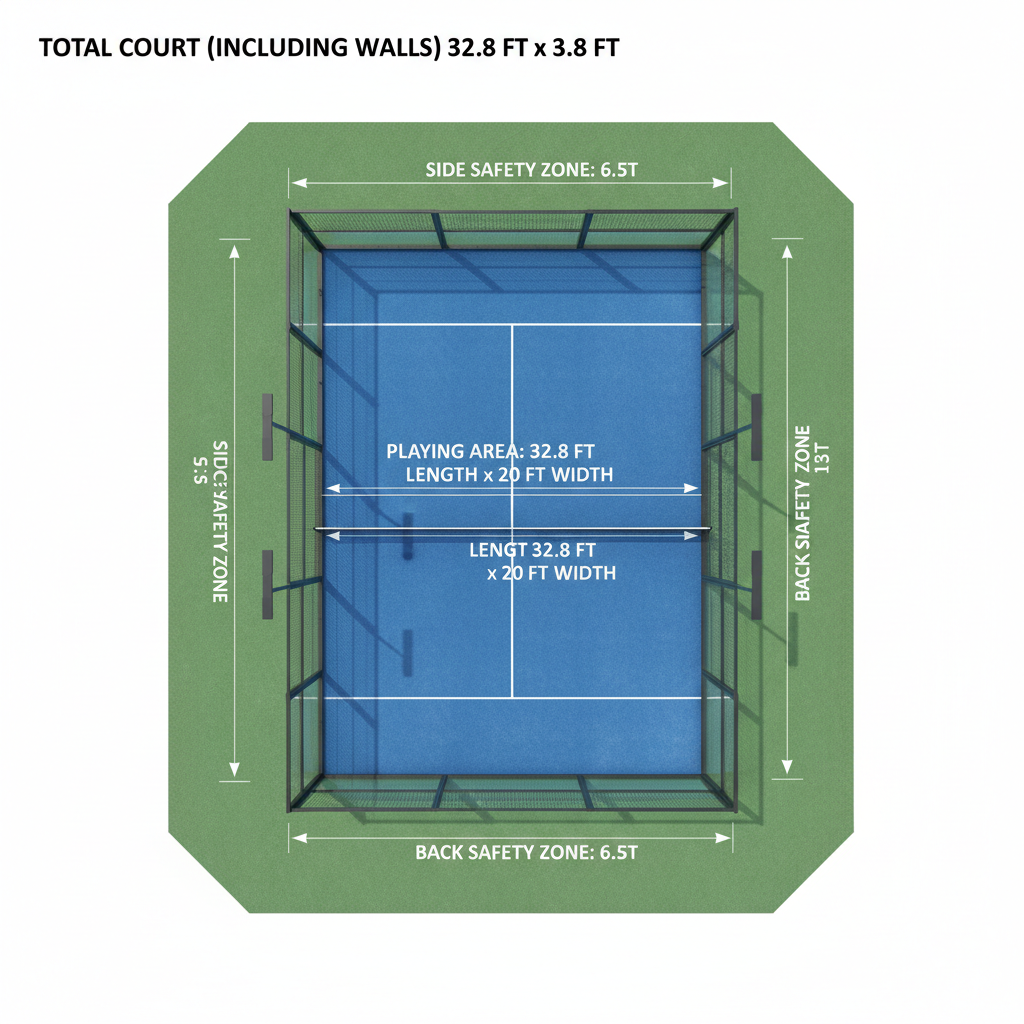
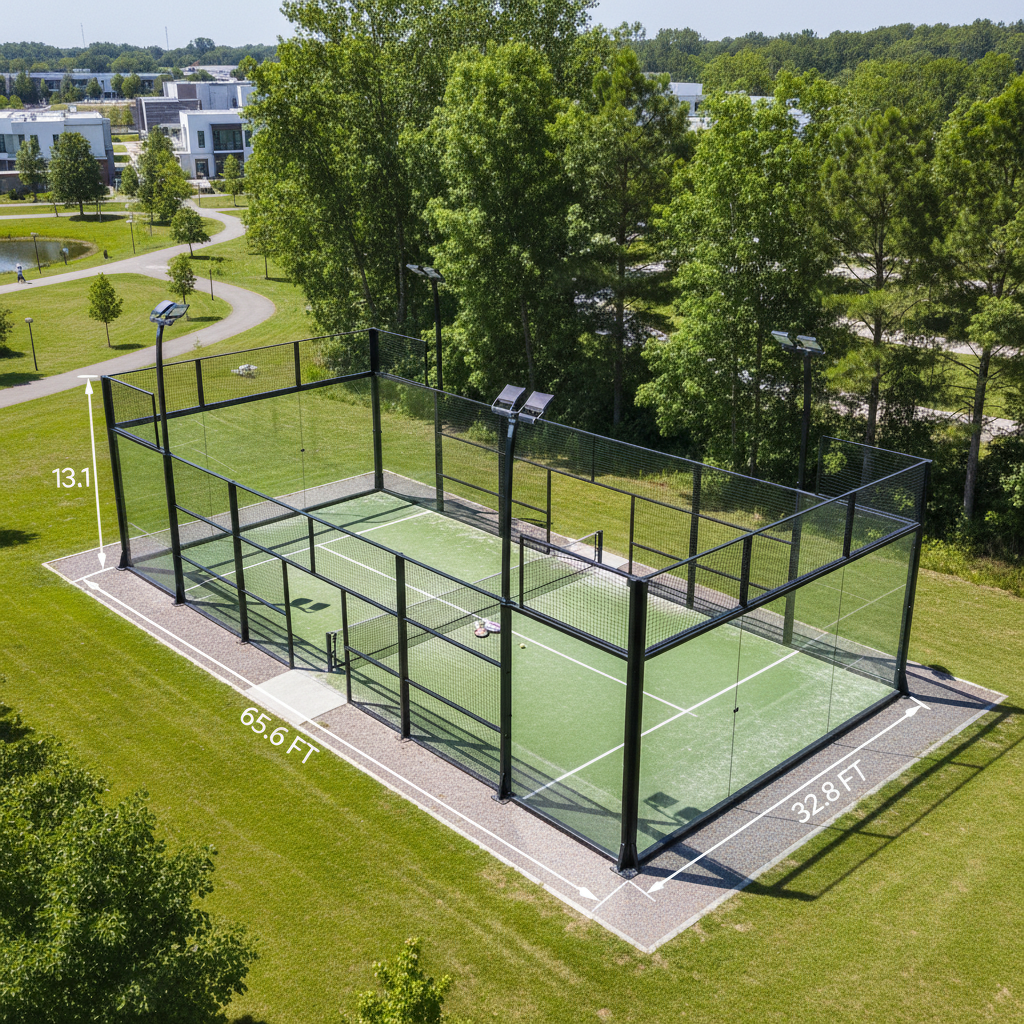
According to the strict regulations set by the International Padel Federation (FIP), the internal playing area of a standard doubles court must form a perfect rectangle. While the metric standard is exactly 20 meters by 10 meters, the conversion for your construction team is 65 feet 7 inches in length by 32 feet 10 inches in width. It is vital to note that FIP regulations allow for a strict tolerance of only 0.5% on these measurements.
You might be wondering about the markings.
The service lines are equally critical for regulation play and must be painted exactly 22 feet 9 inches (6.95 meters) from the net. Additionally, the central service line divides the area between the net and the service line into two equal zones and must extend 8 inches (20 cm) beyond the service line. Getting these internal dimensions right is the first step toward FIP certification.
Internal Dimensions Data
| Component | Metric | Imperial (Precise) | Construction Note |
|---|---|---|---|
| Length | 20.00 m | 65′ 7 ⅜” | Internal face to internal face |
| Width | 10.00 m | 32′ 9 ¾” | Internal face to internal face |
| Service Line | 6.95 m | 22′ 9 ½” | Distance from net |
| Tolerance | ±0.5% | ±4 inches | Strict adherence required |
Strict adherence to the 65′ 7″ length prevents “short” courts that ruin ball trajectory dynamics.
Key Takeaway
Precision is the bedrock of a compliant facility; a deviation greater than 4 inches violates FIP standards and compromises the validity of any match played on your court.
2. How much total surface area and perimeter clearance is required for installation?
Do not make this common mistake.
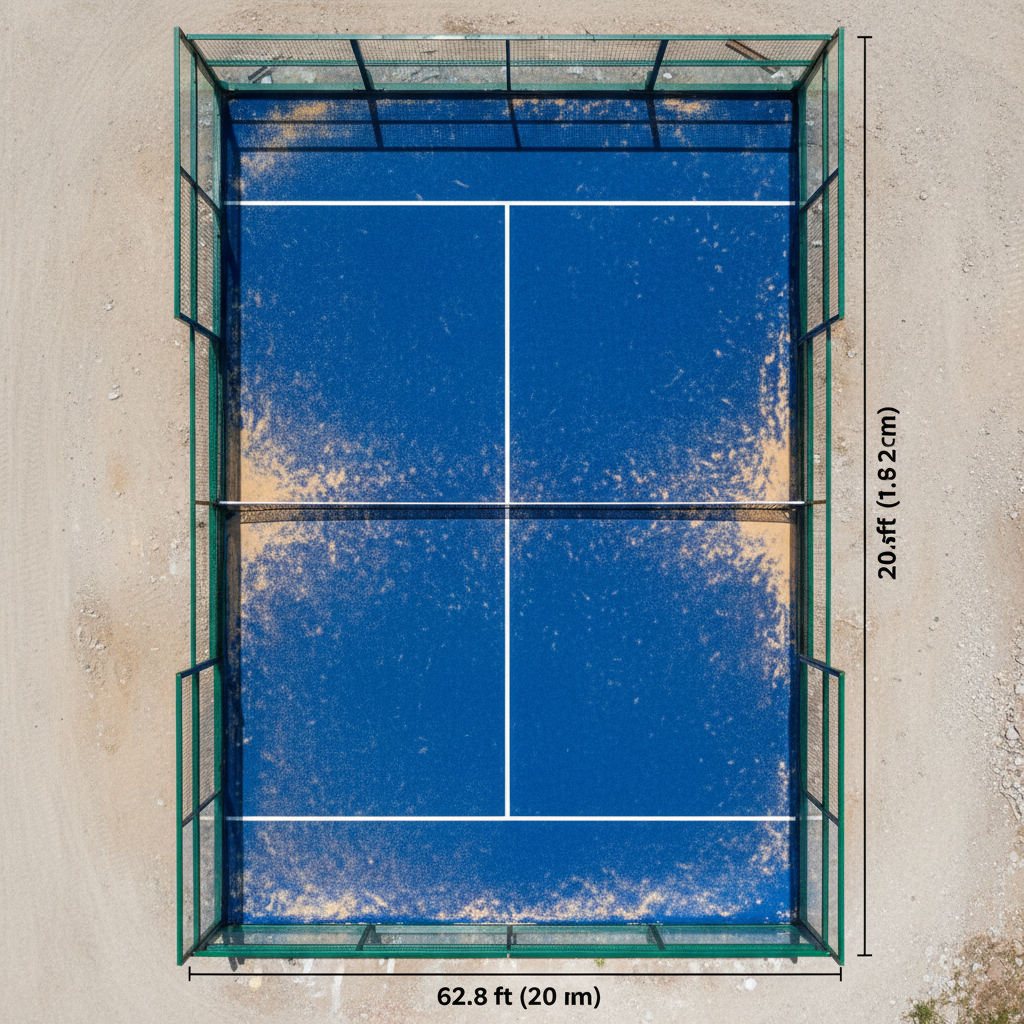
Focusing solely on the internal playing dimensions is a recipe for logistical failure because the court requires a larger footprint for stability. The total installation footprint for a single court typically covers an area of 75 feet 6 inches by 42 feet 8 inches (23 meters by 13 meters). This extra space accounts for the necessary run-off zones and ensures your galvanized Padel Structure is anchored correctly.
Here is why this matters.
For professional tournaments where “out-of-court” play is permitted, you must provide a safety zone that is at least 6 feet 7 inches (2 meters) wide and 13 feet 1 inch (4 meters) long on each side. These zones must be kept free of any obstacles to prevent injury when players run out the door to retrieve a ball. Even for recreational clubs, we strongly recommend leaving a minimum of 4 to 5 feet between courts to allow for maintenance access.
Installation Footprint Analysis
| Component | Dimensions (Metric) | Dimensions (Imperial) | Area (sq ft) |
|---|---|---|---|
| Playing Area | 20m x 10m | 65′ 7″ x 32′ 10″ | ~2,153 |
| Total Footprint | 23m x 13m | 75′ 6″ x 42′ 8″ | ~3,220 |
| Safety Zone | 2m x 4m | 6′ 7″ x 13′ 1″ | ~86 (per side) |
Planning for a 3,220 sq ft footprint per court prevents dangerous cramping and allows for future tournament hosting.
Key Takeaway
Always design your site plan using the 75.5′ x 42.6′ footprint, not just the playing dimensions, to ensure safety compliance and operational viability.
3. What are the specific height regulations for glass walls and metallic fencing?
This specification defines the game.
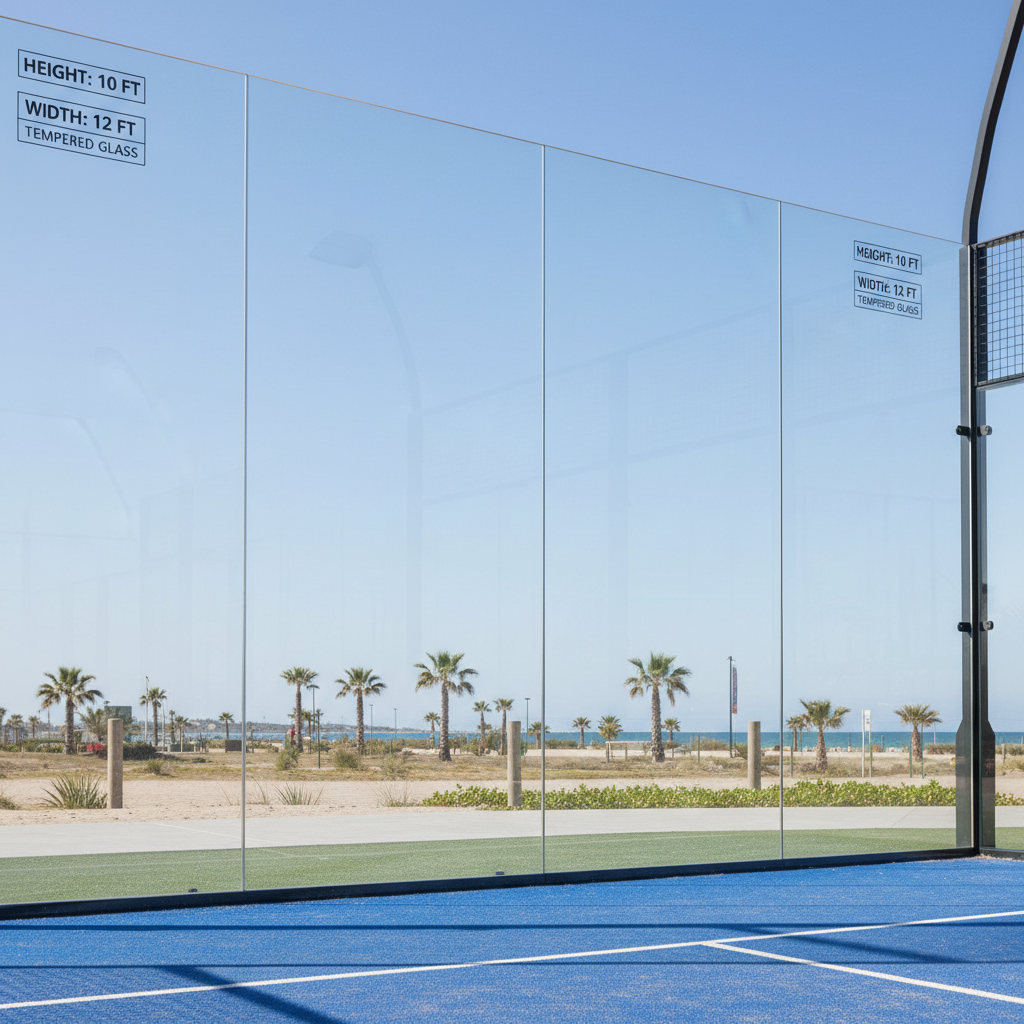
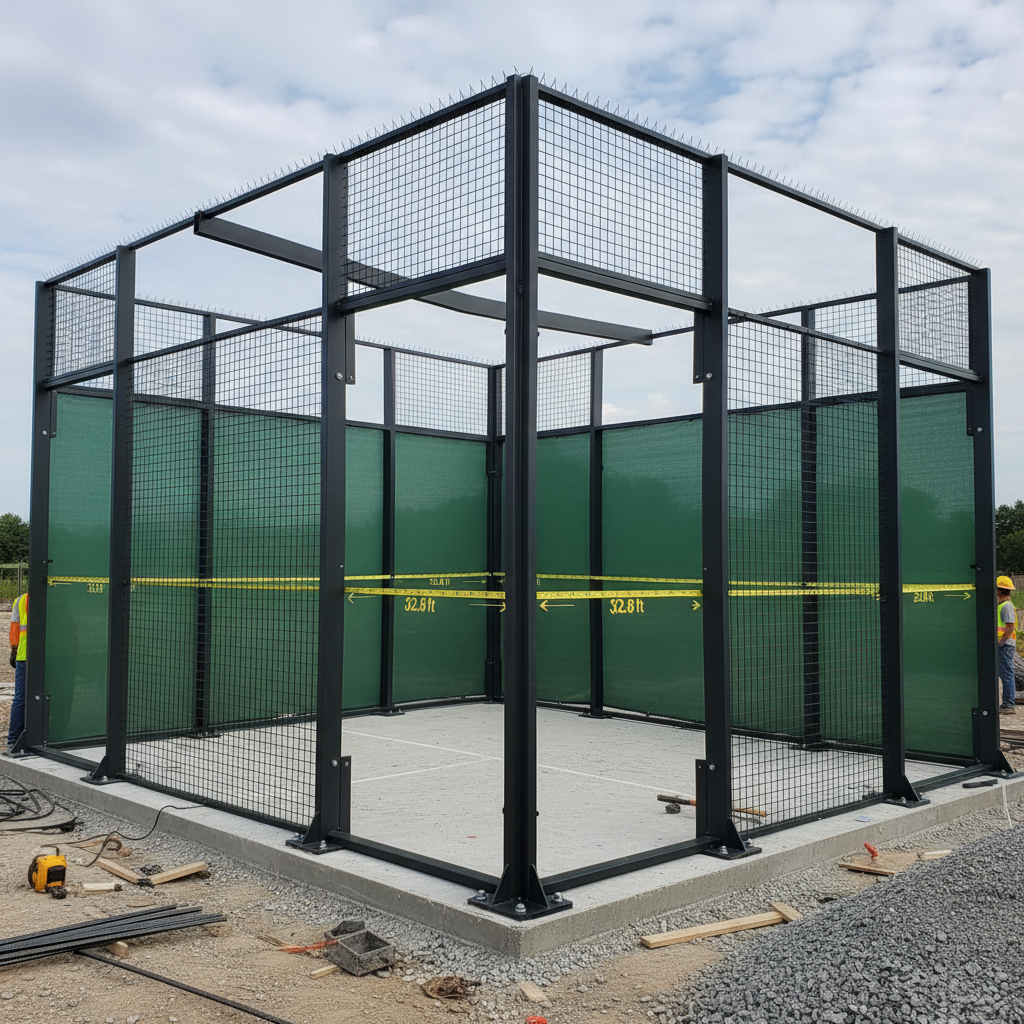
The vertical enclosure is a hybrid of solid rebound walls and metallic mesh, and getting the heights correct is non-negotiable. The back walls must stand exactly 13 feet 1 inch (4 meters) high. This comprises a bottom solid section—usually made of tempered glass—that is 9 feet 10 inches (3 meters) high, topped by a 3-foot 3-inch (1 meter) metallic mesh panel.
Now, pay attention to the sides.
The side walls are more complex because they typically feature a “stepped” design. The first 6 feet 7 inches (2 meters) from the back corner must maintain the 13-foot height, but the wall then steps down. The next section drops to a total height of 9 feet 10 inches (3 meters). Failure to align the glass and mesh transitions perfectly results in “dead spots” where the ball bounces unpredictably.
Wall Height Configuration
| Wall Section | Height (Metric) | Height (Imperial) | Composition |
|---|---|---|---|
| Back Wall | 4.0 m | 13′ 1″ | 3m Glass + 1m Mesh |
| Side Step 1 | 4.0 m | 13′ 1″ | 3m Glass + 1m Mesh |
| Side Step 2 | 3.0 m | 9′ 10″ | 2m Glass + 1m Mesh |
The stepped side wall design is critical for allowing spectator visibility while maintaining ball containment dynamics.
Key Takeaway
The transition from 13 feet to 10 feet along the side wall must be precise to ensure consistent rebounds and avoid “dead spots” that frustrate players.
4. How do net height specifications differ between the center and the anchor posts?
Precision is absolutely mandatory here.
The net is the central dividing line of the court, but it is not a uniform height from post to post. According to FIP rules, the net must measure 2 feet 10.6 inches (0.88 meters) exactly at the center strap. However, it must rise slightly to 3 feet 0.2 inches (0.92 meters) at the lateral posts where it is anchored.
Why is this tolerance so strict?
A net that is too low gives a significant advantage to the serving team, while a net that is too high creates an unfair barrier. If you are designing a Roofed Padel Court, you must ensure the structural posts for the roof do not interfere with the net post positioning. The tension cable inside the net must be strong enough to maintain this subtle curve without sagging.
Net Dimensions Data
| Location | Height (Metric) | Height (Imperial) | Tolerance |
|---|---|---|---|
| Center | 0.88 m | 2′ 10 ⅝” | ± 0.2 inches |
| Posts | 0.92 m | 3′ 0 ¼” | ± 0.2 inches |
| Post Max | 1.05 m | 3′ 5 ⅜” | Max limit |
A variance of less than half an inch in net height can fundamentally alter the competitive fairness of the court.
Key Takeaway
Regularly check your net tension to maintain the critical 0.88m center height, as sagging nets are the most common compliance failure in daily club operations.
5. What are the critical safety distances required when installing adjacent courts?
Don’t cram them together.
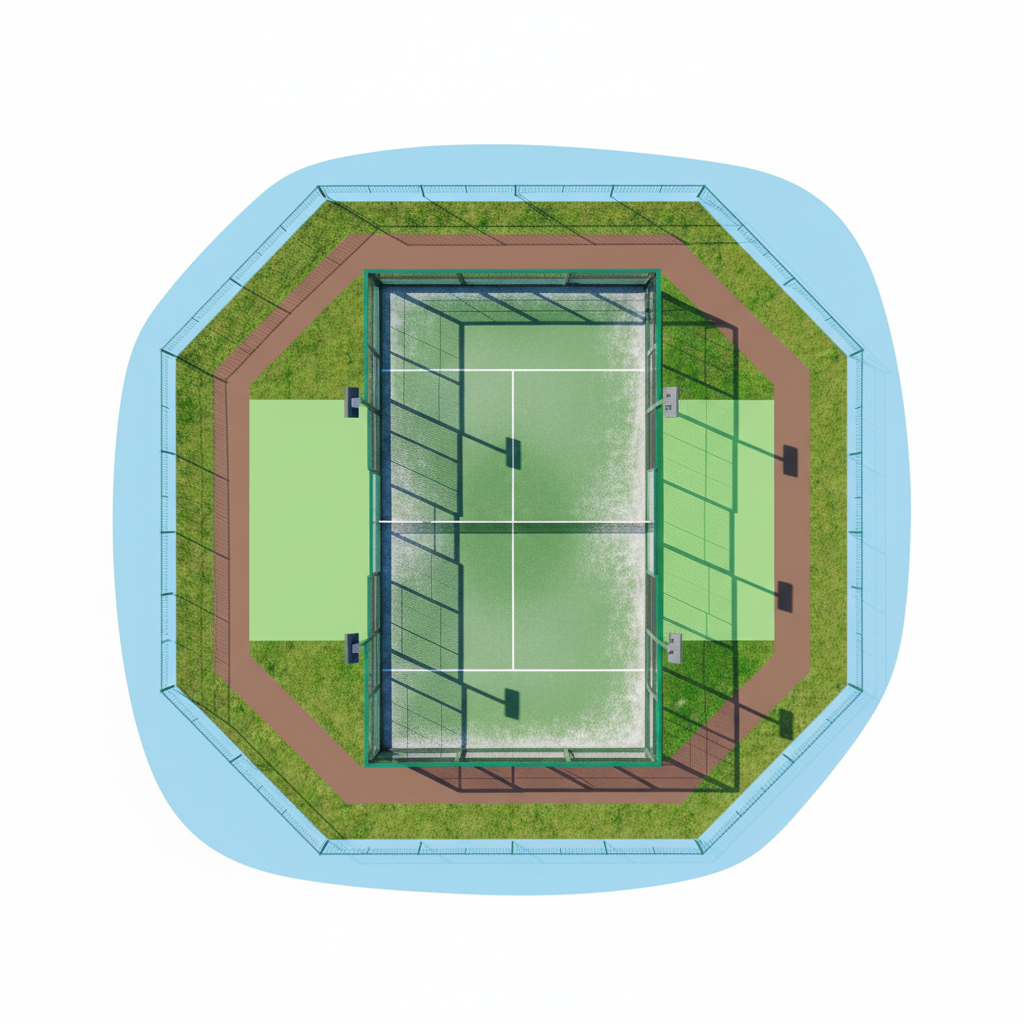
Installing adjacent courts requires a minimum separation distance of 4 meters (13 feet 1 inch) between side walls to be considered safe for high-level play. This space allows players to exit the court safely for run-off plays without colliding with the neighboring structure. While recreational clubs might squeeze this down, it creates a claustrophobic environment.
Consider the player experience.
Sufficient spacing facilitates essential maintenance access for glass replacement and cleaning. It also provides a better spectator experience by allowing walkways between matches. If you reduce this distance, you effectively ban any “out-of-court” play, which limits the level of tournaments you can host.
Separation Guidelines
| Scenario | Min Distance (Metric) | Min Distance (Imperial) | Purpose |
|---|---|---|---|
| Side-by-Side | 4.0 m | 13′ 1″ | Run-off play |
| End-to-End | 2.0 m | 6′ 7″ | Spectator flow |
| Indoor Height | 6.0 m | 19′ 8″ | Overhead clearance |
Proper spacing reduces liability risks and significantly enhances the premium feel of the club environment.
Key Takeaway
Sacrificing safety zones to fit more courts is a false economy; maintain the 13-foot gap to allow for professional play and safe maintenance access.
6. How does the space efficiency of a padel court compare to a tennis court?

Here is the revenue math.
A single tennis court footprint accommodates roughly three standard padel courts, effectively tripling your player capacity per square foot. When you install Padel Glass, the vertical walls contain the game, eliminating the massive run-back areas required for tennis. This density makes padel an incredibly efficient revenue generator for clubs with limited land.
Think about the occupancy.
Replacing one tennis court with three padel courts increases potential hourly revenue by 300% assuming full occupancy. Padel matches typically involve four players, meaning twelve customers occupy the space formerly used by two or four tennis players. This efficiency is the primary driver behind the rapid conversion of tennis facilities worldwide.
Efficiency Comparison
| Feature | Tennis Court | Padel Court | Ratio |
|---|---|---|---|
| Length | 78 ft | 65 ft 7 in | ~0.84 |
| Width | 36 ft | 32 ft 10 in | ~0.91 |
| Total Area | ~7,200 sq ft | ~2,153 sq ft | ~3.3 : 1 |
Converting tennis space to padel offers a 3:1 land-use advantage that dramatically boosts club profitability.
Key Takeaway
Padel’s compact footprint allows you to maximize the commercial potential of your real estate, turning a single tennis court into a bustling hub for twelve players.
7. What are the structural advantages of using fiberglass for court construction?
Rust is your primary enemy.
Fiberglass structures offer complete immunity to rust, making them the superior choice for coastal locations where salt air aggressively corrodes steel. Unlike iron, fiberglass does not require galvanization or constant repainting to maintain its structural integrity. It acts as a “install and forget” solution for harsh environments.
It feels different too.
These frames absorb shock better than rigid iron, effectively reducing the noise generated when bodies or balls impact the walls. This acoustic dampening is a massive benefit for residential clubs where noise complaints can be an issue. Additionally, fiberglass provides electrical insulation, adding a layer of safety during storms.
Material Analysis
| Feature | Fiberglass | Galvanized Iron | Advantage |
|---|---|---|---|
| Corrosion | Immune | Resistant | Fiberglass |
| Maintenance | Low | Medium | Fiberglass |
| Impact Noise | Low | High | Fiberglass |
| Rigidity | High | Very High | Iron |
Fiberglass trades extreme rigidity for superior longevity and lower maintenance in corrosive coastal environments.
Key Takeaway
If your project is near the ocean, fiberglass structures eliminate the risk of corrosion, saving you thousands in maintenance and painting costs over the court’s lifespan.
8. How does the hot-dip galvanization process enhance the longevity of iron courts?
Iron needs armor.
Iron structures obtain longevity through a rigorous hot-dip galvanization process followed by a heat-cured powder coating. This is especially critical for a Panoramic Padel Court, which relies on high-strength steel to support heavy glass panels without rear corner posts. The zinc coating acts as a sacrificial anode, corroding before the steel beneath it.
Here is the secret.
When combined with polyester powder paint, this system withstands extreme weather conditions including heavy rain and intense sun. High-quality iron courts resist deformation from wind loads that might warp lighter materials. This metallurgical bond prevents rust from forming even if the surface paint gets scratched during play.
Galvanization Benefits
| Layer | Function | Durability Impact |
|---|---|---|
| Steel Core | Structural rigidity | High load bearing |
| Zinc Coat | Chemical rust barrier | Prevents oxidation |
| Powder Paint | Physical & UV barrier | Aesthetics & seal |
Double-layered protection ensures the structure can withstand outdoor elements for over 20 years.
Key Takeaway
Never settle for simple painted steel; insist on hot-dip galvanization to ensure your iron structure remains rust-free and structurally sound for decades.
9. What is the expected lifespan and maintenance schedule for a professional court?
Plan for the long game.
A professionally installed court typically lasts 10 to 20 years depending on environmental exposure and usage intensity. However, the artificial turf will wear out faster, typically requiring replacement every 5 to 7 years. Regular maintenance involves inspecting glass gaskets, tightening structural bolts, and redistributing sand on the turf.
Routine saves money.
Artificial turf requires brushing every two weeks to keep the silica sand loose and prevent compaction. Glass panels need cleaning weekly to ensure visibility and prevent neoprene gaskets from drying out. Neglecting these small tasks leads to premature turf wear and potential glass breakage risks.
Maintenance Timeline
| Frequency | Task | Purpose |
|---|---|---|
| Weekly | Clean glass | Visibility & Safety |
| Bi-Weekly | Brush turf | Even sand distribution |
| Annually | Check torque | Structural integrity |
Proactive maintenance prevents minor issues from becoming expensive structural failures.
Key Takeaway
While the structure lasts decades, budgeting for turf replacement every 5-7 years is essential for maintaining a premium playing experience.
10. How do environmental factors influence the choice between iron and fiberglass structures?
Match the material to the climate.
High-humidity or coastal areas strongly favor fiberglass to avoid rapid oxidation of metal components. Conversely, regions prone to tornadoes or extremely high winds benefit from the superior weight and rigidity of iron. Assessing your local weather patterns is the first step in material selection.
Indoor vs. Outdoor strategy.
Indoor facilities face fewer environmental stressors, allowing for lighter aesthetic designs using standard iron. Outdoor courts must withstand UV exposure, rain, and temperature fluctuations. Iron structures in wet climates require frequent inspection for rust spots, whereas fiberglass offers peace of mind in damp conditions.
Selection Matrix
| Environment | Recommended Material | Reason |
|---|---|---|
| Coastal | Fiberglass | Salt resistance |
| High Wind | Galvanized Iron | Structural weight |
| Indoor | Iron / Panoramic | Aesthetic focus |
Selecting the wrong material for your climate will double your maintenance workload and shorten the facility’s lifespan.
Key Takeaway
Choose fiberglass for coastal resilience and galvanized iron for structural rigidity in high-wind zones to ensure your court survives its local environment.
Conclusion
Summary
Building a padel court requires navigating strict metric-to-imperial conversions where accuracy is the foundation of success. From the mandatory 65′ 7″ length to the critical 13′ 1″ wall height, every inch matters for FIP compliance. Whether you choose the rigidity of iron or the resilience of fiberglass, ensuring your foundation and glass specs meet these standards is non-negotiable.
Key Takeaway
Investing in precise layouts and high-quality materials prevents costly retrofitting and liability issues down the road. Your facility’s reputation depends on providing a standard playing experience that players trust.
Ready to build?
Do not leave your project to chance. Verify your layout against professional blueprints. For expert guidance on materials and precise installation, contact us today and let us help you build a world-class facility.
Frequently Asked Questions (FAQ)
Q1: Can I fit a padel court in a space smaller than 65 feet 7 inches long?
No. The FIP regulations for the internal playing area are strict. Shortening the court would violate the rules of the game, alter ball trajectory, and make the facility ineligible for official matches.
Q2: Is it mandatory to use 12mm glass, or can I use 10mm?
Yes, you can use 10mm glass for standard installations. However, 12mm glass is highly recommended for panoramic courts or outdoor areas with wind load for added safety and better rebound consistency.
Q3: Can I install a padel court on an existing tennis court?
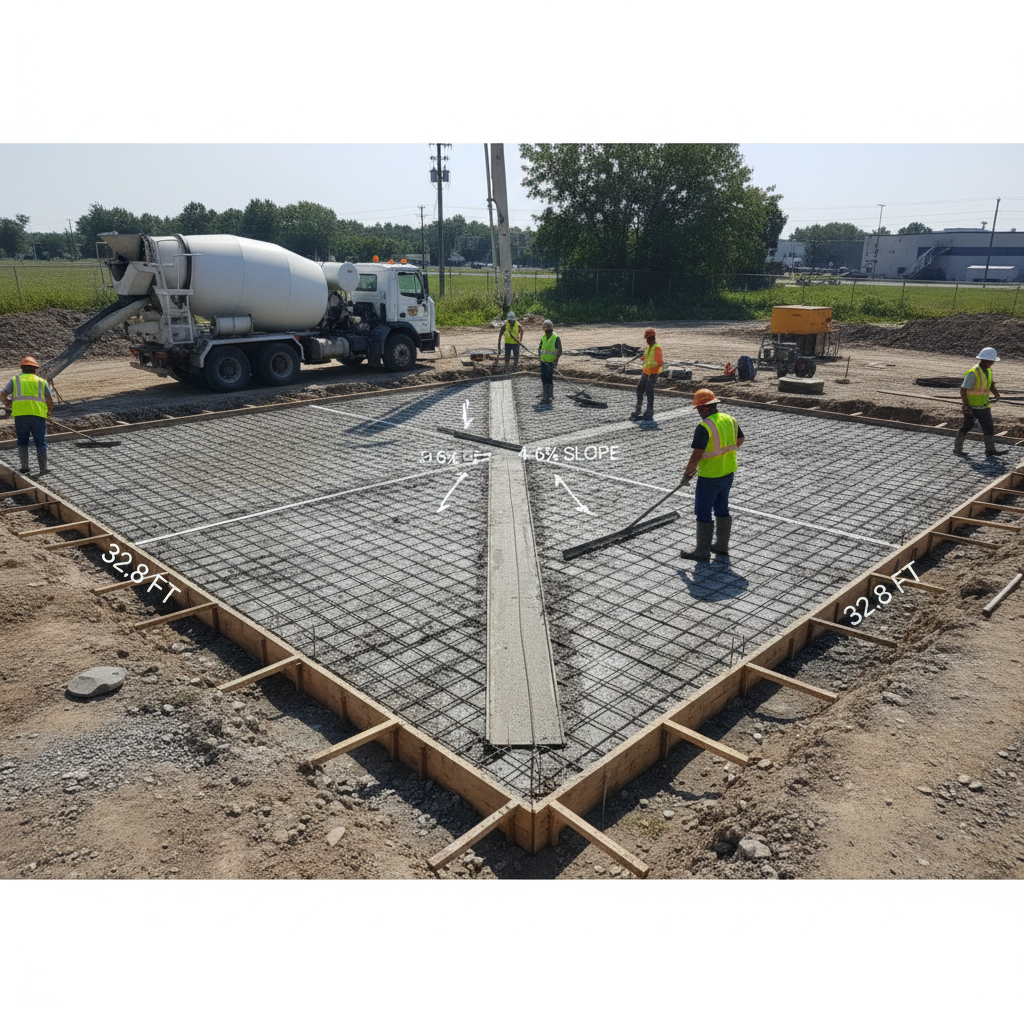
Yes. You can typically fit three padel courts on the footprint of one single tennis court. However, you must verify the slope and surface quality to ensure it meets foundation requirements.
Q4: Do I really need the 6.5-foot safety zone on the sides?
No, not for recreational courts. The 6.5-foot (2m) exterior run-off zone is only mandatory for high-level tournaments where out-of-court play is allowed. For private clubs, 4-5 feet is sufficient.
Q5: What is the best ceiling height for an indoor club?
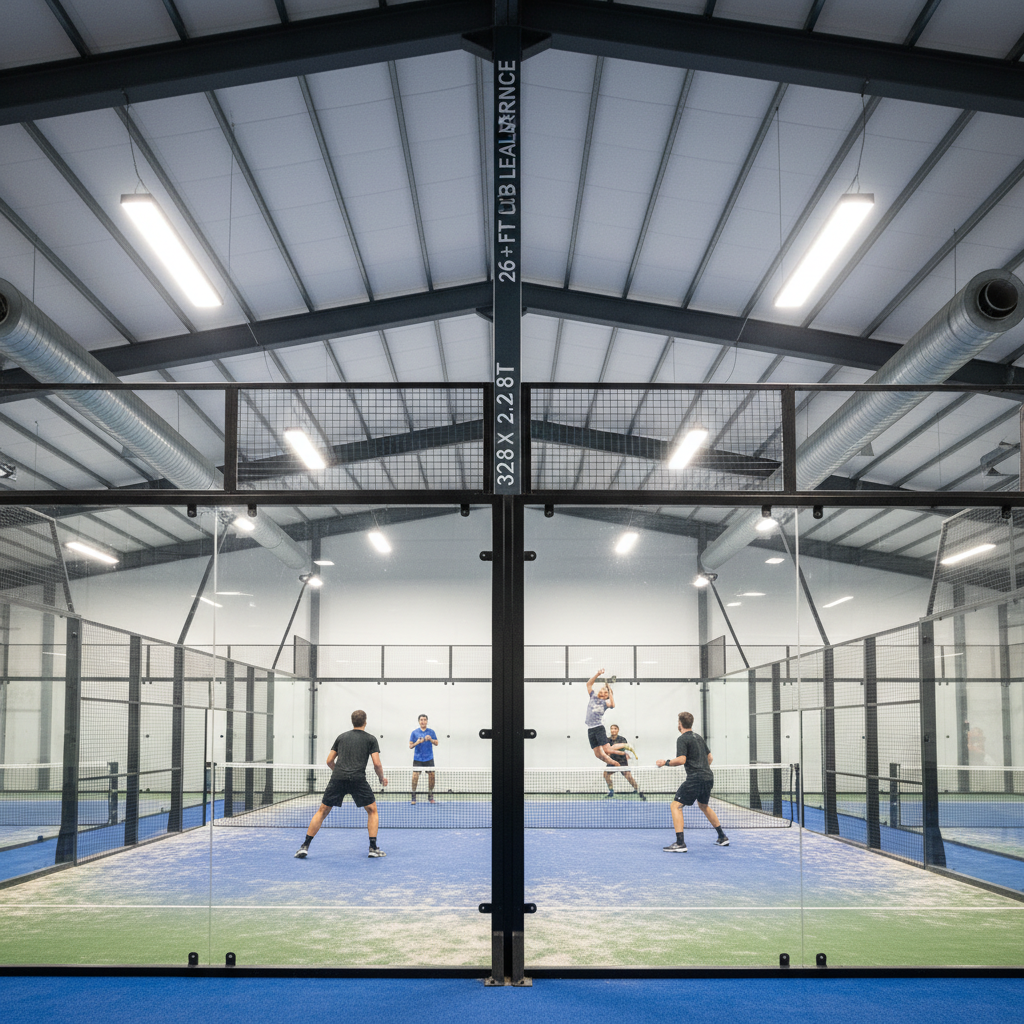
The best height is 26 feet (8 meters) or higher. While 20 feet (6 meters) is the minimum legal height, a higher ceiling allows for the full range of defensive “lob” shots, significantly improving playability.