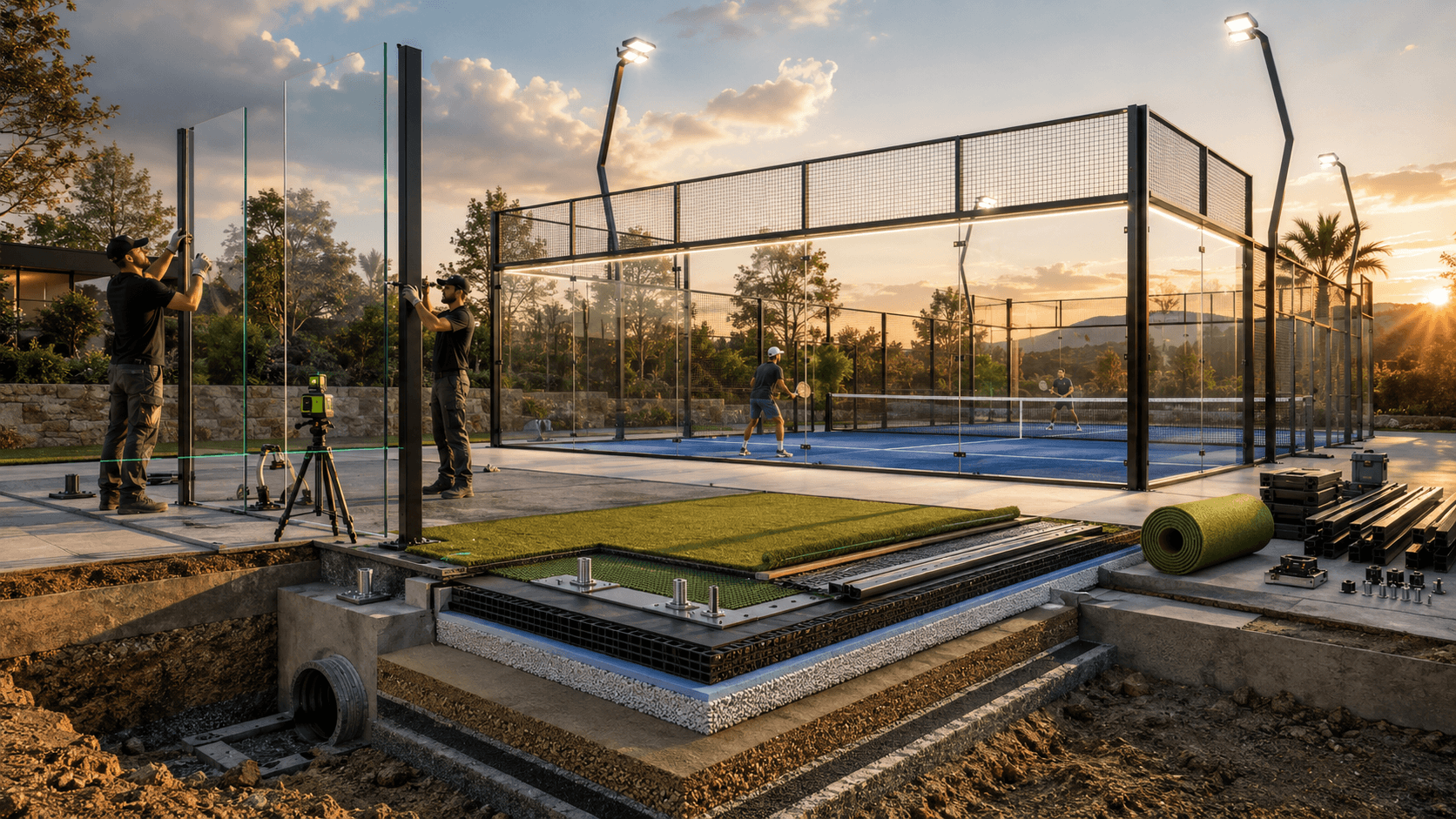
Building a panoramic padel court requires a strategic combination of precision engineering and high-grade materials to ensure long-term ROI. Many club owners invest heavily in facilities only to face shifting glass panels or drainage failures within months. These issues lead to expensive repairs and unhappy members. By following this expert guide, you can construct a professional-grade panoramic padel court that stands the test of time.
Why choose a panoramic padel court for your facility?
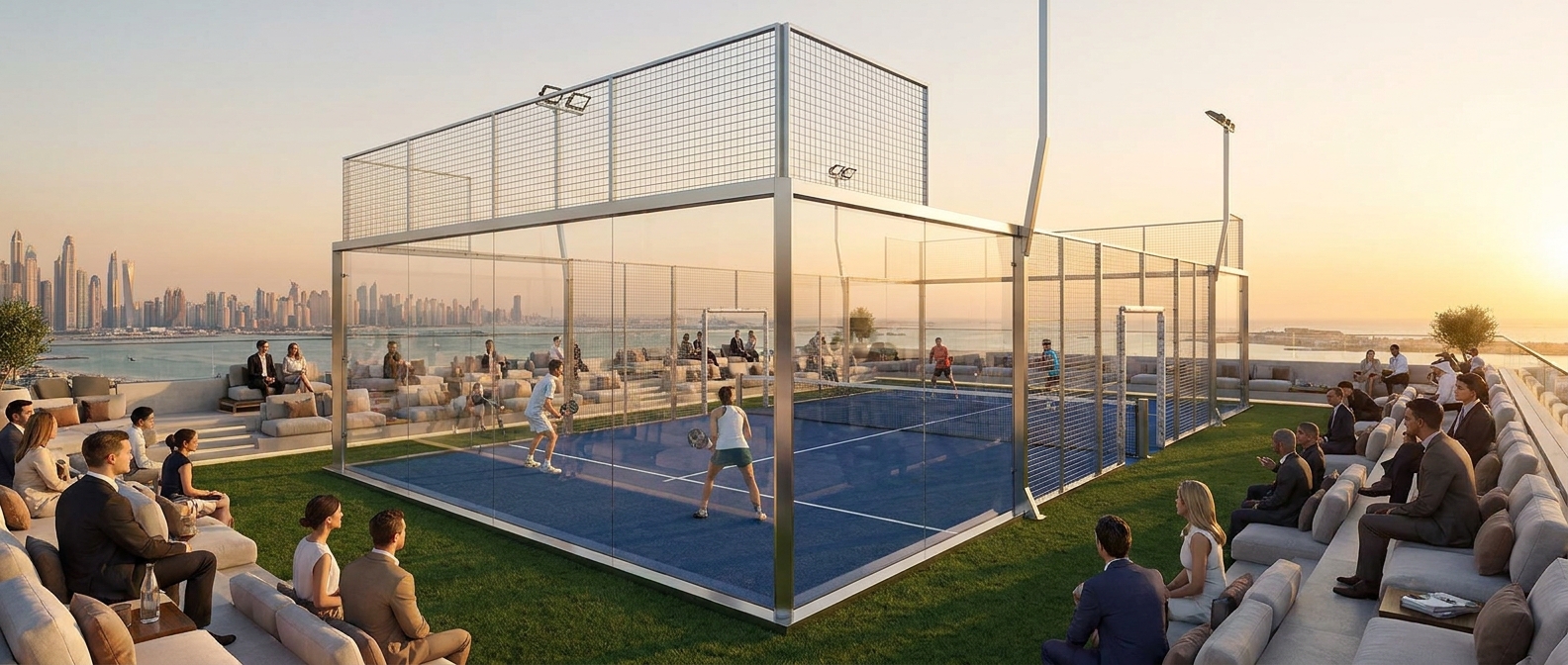
You should choose a panoramic padel court because it offers a premium aesthetic and unobstructed views that significantly enhance the spectator experience. This design removes the vertical steel pillars from the back and side walls, creating a sleek “all-glass” look. It is the gold standard for high-end clubs and televised tournaments.
Superior viewing for spectators
Unobstructed views are essential for modern sports complexes focusing on engagement. Spectators can follow every move without the distraction of structural beams blocking their sightlines.
Think about it. This level of visibility makes your facility the go-to choice for hosting local and international tournaments.
- No rear structural pillars.
- Enhanced filming opportunities.
- Immersive player atmosphere.
Premium branding and revenue
Panoramic designs serve as a powerful marketing tool for your facility’s brand. They attract elite players who are willing to pay more for a superior playing environment.
But that’s not all. You can typically command higher hourly rates for these courts compared to standard models.
- 20-30% higher booking fees.
- Centerpiece for club marketing.
- Attracts high-value corporate events.
Key Takeaway: Choosing a panoramic design elevates your club’s status and provides a direct path to higher profitability through premium rental fees and tournament visibility.
| Feature | Standard Court | Panoramic Court |
|---|---|---|
| Visibility | Partial (Obstructed by pillars) | Total (360-degree glass) |
| Revenue | Moderate | High/Premium |
| Aesthetic | Industrial/Functional | Modern/Elite |
This comparison highlights why panoramic models are preferred for projects where spectator impact and premium branding are top priorities.
What space is needed for a panoramic padel court?
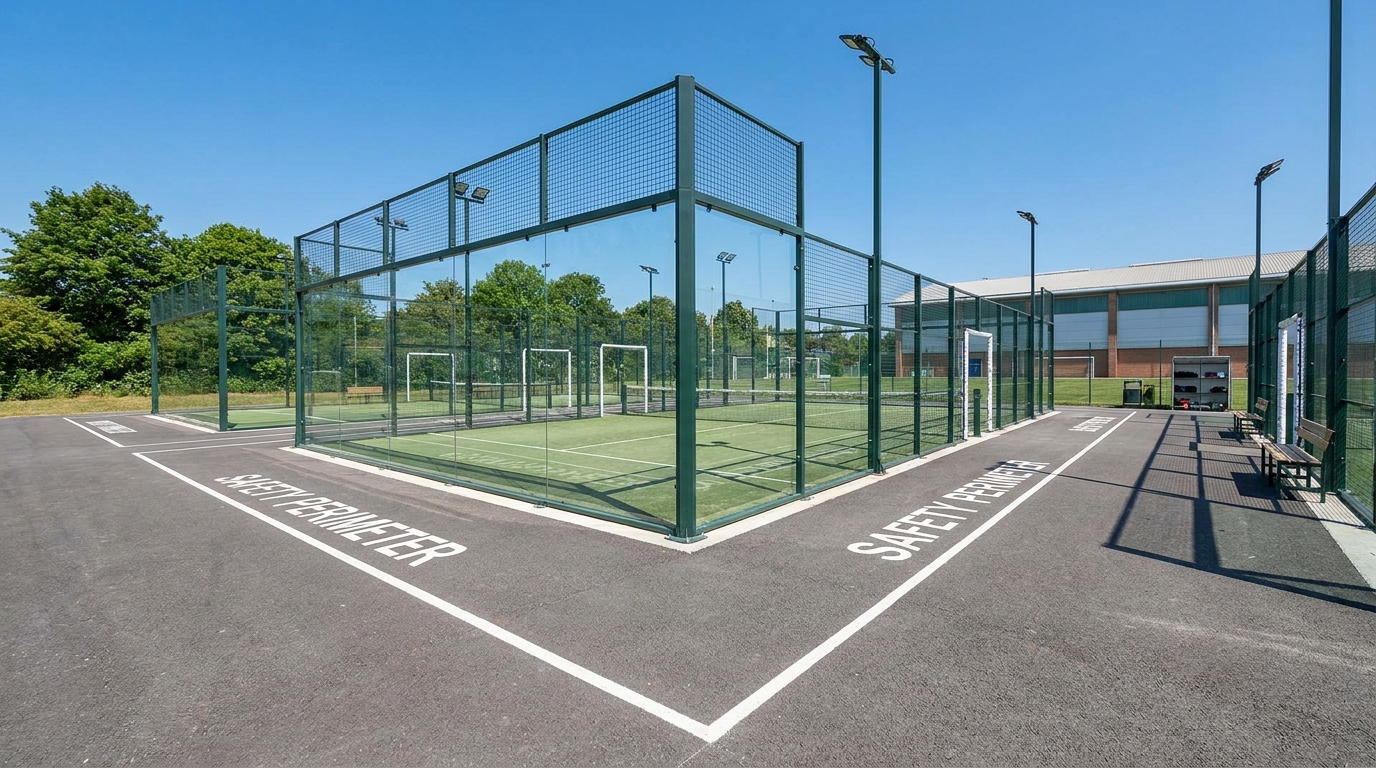
To build a panoramic padel court, you need a minimum footprint of 20 by 10 meters, with an additional 2-meter safety perimeter around the entire structure. Proper spatial planning ensures that players have enough room for out-of-court play and maintenance crews can access the glass easily.
Precise court dimensions
The playing area itself must be exactly 20 meters long by 10 meters wide. Any deviation in these dimensions will disqualify the court from professional play standards.
Here’s the kicker: even a few centimeters of error can lead to improper glass fit during the assembly phase.
- Internal length: 20 meters.
- Internal width: 10 meters.
- Total site area: 24 x 14 meters.
Clearance and zoning rules
Indoor facilities must account for a minimum vertical clearance of 6 meters to allow for high lobs. For outdoor sites, check local zoning laws regarding structural footings and drainage.
You might be wondering about permits. Most municipalities require sports structures to pass wind-load and environmental assessments.
- Minimum ceiling height: 6 meters.
- Perimeter access: 2 meters.
- Drainage slope: 0.5%.
Key Takeaway: Accurate site preparation and adherence to the 20x10m standard are non-negotiable for ensuring professional playability and structural integrity.
| Requirement | Indoor Specification | Outdoor Specification |
|---|---|---|
| Ceiling Height | 6m Minimum | Unlimited |
| Safety Zone | 2m Perimeter | 2m Perimeter |
| Total Area | 336 sqm | 336 sqm |
Proper spatial allocation is the foundation of a successful project, preventing costly modifications after the concrete is poured.
How to design a panoramic padel court for performance?
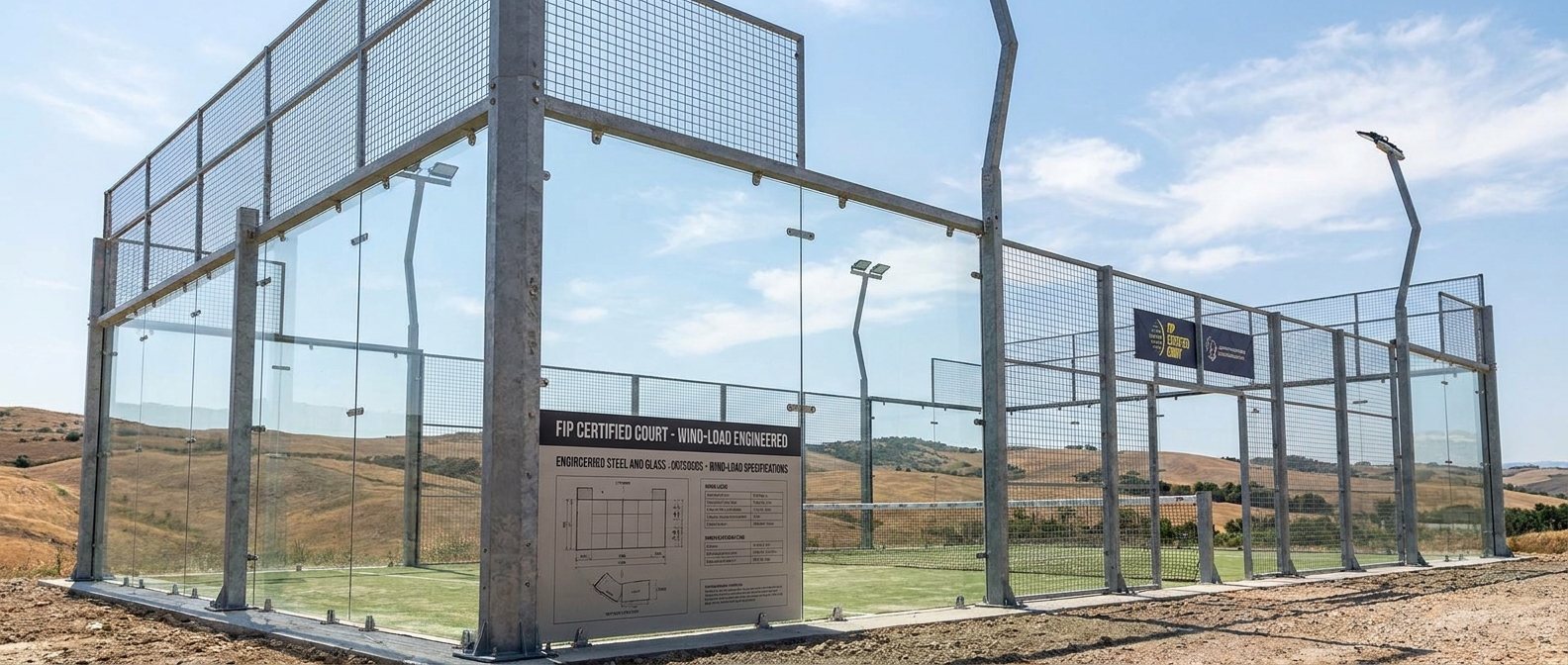
Designing a panoramic padel court requires aligning the axis North-South to minimize sun glare while strictly adhering to FIP safety regulations. Performance design is about more than aesthetics; it involves calculating wind loads and ensuring ball bounce consistency.
Choosing the right layout
Outdoor courts must be oriented correctly to prevent the sun from blinding players during serves. A North-South axis is the industry standard for minimizing glare throughout the day.
But wait—there’s more. The placement of access points should be planned to avoid disrupting the spectators’ line of sight.
- North-South orientation.
- Strategic entrance placement.
- Wind-load engineered glass.
Adhering to FIP standards
The International Padel Federation (FIP) sets strict rules for surface friction and rebound characteristics. Every design choice, from turf density to glass thickness, must meet these benchmarks.
It sounds complicated, but it’s essential. High-performance courts depend on these micro-adjustments for professional-grade play.
- Rebound consistency tests.
- Safety distance compliance.
- Lighting uniformity standards.
Key Takeaway: Professional design focuses on player safety and fair play by balancing court orientation with strict technical adherence to international standards.
| Design Factor | Specification | Benefit |
|---|---|---|
| Orientation | North-South | Reduced sun glare |
| Wind Load | Site-specific | Structural safety |
| FIP Rules | Full Compliance | Professional status |
A design that follows these guidelines ensures the court remains functional and safe for years, regardless of weather conditions or play intensity.
Which materials suit a panoramic padel court best?
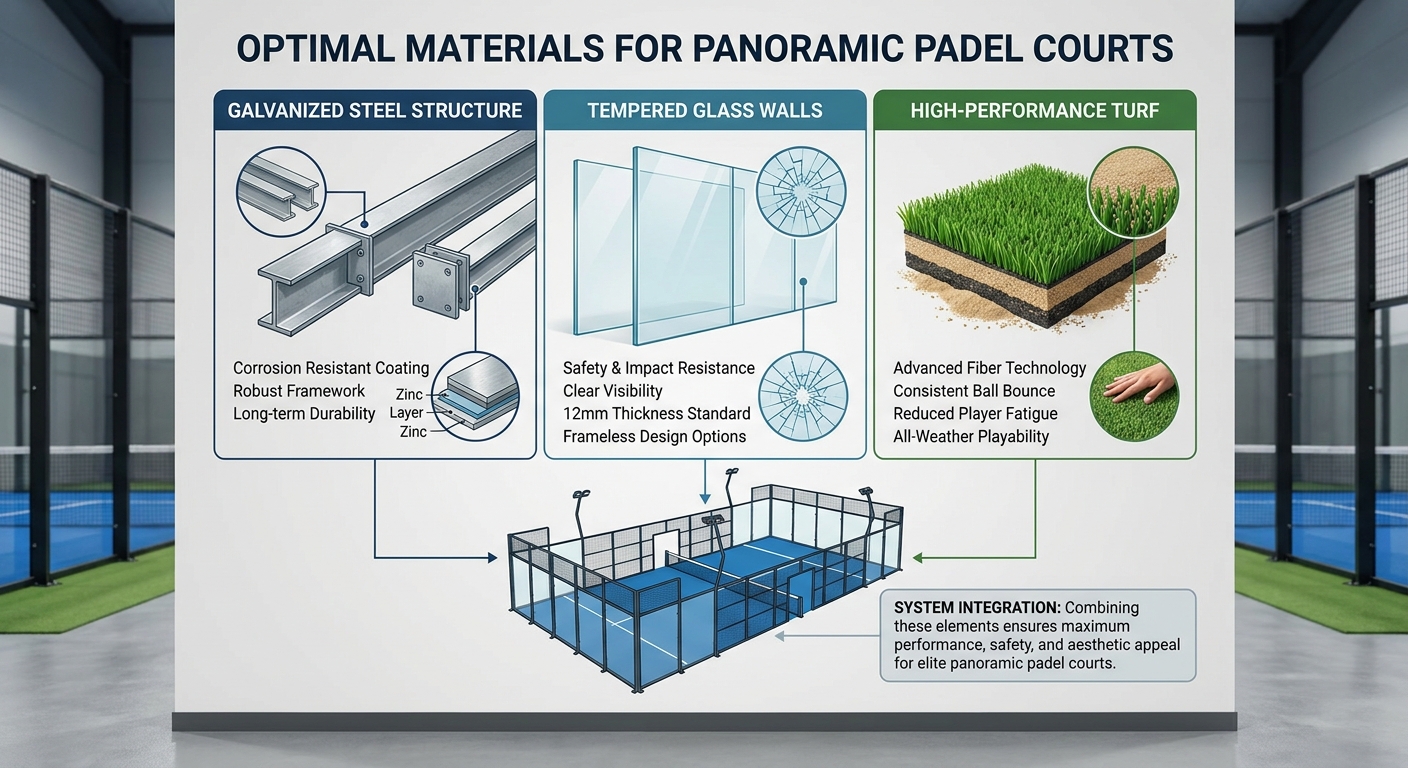
The best materials for a panoramic padel court include hot-dip galvanized steel for the frame and 12mm tempered safety glass for maximum impact resistance. Using low-quality materials can lead to premature rusting and dangerous glass breakages.
Galvanized steel frameworks
The primary structure should be made of hot-dip galvanized steel to withstand humidity and coastal salt. This treatment provides a protective zinc layer that prevents corrosion for over 20 years.
Let’s look at the facts. Untreated steel will start to show signs of decay within just two seasons in humid climates.
- Hot-dip galvanization.
- Modular bracing system.
- Powder-coated finish.
High-performance turf
The playing surface determines the ball speed and player comfort. Monofilament turf with high Dtex ratings offers the best balance of durability and consistent bounce.
Make no mistake. The grass is where the most wear occurs, so choosing a premium grade is a smart investment.
- High-density monofilament.
- UV-resistant fibers.
- Reinforced backing.
Key Takeaway: Investing in hot-dip galvanized steel and certified safety glass is the only way to ensure a 20-year lifespan for your facility.
| Component | Standard Material | Premium Specification |
|---|---|---|
| Frame | Painted Steel | Hot-dip Galvanized |
| Glass | 10mm Tempered | 12mm Heat-Soaked |
| Turf | Fibrillated | High-Dtex Monofilament |
Selecting premium materials during the manufacturing phase dramatically reduces long-term maintenance costs and improves the overall player experience.
How do you build a panoramic padel court foundation?
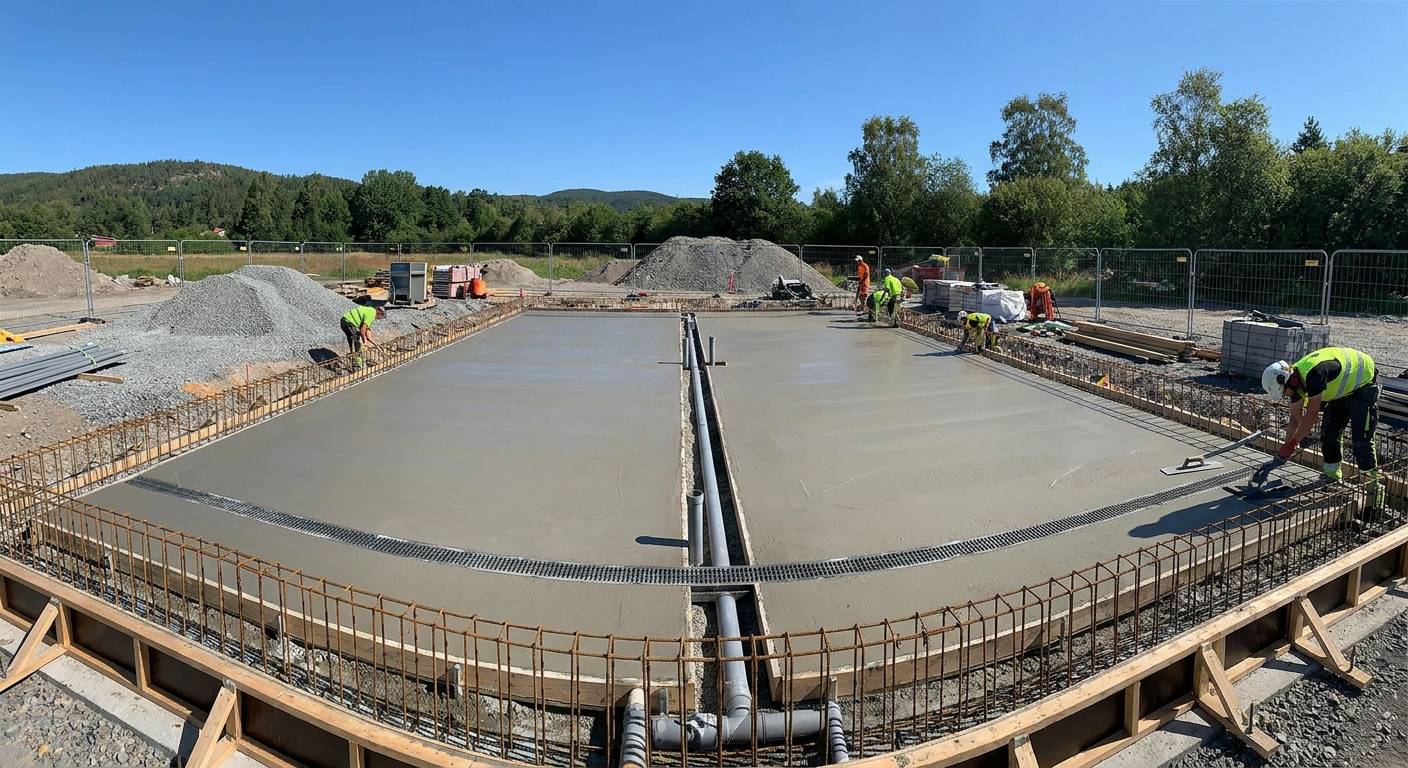
You must build a panoramic padel court foundation using a reinforced concrete slab at least 15cm thick with a precise 0.5% slope for drainage. A flawed foundation is the leading cause of cracked glass and water pooling on the turf.
Soil testing and excavation
Before pouring concrete, the soil must be tested for its load-bearing capacity. Excavation should reach a depth that prevents frost heave in colder climates.
Here’s the deal. If the ground shifts even slightly, the rigid glass panels will lose alignment and potentially shatter.
- Soil density testing.
- Compacted gravel base.
- Perimeter footings.
Concrete slab specifications
A high-strength concrete mix (C25/30) reinforced with steel mesh provides the necessary stability. The slab must be finished to a “laser-level” tolerance to ensure a fair ball bounce.
But that’s not all. You must integrate a perimeter drainage channel to whisk away rainwater during heavy storms.
- 15cm thickness.
- Reinforced steel mesh.
- 0.5% lateral slope.
Key Takeaway: A perfectly level and well-drained concrete foundation is the most critical technical step for ensuring the long-term safety of the glass structure.
| Step | Detail | Criticality |
|---|---|---|
| Excavation | 30cm depth | High |
| Base Layer | Compacted gravel | Medium |
| Pouring | Reinforced concrete | Extreme |
This structured approach to the foundation prevents the most common structural failures and ensures a professional playing surface from day one.
How to install a panoramic padel court structure?
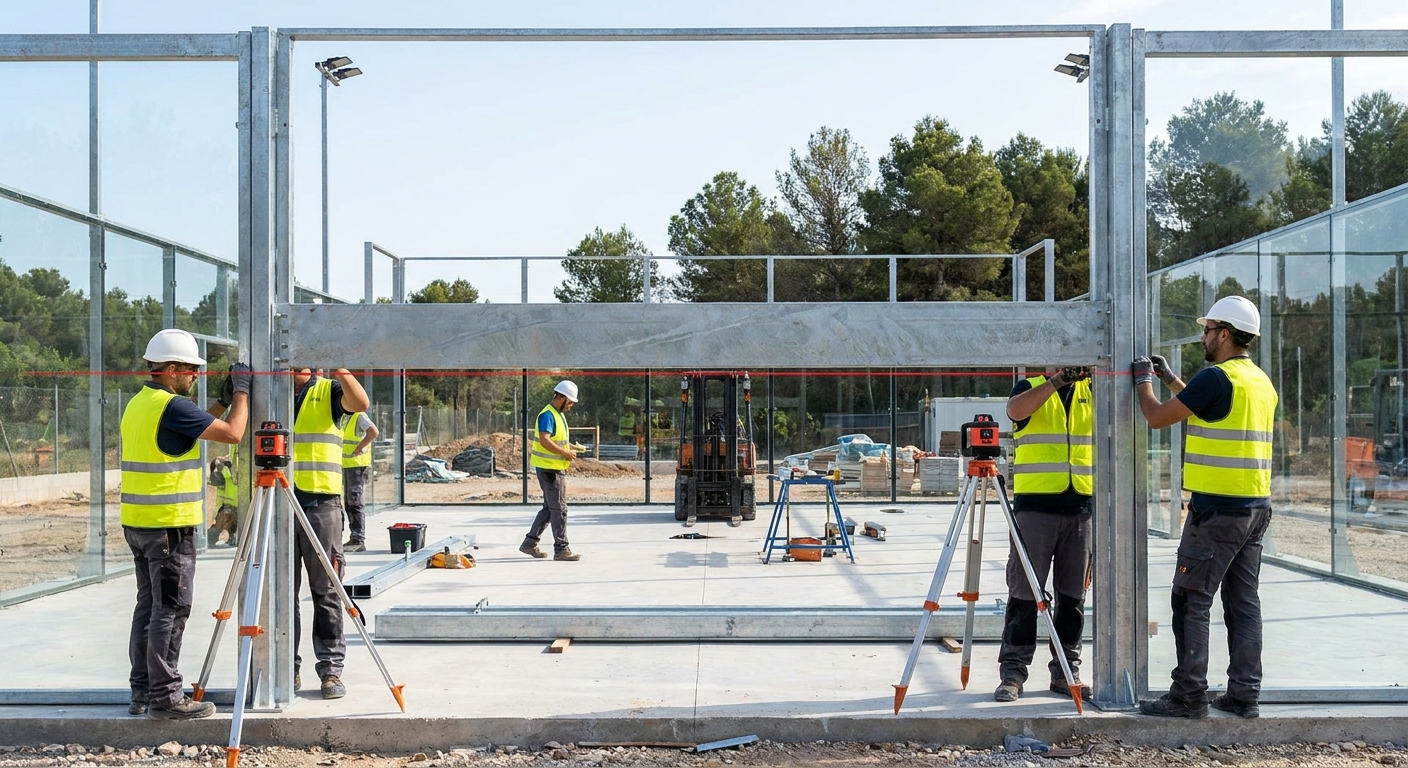
Installing a panoramic padel court structure involves chemically anchoring steel pillars into the foundation with laser-guided precision to ensure vertical alignment. Because panoramic models lack rear pillars, the corner supports must be reinforced to handle immense pressure.
Anchoring the steel pillars
The base plates are fixed to the concrete using high-strength chemical anchors. This method provides a more secure bond than mechanical bolts for a structure under constant vibration.
You must be precise here. Even a 2mm deviation at the base will result in a significant gap at the top of the glass.
- Chemical resin anchors.
- Laser-level alignment.
- Torque-controlled tightening.
Aligning support beams
Vertical and horizontal beams must be perfectly square to allow for the glass panels to drop into place safely. Specialized corner bracing is used to provide the stability normally provided by central posts.
But wait—there’s more. Using a digital inclinometer ensures that every beam is perfectly vertical before the glass is delivered.
- Cross-bracing systems.
- Digital verticality check.
- Modular bolt assembly.
Key Takeaway: Structural precision during the anchoring phase is essential to ensure the glass panels fit correctly and the court can withstand high-impact play.
| Component | Installation Method | Goal |
|---|---|---|
| Base Pillars | Chemical Anchoring | Vibration resistance |
| Top Rails | Modular Bolting | Level perimeter |
| Corners | Reinforced Bracing | Structural stability |
A correctly installed frame provides the necessary “skeleton” for the glass and lighting systems, preventing shifting over time.
Is glass safe in a panoramic padel court setup?
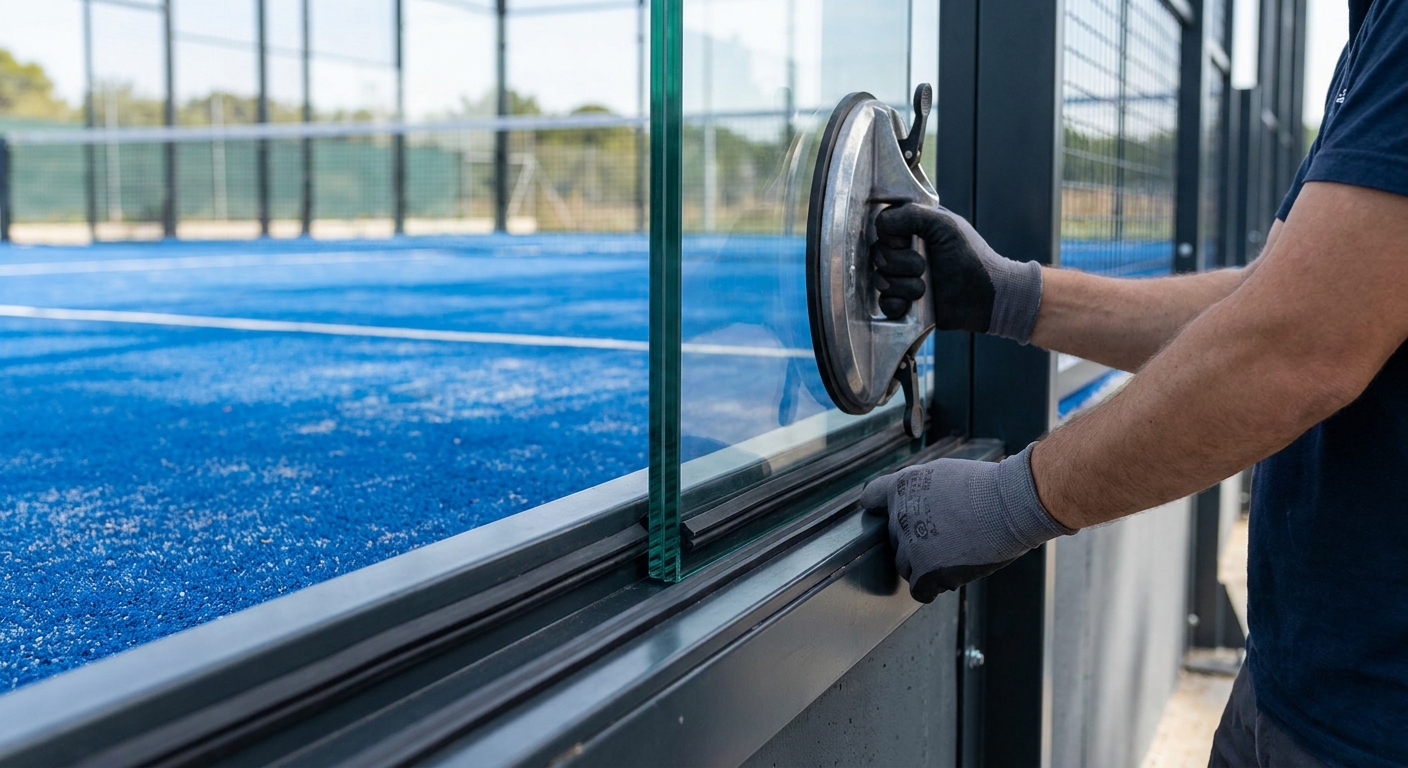
Glass is exceptionally safe in a panoramic padel court provided you use 12mm tempered safety glass that meets international anti-explosion standards. Modern panoramic designs prioritize impact resistance and secure mounting to protect players during intense collisions.
Tempered safety glass specs
Only 10mm or 12mm tempered glass should be used. This material is designed to crumble into small, harmless pieces rather than sharp shards if it ever sustains a critical impact.
Here’s the kicker: heat-soaked glass is even safer as it eliminates the risk of spontaneous breakage due to nickel-sulfide inclusions.
- EN 12150-1 certification.
- Polished edge finishing.
- 12mm thickness.
Proper glass fitting techniques
Glass must never touch the metal frame directly. EPDM rubber gaskets and nylon bushings are used to cushion the panels and allow for thermal expansion.
Think about it. Without these flexible spacers, the heat from the sun would cause the glass to expand and crack against the rigid steel.
- EPDM rubber gaskets.
- Nylon screw bushings.
- Expansion joint gaps.
Key Takeaway: Safety is achieved through the combination of high-grade tempered glass and specialized flexible mounting systems that absorb impact and heat.
| Standard | Requirement | Result |
|---|---|---|
| Impact Test | 50kg pendulum | Pass |
| Fragmentation | 40+ pieces per 5cm | Safe failure |
| Thickness | 12mm Minimum | Elite durability |
These safety measures ensure that your facility is a secure environment for all players, from beginners to professional athletes.
How to install panoramic padel court turf correctly?
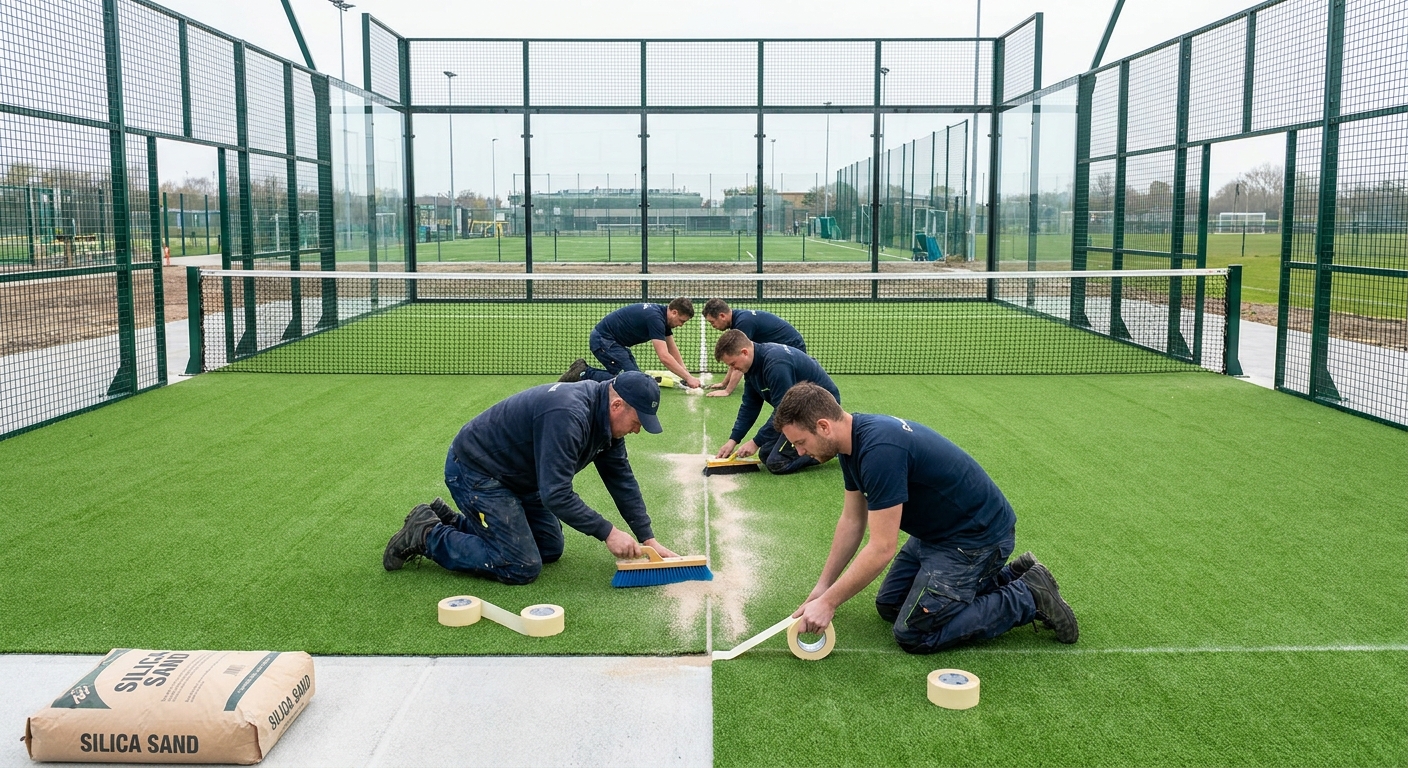
You install panoramic padel court turf by bonding high-density monofilament rolls with two-component polyurethane glue followed by a uniform silica sand infill. The quality of the turf installation determines the “feel” of the game and the speed of the ball.
Seam bonding and gluing
Turf rolls are laid out and joined using geotextile tape and specialized industrial glue. This bond must be perfect to prevent “opening” seams that can trip players.
You might be wondering about the glue. It must be a two-component polyurethane mix that resists both moisture and extreme temperatures.
- Polyurethane adhesive.
- Geotextile joining tape.
- Weighted seam rolling.
Silica sand infill levels
Kiln-dried silica sand is spread across the surface and brushed into the fibers. The sand keeps the fibers upright and provides the necessary friction for player pivots.
But that’s not all. The sand must be distributed at a rate of 3kg to 5kg per square meter for optimal performance.
- Kiln-dried silica sand.
- Mechanical brushing.
- Uniform 15-20mm depth.
Key Takeaway: Precise seam bonding and uniform sand distribution are the two factors that ensure a consistent ball bounce and long-term turf durability.
| Step | Material | Purpose |
|---|---|---|
| Gluing | Two-part Polyurethane | Permanent bond |
| Brushing | Mechanical Power Brush | Sand settlement |
| Infilling | Rounded Silica Sand | Fiber protection |
Proper turf installation prevents the most common playing surface complaints, such as uneven bounce or slippery patches.
What lighting works for a panoramic padel court?
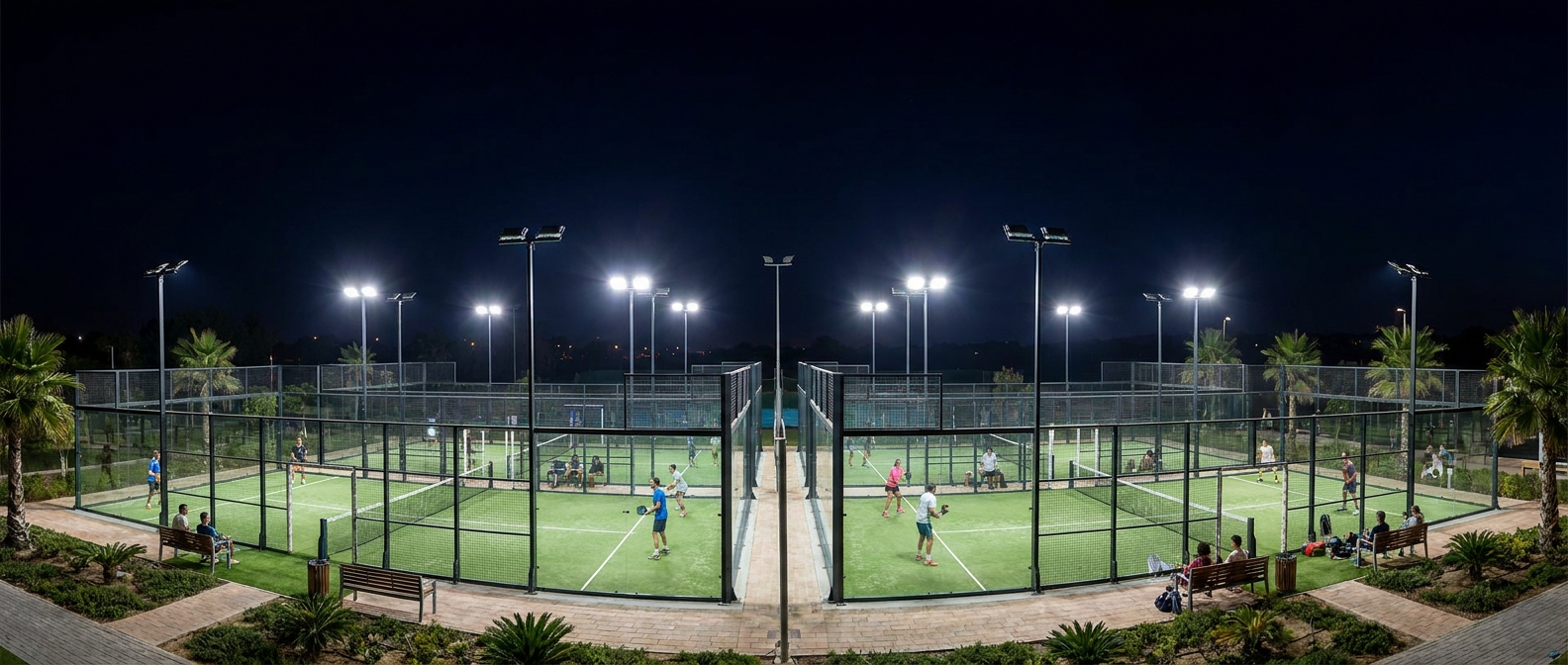
The most effective lighting for a panoramic padel court consists of 200W-300W LED floodlights positioned to eliminate shadows during high-velocity play. High-quality lighting is essential for evening bookings and professional video recording of matches.
Eliminating player shadows
Fixture placement is key to achieving a uniform LUX level across the entire 200sqm surface. Lights must be angled to avoid creating “blind spots” when players look up for high lobs.
Make no mistake. Poorly placed lights can cause glare that ruins the competitive experience for both players and spectators.
- Uniform LUX distribution.
- Anti-glare lens covers.
- Shadow-free positioning.
Energy-efficient LED setups
Modern LED floodlights offer instant-on capability and consume 50% less power than traditional metal halide lamps. They also have a much longer lifespan, reducing maintenance visits to the poles.
Here’s the deal: investing in high-efficiency LEDs can save you thousands of dollars in annual utility costs.
- 200W/300W LED units.
- IP66 waterproof rating.
- 50,000-hour lifespan.
Key Takeaway: High-performance LED lighting enhances playability for night games while significantly lowering your facility’s operational and maintenance expenses.
| Light Type | Energy Usage | Lifespan |
|---|---|---|
| Metal Halide | High | 10,000 Hours |
| Standard LED | Medium | 30,000 Hours |
| Premium LED | Low | 50,000 Hours |
Optimized lighting ensures that your courts remain a viable revenue source 24 hours a day, regardless of natural light conditions.
How to maintain a panoramic padel court long-term?
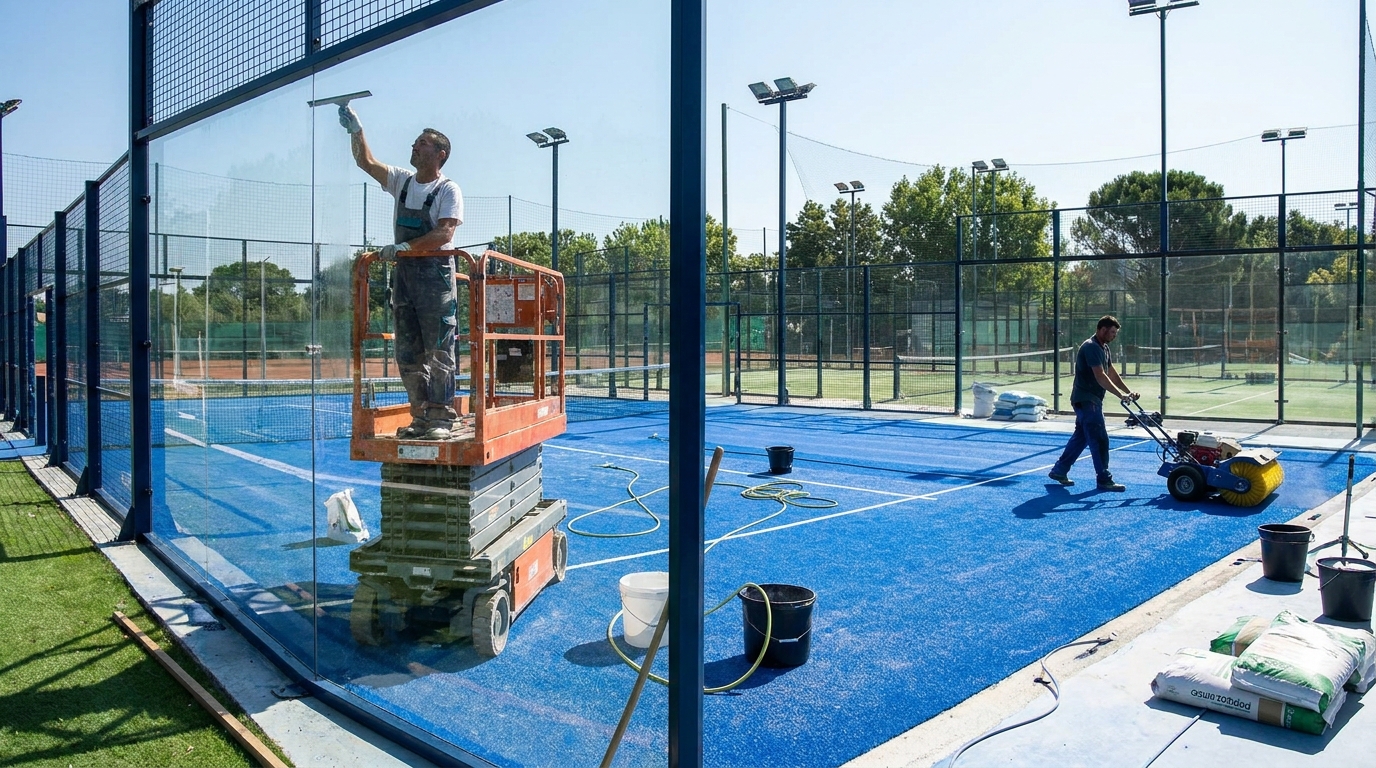
Maintaining a panoramic padel court requires weekly glass cleaning and quarterly mechanical turf brushing to prevent sand compaction and fiber wear. Maintenance is the difference between a court that lasts 5 years and one that lasts 15.
Regular glass cleaning tips
The panoramic view is the court’s biggest selling point, so the glass must remain crystal clear. Use non-abrasive solutions and rubber squeegees to prevent mineral buildup and scratches.
But wait—there’s more. Regularly checking the bolt torque on the glass supports prevents panels from vibrating or shifting over time.
- Weekly squeegee cleaning.
- Quarterly hardware checks.
- Non-abrasive detergents.
Professional turf brushing
Sand tends to compact or migrate toward the edges during heavy play. Deep mechanical brushing every three months redistributes the infill and lifts the turf fibers back to their original state.
Here’s the kicker: ignoring turf maintenance leads to “dead spots” where the ball doesn’t bounce correctly, frustrating your members.
- Mechanical power brushing.
- Sand redistribution.
- Fiber de-compaction.
Key Takeaway: Consistent, proactive maintenance of both the glass and the turf is the only way to preserve the elite playing characteristics of a panoramic facility.
| Task | Frequency | Estimated Time |
|---|---|---|
| Glass Cleaning | Weekly | 2 Hours |
| Turf Brushing | Quarterly | 4 Hours |
| Bolt Inspection | Annually | 1 Hour |
A disciplined maintenance schedule protects your investment and ensures that players always enjoy a first-class experience at your facility.
Conclusion
Building a panoramic padel court is a high-reward investment that combines elite aesthetics with professional-grade performance. By focusing on a reinforced foundation, precision-engineered steel, and high-safety glass, you create a facility that attracts serious players and generates consistent revenue. Our team specializes in providing factory-direct solutions and technical expertise to streamline your construction process from ground-breaking to the first serve.
Ready to elevate your sports complex? We offer global installation support and premium materials to ensure your project succeeds. To receive a detailed technical specification and pricing for your new facility, please contact us today. We are dedicated to building the world’s most durable and beautiful padel environments.
Frequently Asked Questions
How long does it take to build a panoramic padel court?
Typically, the installation takes 7 to 10 days once the concrete has cured. The entire process, including foundation work and curing, usually spans about 30 to 45 days.
What is the best way to clean panoramic glass?
You should use a mild, non-abrasive detergent and a professional rubber squeegee. Weekly cleaning prevents the buildup of minerals and dust that can obscure the view.
Can I install a panoramic padel court in a coastal area?
Yes, but you must specify hot-dip galvanized steel for the structure. This provides the necessary corrosion resistance to handle salt air and high humidity.
Does a panoramic court require specialized lighting?
High-efficiency LED floodlights are recommended to eliminate shadows. Because the glass area is larger, anti-glare fixtures are essential for maintaining visibility during lobs.
Can I customize the color of the steel frame?
Most manufacturers offer custom RAL colors for the structure. This allows you to match the court perfectly with your club’s branding or architectural style.