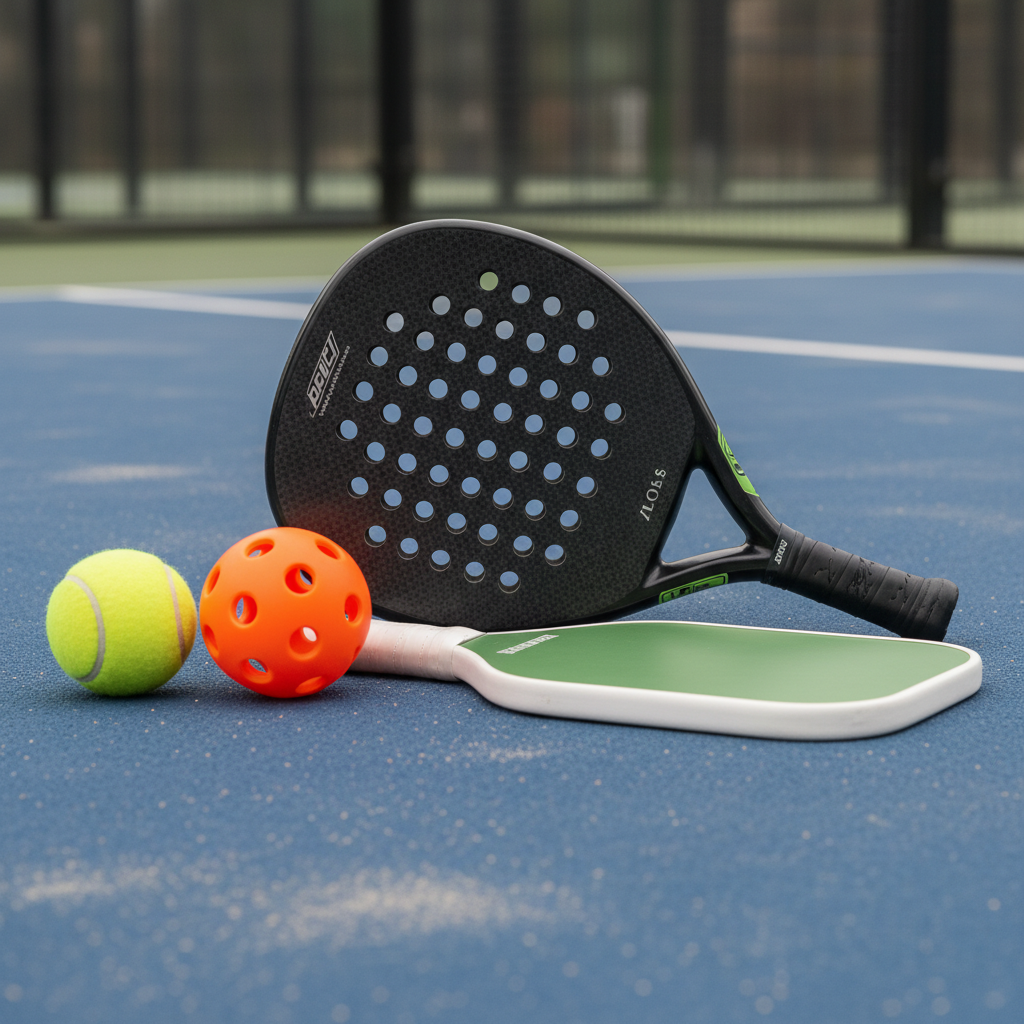
Tennis is a high-intensity sport played on large, open courts with stringed rackets, whereas padel is a tactical, social game played within smaller glass-walled enclosures using solid perforated paddles. You may find that finding a sport that fits both your physical lifestyle and available property space is a significant challenge. Traditional courts often demand massive land footprints and years of technical practice to enjoy a competitive match. By analyzing the nuances of padel vs tennis, you can identify the perfect solution for your recreational or commercial facility needs.
What are the main differences in padel vs tennis?

The primary distinction in padel vs tennis lies in the court structure and the equipment used to play. Tennis is defined by its vast, open-air boundaries and high-tension string rackets, while padel utilizes tempered glass walls and carbon fiber paddles. These structural differences fundamentally change how the ball moves and how you interact with the court.
Scoring and gameplay rules
Padel utilizes the same scoring system as tennis, yet the way you win points differs due to the surrounding walls. In padel, you can play the ball off the glass, which extends rallies and emphasizes positioning over raw power. This creates a more chess-like experience where patience is rewarded.
The best part?
- Uses the 15, 30, 40 scoring system.
- Serves must be underhand in padel.
- Walls keep the ball in play longer.
- Tennis points end when the ball bounces twice.
Key Takeaway: While the scoring language is identical, the inclusion of walls in padel creates a dynamic, multi-dimensional playing field that rewards strategy.
| Feature | Tennis | Padel |
|---|---|---|
| Serve Style | Overhand | Underhand |
| Wall Usage | No | Yes |
| Ball Type | High Pressure | Low Pressure |
The data confirms that padel serves as a more accessible tactical game, while tennis remains a test of technical serving and baseline power.
How does padel vs tennis court sizing compare?

Dimensions for padel vs tennis vary significantly, as a standard padel court is roughly one-third the size of a full-size tennis court. If you are looking to maximize space efficiency, you can explore whether it is possible to can-you-play-padel-on-a-tennis-court/ by comparing the precise boundary requirements. This smaller footprint allows for higher player density in restricted areas.
Comparative land requirements
You need approximately 648 square meters for a standard tennis court, excluding the necessary runoff areas. Conversely, a padel court only requires 200 square meters, fitting neatly into smaller residential backyards or urban clubs. This efficiency allows developers to install multiple padel courts in the space of a single tennis installation.
Think about it:
- Tennis: 23.77m x 10.97m.
- Padel: 20m x 10m.
- Padel requires less clearing.
- Tennis needs larger safety margins.
Key Takeaway: Padel is the superior choice for high-density environments where maximizing the number of active players per square meter is a priority.
| Dimension | Tennis Court | Padel Court |
|---|---|---|
| Length | 23.77 Meters | 20 Meters |
| Width | 10.97 Meters | 10 Meters |
| Total Area | ~260 sqm (Play only) | 200 sqm (Total) |
This spatial analysis highlights that you can host three times as many players in a padel facility compared to a traditional tennis setup of the same size.
Which is easier to learn: padel vs tennis?

Learning the basics of padel vs tennis is generally considered faster for newcomers due to the shorter rackets and underhand serves. Tennis requires significant coordination to master the overhand serve and the timing of stringed racket impacts. Most players find they can enjoy a competitive game of padel within their very first hour on the court.
The technical skill ceiling
Tennis has a much higher technical barrier because of the speed and bounce height of the ball. In padel, the ball is less pressurized and the paddle is easier to control, meaning you spend less time chasing balls and more time playing. This low barrier to entry makes it an ideal sport for all ages and fitness levels.
Here is the kicker:
- Underhand serves are easier to land.
- Shorter paddles improve hand-eye coordination.
- Wall rebounds give players a second chance.
- Tennis requires years of muscle memory.
Key Takeaway: Padel offers immediate gratification for beginners, whereas tennis requires a long-term commitment to technical coaching and practice.
| Learning Factor | Tennis | Padel |
|---|---|---|
| Serve Difficulty | High | Low |
| Rally Length | Short (Beginner) | Long (Beginner) |
| Physical Impact | High | Moderate |
The evidence suggests that padel is the preferred option for social clubs looking to encourage rapid member engagement and high participation rates.
What are the space requirements for padel vs tennis?

The total footprint for padel vs tennis must account for not just the playing surface, but also the structural clearance and spectator zones. When planning your project, understanding the specifics of /padel-court-construction/ is vital for ensuring your land is utilized correctly. Proper zoning ensures that the enclosed nature of padel doesn’t interfere with the open-air requirements of tennis.
Perimeter and height clearances
Padel courts require a minimum height clearance of six meters to allow for “lobs” that hit the glass walls properly. Tennis courts need much more horizontal space on the sides and back to prevent players from hitting fences during high-speed chases. You must factor in these safety zones when measuring your available land.
Look at it this way:
- Tennis needs 3.6m side clearance.
- Padel walls act as the boundary.
- Vertical space is critical for padel.
- Tennis is more flexible with ceiling height.
Key Takeaway: Padel courts are self-contained units that require less peripheral safety space, making them easier to fit into tight architectural designs.
| Space Type | Tennis Requirement | Padel Requirement |
|---|---|---|
| Horizontal Buffer | 3-6 Meters | 0-1 Meters |
| Vertical Clearance | Optional (Outdoor) | 6-8 Meters |
| Foundation Type | Concrete/Asphalt | Reinforced Concrete |
Analysis shows that while padel requires specific vertical clearance for the ball’s trajectory, it saves massive amounts of horizontal land compared to tennis.
How do equipment costs differ for padel vs tennis?

Comparing equipment costs for padel vs tennis reveals that while the initial entry cost is similar, the maintenance of gear varies. Tennis rackets require frequent restringing and have a larger variety of string types to manage. Padel paddles are solid units that do not require restringing but may need replacement after intense physical impact with the walls or floor.
Racket vs paddle technology
Tennis rackets are designed for tension and vibration control using advanced synthetic strings. Padel paddles use an EVA foam core surrounded by carbon fiber or fiberglass to provide a “pop” sensation without strings. You will find that padel balls also have slightly less pressure, which affects their longevity and bounce.
Why is this important?
- No stringing costs for padel.
- Tennis rackets are more aerodynamic.
- Padel paddles are more durable against ground hits.
- Tennis balls lose pressure faster.
Key Takeaway: Padel eliminates the recurring cost of stringing, though the solid paddles represent a higher one-time investment for premium models.
| Item | Tennis Cost (Avg) | Padel Cost (Avg) |
|---|---|---|
| Racket/Paddle | $150 – $250 | $100 – $350 |
| Maintenance | Stringing ($30) | None |
| Ball Lifespan | 1-2 Matches | 2-4 Matches |
This comparison indicates that padel is more cost-effective for the casual player who wants to avoid the logistical hassle of regular racket maintenance.
What are construction costs for padel vs tennis?

The financial investment for padel vs tennis construction depends heavily on the materials, specifically the glass and steel required for padel enclosures. If you are converting an existing area, checking can-you-play-padel-on-a-tennis-court/ can help you estimate the savings of using an existing foundation. Generally, a padel court costs more per square meter due to the specialized tempered glass and turf systems.
Material and labor expenses
Tennis courts are primarily about the base layer—asphalt or concrete—and the acrylic surface coating. Padel construction involves heavy-duty steel frames and 10mm to 12mm tempered glass panels that must be perfectly aligned. You also need to factor in the cost of high-quality artificial turf and specialized sand infill.
It gets even better:
- Padel requires precision glass engineering.
- Tennis needs extensive drainage systems.
- Lighting is easier to install on padel frames.
- Labor for padel glass is highly specialized.
Key Takeaway: While padel has higher material costs due to glass and steel, the smaller footprint often balances the total project budget compared to a massive tennis court.
| Component | Tennis Cost | Padel Cost |
|---|---|---|
| Foundation | High (due to size) | Moderate (due to size) |
| Enclosure | Low (Chain link) | High (Glass/Steel) |
| Surface | Acrylic/Clay | Artificial Turf |
This data shows that padel construction is a more intensive engineering project, but it utilizes land value more effectively in premium real estate markets.
Which surface is better for padel vs tennis play?

The choice of surface in padel vs tennis affects player joint health and the speed of the game. Padel almost exclusively uses monofilament or textured artificial turf, while tennis offers a range from hardcourt acrylic to natural grass and clay. Choosing the right surface depends on your local climate and how much maintenance you are willing to perform.
Impact on player joints
You will notice that padel’s artificial turf is much more forgiving on the knees and ankles than a standard tennis hardcourt. The sand infill allows for controlled sliding, which reduces the jarring stops common in tennis. However, tennis hardcourts provide a more consistent ball bounce and require significantly less daily grooming.
Consider this:
- Turf requires regular brushing.
- Hardcourts need periodic resurfacing.
- Clay tennis courts require daily watering.
- Padel turf drains faster after rain.
Key Takeaway: Padel surfaces offer superior shock absorption, making it a better choice for older players or those looking to minimize injury risk.
| Surface Type | Traction | Maintenance |
|---|---|---|
| Artificial Turf | High (Slide-able) | Weekly |
| Acrylic Hardcourt | Very High | Low |
| Clay | Low (Slide-able) | Daily |
This analysis highlights that padel surfaces prioritize player comfort and drainage, whereas tennis surfaces focus on variety and specific ball-bounce dynamics.
How do glass walls change padel vs tennis dynamics?

The inclusion of glass walls is the defining characteristic that separates the strategy of padel vs tennis. Mastering /padel-court-construction/ involves ensuring these walls are structurally sound to handle high-velocity impacts. In tennis, once the ball passes you, the point is over; in padel, the wall is your best friend and a vital part of your counter-attack.
Defensive and offensive wall play
You can use the back and side walls to slow down the pace of the game or to surprise your opponents with difficult angles. This means that even if you are outpositioned, the rebound gives you a second chance to return the ball. In tennis, the lack of walls rewards raw power and precise placement to “hit through” the opponent.
That is not all:
- Walls enable “boasts” or indirect shots.
- Glass provides transparency for spectators.
- Steel mesh adds unpredictable bounces.
- Tennis requires more horizontal running.
Key Takeaway: The walls in padel transform the game into a 360-degree experience, shifting the focus from physical sprinting to mental geometry.
| Feature | Tennis Boundary | Padel Boundary |
|---|---|---|
| Interaction | Out of bounds | Part of play |
| Material | Air / Fence | Glass / Mesh |
| Tactical Role | Limit | Opportunity |
The presence of walls creates a unique tactical depth that allows for longer, more exciting rallies regardless of the players’ physical speed.
Can you convert a court between padel vs tennis?

Conversion feasibility for padel vs tennis is a common question for facility owners looking to modernize their offerings. Because a tennis court is much larger, you can comfortably fit two or even three padel courts within its existing boundaries. This is a popular strategy for clubs that have underutilized tennis courts and want to capitalize on the padel trend.
Structural requirements for conversion
You must ensure the existing concrete or asphalt base is thick enough to support the heavy glass panels and steel pillars of a padel court. Often, a new reinforced concrete ring beam is required around the perimeter of the padel court to anchor the structure safely. Once the foundation is secured, the installation of the turf and glass can proceed relatively quickly.
The bottom line?
- Maximizes existing land assets.
- Increases player capacity immediately.
- Requires structural anchoring.
- Can be done in phases.
Key Takeaway: Converting a single tennis court into multiple padel courts is the most effective way to triple your facility’s capacity and potential revenue.
| Conversion Step | Importance | Complexity |
|---|---|---|
| Foundation Check | Critical | Moderate |
| Ring Beam Install | High | High |
| Turf Laying | Moderate | Low |
This demonstrates that while conversion requires technical oversight, the ability to serve 12 players instead of 4 in the same space is a game-changer for club owners.
Which offers a better ROI: padel vs tennis?

When looking at the Return on Investment (ROI) for padel vs tennis, padel consistently outperforms in urban environments due to player density. Since you can check can-you-play-padel-on-a-tennis-court/ to see how many units fit in one space, the math usually favors the sport that allows more bookings per hour. Padel’s social nature also drives higher secondary spending on food, beverages, and equipment.
Revenue per square meter
Padel courts are typically played as doubles, meaning four players are paying for a court that is 30% the size of a tennis court. This creates a much higher revenue-to-space ratio, which is essential for businesses with high rent or land costs. Additionally, the shorter learning curve leads to higher retention rates and more frequent bookings from casual players.
You might wonder:
- 4 players on 200sqm vs 2-4 on 600sqm.
- Higher churn of court bookings.
- Stronger community and social ties.
- Lower maintenance costs over time.
Key Takeaway: Padel is a superior commercial investment because it maximizes player density and appeals to a broader demographic of casual, paying users.
| Metric | Tennis ROI | Padel ROI |
|---|---|---|
| Players Per Acre | Low | Very High |
| Booking Frequency | Moderate | High |
| Social Spend | Moderate | High |
The financial data confirms that for any commercial sports venture, padel provides a faster path to profitability and a more sustainable long-term revenue model.
*
Summary and Next Steps
Deciding between padel and tennis depends on your specific goals, whether they are focused on professional skill development or maximizing social engagement and land value. Padel offers an accessible, high-density alternative that is perfect for modern lifestyles and commercial growth. If you are ready to transform your space or need expert guidance on construction, contact us today to start your journey. We specialize in bringing high-end, durable sports installations to life, ensuring your investment pays off for years to come.
Frequently Asked Questions
Can I play padel on an existing tennis court without modifications?
No, padel requires specific glass walls and a smaller court boundary that must be physically installed; you cannot play it effectively using just tennis lines.
What is the main reason padel is becoming more popular than tennis?
It is much easier to learn, highly social, and the rallies last longer, providing more immediate fun for players of all skill levels.
Is building a padel court more expensive than a tennis court?
While the materials like tempered glass are more expensive per square foot, the smaller overall size often makes the total project cost comparable.
Can children play padel easily compared to tennis?
Yes, the underhand serve and shorter paddle make it significantly easier for children to start rallying and enjoying the sport quickly.
How much maintenance does a padel court need?
It requires weekly brushing of the turf and occasional glass cleaning, which is generally less labor-intensive than maintaining a clay or grass tennis court.