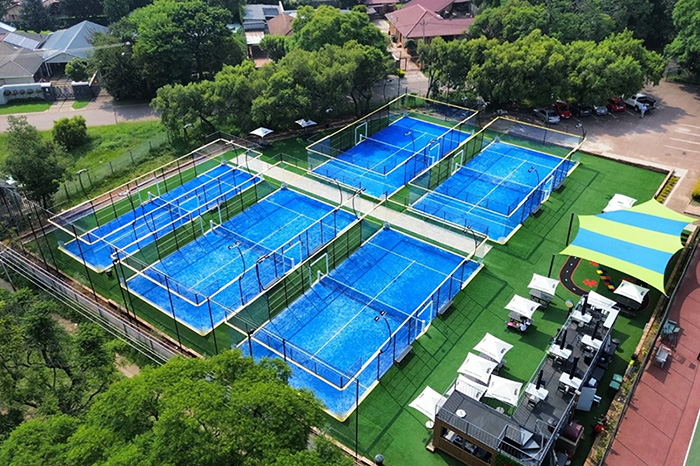
Intro Note: This comprehensive guide breaks down factory-direct pricing for B2B clients, club owners, and investors planning padel facility construction.
Introduction
Finding transparent pricing for padel courts remains notoriously difficult because quotes vary wildly between suppliers. You likely waste weeks waiting for estimates only to find hidden fees for foundation or glass that blow your budget. We provide a factory-direct breakdown of every cent involved, from steel structures to turf. SuperbPadel manufactures courts for 500+ clients worldwide, cutting out middlemen to offer clear answers.
Table of Contents
- 1. What Is the Average Total Investment Required?
- 2. How Much Does the Foundation and Groundwork Cost?
- 3. What Are the Costs for Steel and Glass Structures?
- 4. How Does the Price of Artificial Turf Vary?
- 5. How Much Should You Budget for LED Lighting?
- 6. What Are the Installation and Labor Expenses?
- 7. How Do Shipping and Transportation Affect the Budget?
- 8. What Is the Price Difference Between Indoor and Outdoor?
- 9. What Hidden Costs Do Owners Often Overlook?
- 10. How Can You Save Money Without Sacrificing Quality?
- FAQ
1. What Is the Average Total Investment Required?
Total investment for a single court typically ranges between $24,000 and $65,000 depending on location and quality. Here’s the deal: understanding the cost to build a padel court requires analyzing regional differences. Investors in Europe might pay €17,500 for basic setups, while US projects often exceed $45,000 due to labor rates. UK builders face costs around £45,000–£75,000. These figures usually cover materials like glass, steel, turf, and lighting but exclude land purchase or complex permits.
![Image Suggestion: Photorealistic wide shot of a newly finished outdoor padel court with price tags overlaying different sections like glass, turf, and lights.]
Global Cost Estimates
Prices fluctuate based on steel markets and shipping logistics. High-end panoramic courts naturally command premium pricing compared to standard pillar-based models. Most turnkey solutions sit in the middle range. Buyers must verify if quotes include installation or just materials (EXW/FOB terms).
Regional Variations
- USA: Higher labor drives prices up ($40k+).
- Europe: Mature market offers competitive rates (€20k+).
- Asia: Factory-direct sourcing lowers material expense significantly.
Table 1: Estimated Global Price Ranges (2025)
| Region | Low End Estimate | High End Estimate | Currency |
|---|---|---|---|
| USA | 24,000 | 65,000 | USD |
| UK | 45,000 | 80,000 | GBP |
| Europe | 17,500 | 91,200 | EUR |
| Asia (FOB) | 12,000 | 25,000 | USD |
Key Takeaway: Always request itemized quotes separating materials from labor.
2. How Much Does the Foundation and Groundwork Cost?
Foundation work represents a massive variable, costing anywhere from $0 (re-using existing slabs) up to $35,000 for new concrete bases. You might be wondering why this variance exists. Site conditions dictate everything. Building on raw, uneven land requires excavation, leveling, and drainage systems which quickly inflate expenses. Conversely, converting unused tennis courts minimizes groundwork, saving thousands instantly.
![Image Suggestion: Diagram showing cross-section of a padel court foundation with layers: gravel, reinforced concrete, and asphalt.]
Concrete vs Asphalt
Concrete offers superior durability and ball bounce consistency. Experts recommend 12cm reinforced concrete per court. Asphalt provides a cheaper alternative but may soften under extreme heat. Your choice impacts longevity.
Site Preparation Needs
- Excavation: Removing soil or rocks.
- Leveling: Laser-grading for perfect flatness.
- Drainage: Essential for Standard Padel Court longevity outdoors.
Proper groundwork prevents glass breakage caused by shifting soil. Never cut corners here.
Key Takeaway: A poor foundation ruins even expensive courts; prioritize concrete quality.
3. What Are the Costs for Steel and Glass Structures?
Steel and glass components typically cost between $15,000 and $38,000 depending on specifications. But here’s the kicker: the thickness of your glass dramatically changes safety and price. Standard courts use 10mm tempered glass, while 12mm panels offer necessary resistance for windy outdoor environments. Galvanized steel resists rust, essential for coastal locations.
![Image Suggestion: Close-up of 12mm tempered glass connector and galvanized steel profile.]
Glass Thickness Impact
Thicker glass prevents shattering during aggressive play. 12mm glass adds weight and material cost but ensures safety compliance. 10mm suits indoor facilities well. Check our Padel Glass options for details.
Steel Profile Quality
- Galvanized: Best for weather resistance.
- Thickness: 3mm steel tube preferred.
- Finish: Powder coating adds visual appeal.
Table 2: Structure Component Pricing
| Component | Specification | Estimated Cost Impact |
|---|---|---|
| Glass Walls | 10mm Tempered | Base Price |
| Glass Walls | 12mm Tempered | +$1,500 – $2,500 |
| Steel Frame | Standard 2mm | Base Price |
| Steel Frame | Reinforced 3mm | +$800 – $1,500 |
Key Takeaway: Outdoors demands 12mm glass; do not compromise structural integrity.
4. How Does the Price of Artificial Turf Vary?
Artificial turf prices range from $1,600 to $13,500 based on fiber technology and brand. Let’s face it, players notice the floor first. Monofilament turf lasts longer and plays better than older fibrillated styles. Texturized Padel Grass requires less sand maintenance, justifying a higher upfront cost.
![Image Suggestion: Split image comparing fibrillated turf fibers vs. monofilament texturized turf fibers.]
Monofilament vs Fibrillated
Monofilament fibers stand upright, offering natural ball roll. Fibrillated turf costs less but mats down faster. Serious clubs prefer monofilament for durability.
Sand Infill Requirements
- Quantity: 3-4 tons per court.
- Type: Silica sand (washed/dried).
- Color: Blue sand hides dirt better.
Investing in premium turf reduces maintenance hours significantly.
Table 3: Turf Options Overview
| Turf Type | Durability | Price Range | Ideal For |
|---|---|---|---|
| Fibrillated | Medium | $1,600 – $3,000 | Schools/Casual |
| Monofilament | High | $3,500 – $6,000 | Clubs/Pro |
| Texturized | Very High | $6,000 – $13,500 | WPT Standards |
Key Takeaway: Texturized monofilament offers best ROI through reduced maintenance.
5. How Much Should You Budget for LED Lighting?
Lighting systems usually cost between $600 for basic setups and $10,000 for broadcast-quality rigs. What’s the real story? Cheap lights cause glare and uneven spots. Players hate losing balls in shadows. Professional Padel LED Lighting ensures uniform coverage with 8-12 fixtures per court.
![Image Suggestion: Night shot of a padel court illuminated by 8 LED floodlights showing even light distribution.]
Lux Levels Matter
Recreational courts need 200-300 lux. Competitions require 500-750 lux. TV broadcasting demands even more. Higher lux requires more powerful drivers and fixtures.
Pole Configuration
- Straight: Standard, cost-effective.
- Curved: Aesthetic, often pricier.
- Integration: Mounted on court structure.
Poor lighting kills evening revenue; invest wisely here.
Key Takeaway: Aim for minimum 300 lux to satisfy paying members.
6. What Are the Installation and Labor Expenses?
Professional installation labor generally runs between $13,000 and $25,000 per project in Western markets. Think about this: one mistake aligning glass panels can shatter thousands of dollars. Expert teams finish a court in 3-5 days. Local contractors might charge less but lack specific padel knowledge.
![Image Suggestion: Construction crew using a crane to carefully position a large glass panel.]
Timeline Expectations
Once concrete cures (28 days), assembly moves fast. Unloading containers takes one day. Structure erection takes two. Turf and glass follow.
DIY vs Professional
- DIY: High risk, warranty void often.
- Supervisor: Hire one expert to lead locals.
- Full Team: Most expensive, guaranteed results.
Buying factory-direct often includes options for installation supervisors.
Key Takeaway: Hire an experienced supervisor to guide local labor.
7. How Do Shipping and Transportation Affect the Budget?
Logistics adds $8,400 to $22,000 depending on distance and container availability. Ready for the good part? Ordering multiple courts fills containers efficiently, lowering per-unit shipping costs. A 40ft container typically holds two complete court structures.
![Image Suggestion: Cargo ship loaded with containers, with an overlay graphic showing “2 Courts per 40ft Container”.]
Container Optimization
One court wastes space in a 20ft container. Two courts fit perfectly in a 40ft High Cube. Buying pairs saves money immediately.
Import Duties and Taxes
- Tariffs: Varies by country (HS Codes).
- VAT: 20% in UK/EU typically.
- Inland: Trucking from port to site.
Always ask for CIF quotes to understand landed costs.
Key Takeaway: Purchase courts in even numbers (2, 4, 6) to maximize shipping value.
8. What Is the Price Difference Between Indoor and Outdoor?
Indoor courts cost significantly more, often requiring a $40,000+ premium for the enclosure building alone. It gets better/worse: Operating indoor Roofed Padel Court facilities guarantees year-round revenue but demands expensive climate control. Outdoor courts are cheaper to build but lose revenue during rain or winter.
![Image Suggestion: Comparison photo split: Left side outdoor court in sun, Right side indoor court with ceiling structure.]
Canopy and Tent Costs
Installing a lightweight tent cover costs less than a permanent steel building. Canopies protect from rain but not extreme cold.
Operational Differences
- Indoor: HVAC bills, higher lighting use.
- Outdoor: Weather maintenance, lost hours.
- Hybrid: Retractable roofs offer balance.
Table 4: Indoor vs Outdoor Comparison
| Feature | Outdoor | Indoor |
|---|---|---|
| Initial Cost | Low | High (Building + HVAC) |
| Playability | Weather Dependent | 365 Days/Year |
| Maintenance | High (Sun/Rain) | Low (Controlled) |
| Revenue Potential | Seasonal | Consistent |
Key Takeaway: Indoor courts ensure consistent cash flow despite higher entry price.
9. What Hidden Costs Do Owners Often Overlook?
Owners frequently forget permits, electrical hookups, and amenities, which can add $5,000+ unexpectedly. You need to know this: zoning boards often classify padel courts as permanent structures. Obtaining permits takes time and money ($500-$3,000).
![Image Suggestion: Checklist graphic on a clipboard showing checked items like “Permits”, “Electrical”, “Wifi”, “Furniture”.]
Electrical Connections
Running heavy cables from the main grid to courts is expensive. trenching costs accumulate quickly.
Essential Amenities
- Walkways: Safe paths for players.
- Furniture: Benches, trash cans.
- Tech: Booking systems, cameras.
Budget 10-15% extra for these “finishing touches”.
Key Takeaway: Allocate a contingency fund for permits and electrical work.
10. How Can You Save Money Without Sacrificing Quality?
Buying factory-direct from manufacturers like SuperbPadel saves roughly 30% by removing distributor markups. Here is the secret: Distributors add margins for holding stock. Ordering custom production takes longer but slashes costs. Clustering amenities between courts also reduces material needs.
![Image Suggestion: Infographic showing “Factory Direct” path vs “Distributor” path with money bags indicating savings.]
Factory Direct Benefits
You communicate directly with engineers. Custom colors cost no extra. Warranties come straight from the source.
Smart Planning Tips
- Bulk Order: 4 courts ship cheaper than 1.
- Shared Walls: Not recommended for safety.
- Local Concrete: Don’t import cement work.
Check our Panoramic Padel Court options to see value-engineered premium designs.
Table 5: Cost Saving Strategies
| Strategy | Potential Savings | Impact on Quality |
|---|---|---|
| Factory Direct | 20-30% | Neutral/Positive |
| DIY Installation | 15-20% | High Risk |
| Bulk Shipping | 5-10% | Neutral |
| Reusing Slab | 30-40% | Neutral |
Key Takeaway: Buying direct remains the single most effective cost-cutting strategy.
Conclusion
Building a padel court involves complex variables, yet the cost to build a padel court yields high returns when executed correctly. You now understand that foundations, steel quality, and installation labor drive the budget most. Do not let hidden fees surprise you. Smart investors buy direct, optimize shipping, and prioritize durable materials like monofilament turf and 12mm glass.
Ready to start your project?
Stop guessing and get precise numbers. We provide factory-direct quotes that eliminate middleman markups.
Contact us today for your custom proposal and layout design.
FAQ
Q1: What is the cheapest price for a padel court?
A basic court kit (materials only) can cost around $12,000 – $15,000 FOB from a factory. However, this excludes shipping, foundation, installation, and taxes, so the real finished cost will be higher.
Q2: How long does installation take?
Once the concrete foundation cures, a professional team typically installs one court in 3 to 5 days. Simultaneous installation of multiple courts reduces the average time per court.
Q3: Does the price include the foundation?
No, foundation work is almost never included in manufacturer quotes because it requires local materials (concrete) and labor. You must hire local contractors for groundwork.
Q4: Is 10mm or 12mm glass better?
12mm glass is strongly recommended for outdoor courts to withstand wind loads and impact. 10mm glass is sufficient for indoor courts where wind is not a factor.
Q5: Can I install the court myself?
While possible with a skilled construction crew, it is risky. Glass handling requires expertise, and improper leveling affects play. We suggest hiring a professional supervisor at minimum.
Internal Links Reference List: