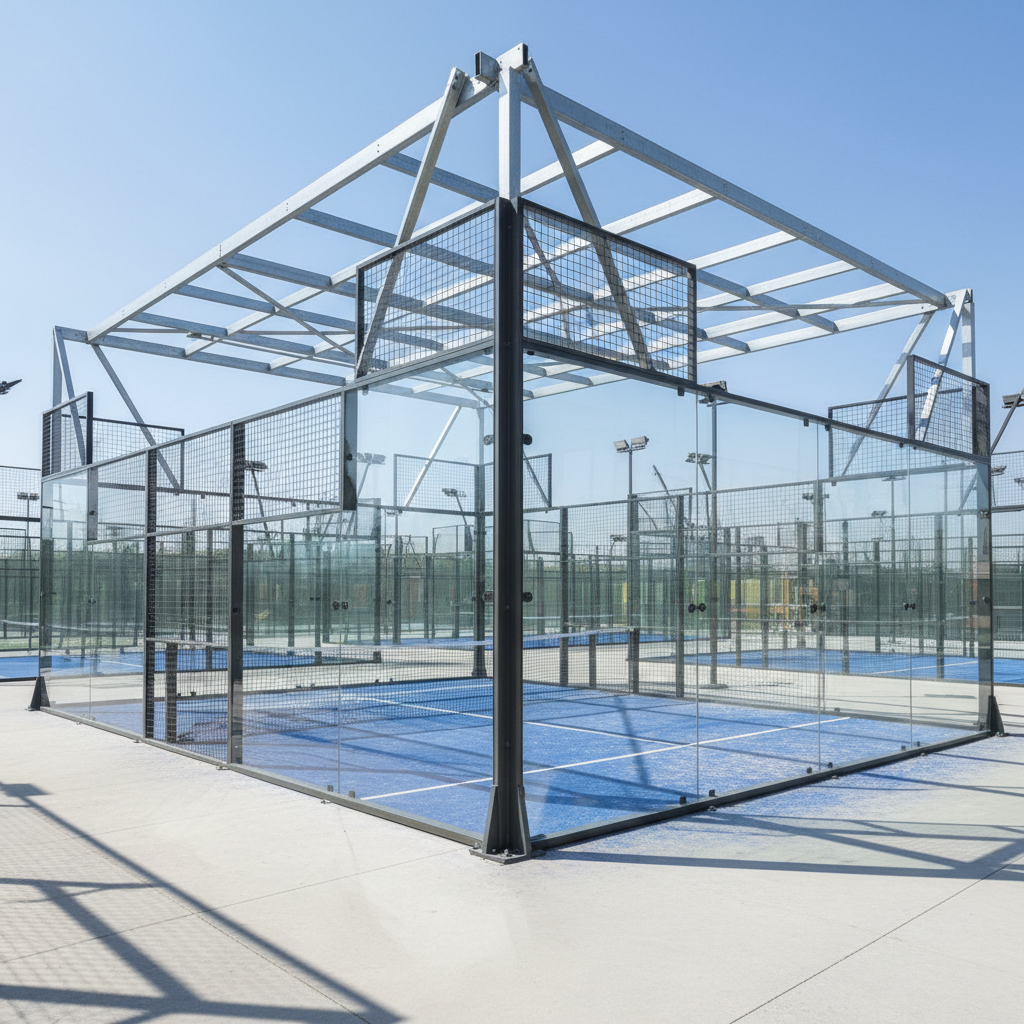
A standard padel court measures exactly 20 meters in length and 10 meters in width, creating a playing area of 200 square meters. For club owners and investors, navigating the specific Federation regulations is often confusing, and building errors can lead to unplayable facilities that drain your budget. We provide the precise, factory-level specifications you need to install a compliant padel court that ensures player safety and long-term durability.
What are the official dimensions of a padel court?
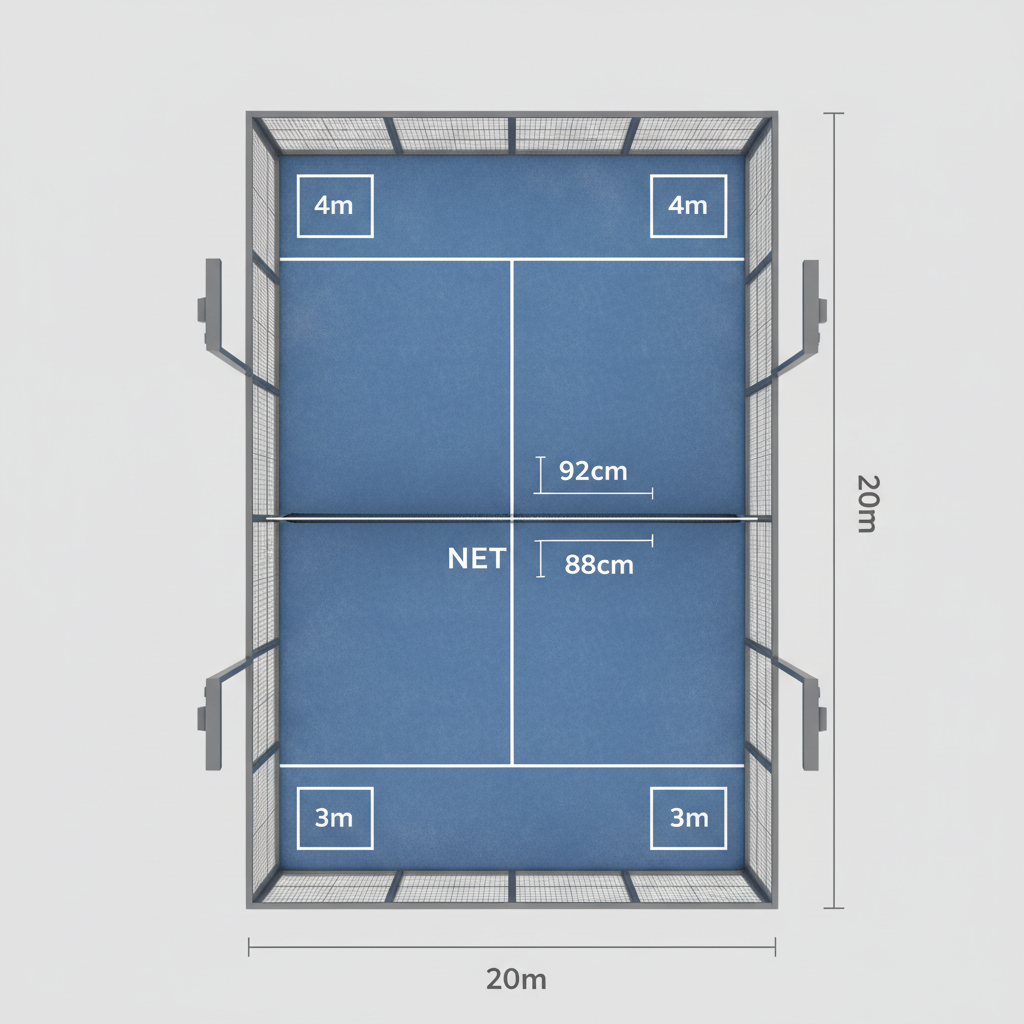
A standard doubles padel court is a rectangle measuring 20 meters long and 10 meters wide. Adherence to this 10×20 meter footprint is mandatory for any facility hosting official competitions, with a strictly allowed tolerance of only 0.5%. This precise measurement ensures consistency across locations, allowing players to rely on muscle memory regardless of the venue.
Here is the deal…
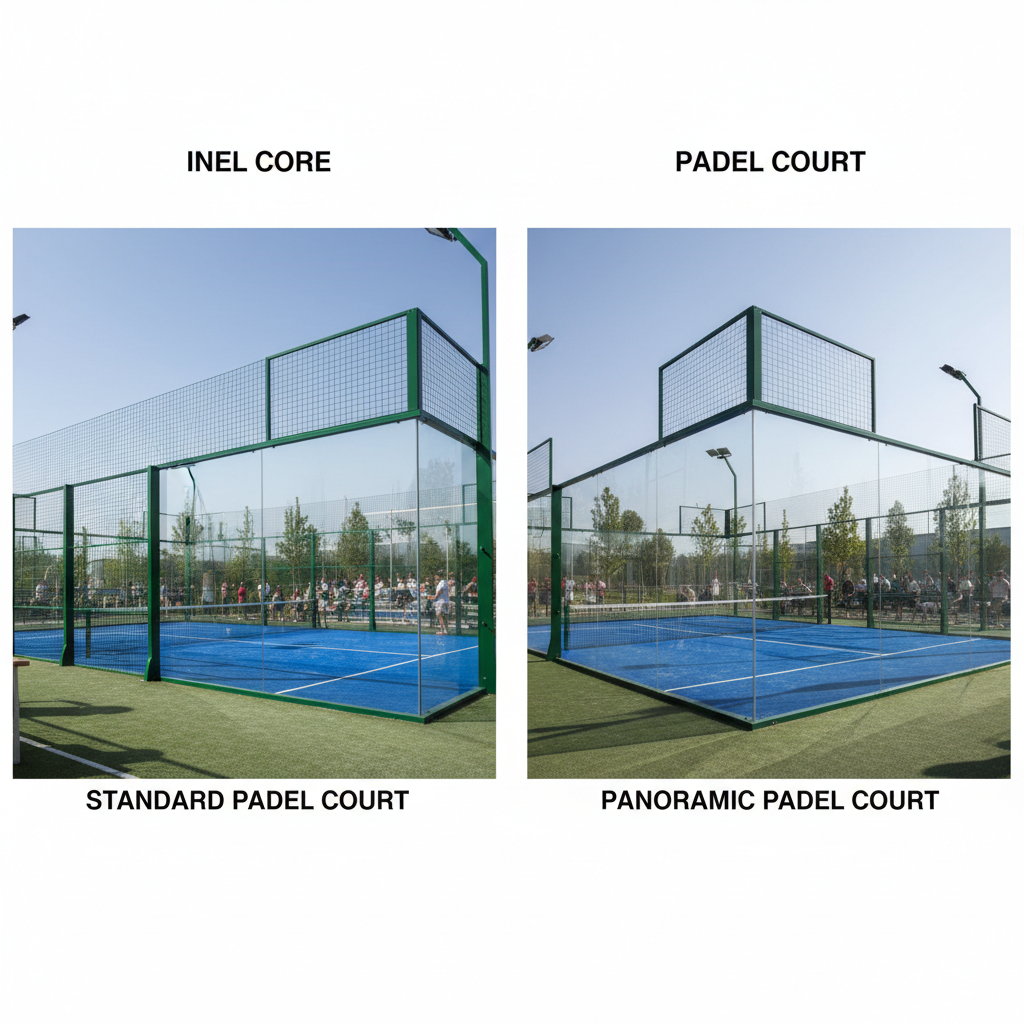
Designers must verify these internal dimensions early in the planning phase to avoid structural conflicts. A Standard Padel Court fits within this footprint, but you must also account for the external space required for lighting columns and support posts.
How do length and width define the playing area?
The 20-meter length and 10-meter width form the play boundaries, which must be divided symmetrically by the net. Measurements are always taken from the inside faces of the enclosing walls or mesh fences to guarantee the full 200-square-meter surface.
- Length: 20 meters (internal).
- Width: 10 meters (internal).
- Symmetry: Halves must be identical.
- Tolerance: ±0.5% max.
Why is strict adherence to these numbers vital?
Even a deviation of a few centimeters can alter ball trajectory and invalidate the court for tournament play. Professional installers use laser measurements to ensure the diagonal distances are equal, confirming the rectangle is perfectly squared.
Key Takeaway: Precision is non-negotiable
Sticking strictly to the 20x10m dimension guarantees your court is tournament-ready, safe for players, and free from costly reconstruction risks.
| Measurement Parameter | Dimension Value | Tolerance |
|---|---|---|
| Total Length | 20.00 meters | ±0.5% |
| Total Width | 10.00 meters | ±0.5% |
| Total Area | 200 sq meters | N/A |
Precise dimensions form the foundation of a certified and playable facility.
How are service zones defined on a padel court?
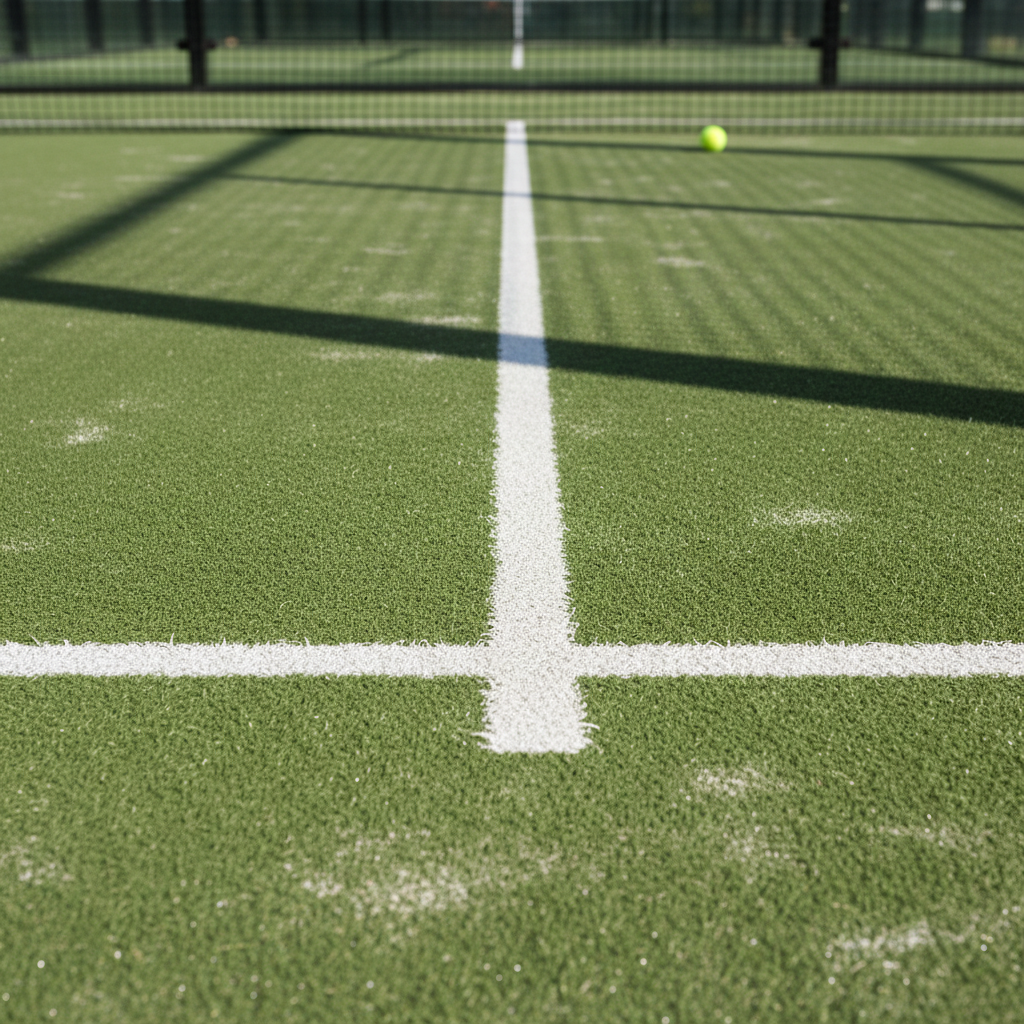
The service lines are positioned exactly 6.95 meters from the net, running parallel to it across the full width of the court. A central service line bisects the area between the net and the service line, creating two equal service boxes on each side measuring 6.95 meters by 5 meters. These lines are critical for defining the valid serve landing zones during a match.
Where exactly is the central service line placed?
The central line divides the 10-meter width into two equal 5-meter sections. Uniquely, this line extends 20 centimeters beyond the service line towards the back wall to assist players in visualizing the separate zones.
- Distance from Net: 6.95 meters.
- Box Width: 5.00 meters.
- Extension: 20 cm beyond service line.
- Color: White or black (contrast required).
What are the specifications for line width?
All lines on the court, including the service and central lines, must measure exactly 5 centimeters in width. Builders typically use high-contrast paint or woven white fibers within the turf to ensure visibility.
Key Takeaway: Markings define the game
Accurate 6.95m service lines and 5cm line widths are essential for preventing disputes and ensuring fair play during serves.
| Feature | Measurement | Purpose |
|---|---|---|
| Service Line Dist. | 6.95 m | Define serve depth |
| Line Width | 5.0 cm | Visibility |
| Center Extension | 20 cm | Visual aid |
Clear and accurate markings prevent service disputes and maintain professional standards.
What is the required net height for a padel court?
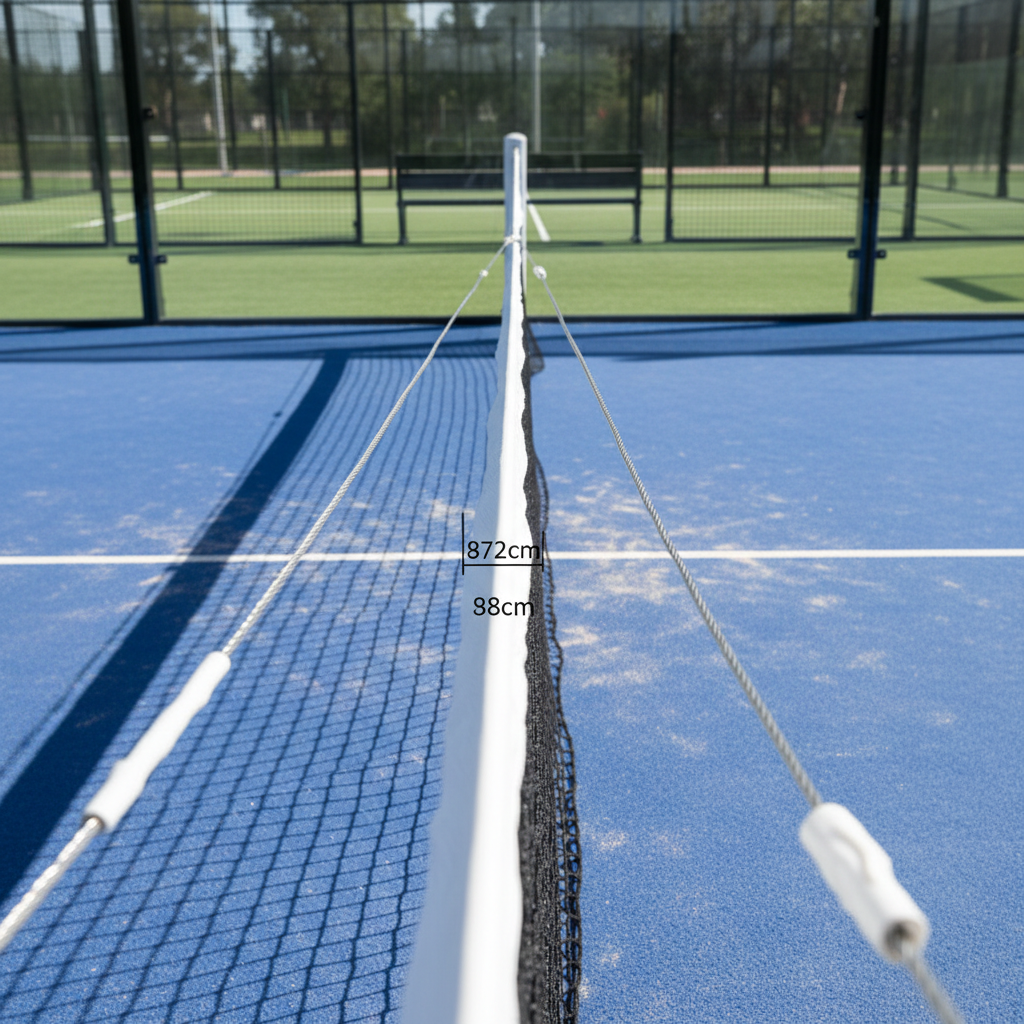
The net must measure 0.88 meters in height at the center of the court and rise to 0.92 meters at the lateral posts. This mandated “sag” is a specific feature of padel, designed to regulate the difficulty of cross-court shots versus down-the-line strokes. The net spans the entire 10-meter width and is suspended by a metal cable.
You might be wondering…
How high is the net at the center versus the posts?
At the exact center, the net is lower at 0.88 meters, while it stands taller at 0.92 meters near the posts. The supporting posts themselves must not exceed 1.05 meters in height to avoid obstructing play.
- Center Height: 0.88 meters.
- Post Height: 0.92 meters.
- Max Post Height: 1.05 meters.
- Tolerance: ±0.005 meters.
What are the specifications for the net band?
A white strip measuring between 5.0 and 6.3 centimeters wide covers the top suspension cable. This band increases visibility and can accommodate advertising logos provided they do not exceed 9.0 centimeters in height.
Key Takeaway: Sag is mandatory but regulated
Maintaining the specific 0.88m center and 0.92m post heights ensures the correct physical mechanics for official padel gameplay.
| Component | Height/Size | Tolerance |
|---|---|---|
| Center Height | 0.88 m | ±0.5 cm |
| Post Height | 0.92 m | ±0.5 cm |
| Band Width | 5.0-6.3 cm | N/A |
Correct net geometry balances the difficulty of different shot types.
How are walls and fences structured in a padel court?
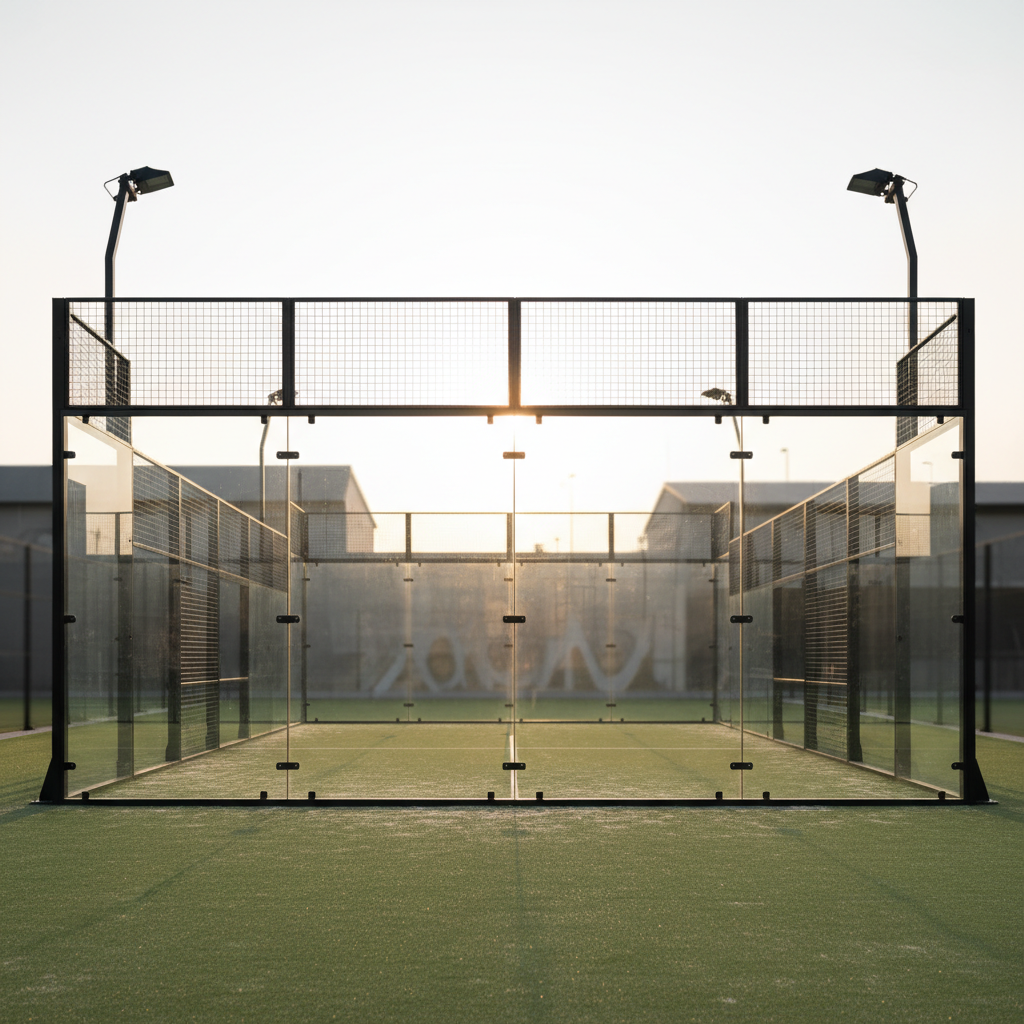
The rear enclosure stands 4 meters high, consisting of a solid 3-meter bottom section topped by 1 meter of metallic mesh. This combination provides the necessary rebound surface for gameplay while containing the ball within the court area. A robust padel structure made of galvanized steel supports these heavy glass and mesh elements.
What are the dimensions of the back walls?
The back walls span the full 10-meter width and reach a total height of 4 meters. The solid rebound zone occupies the first 3 meters from the ground, which is critical for the ball’s return play.
- Total Height: 4 meters.
- Solid Part: Bottom 3 meters.
- Mesh Part: Top 1 meter.
- Width: 10 meters.
How do side wall configurations vary?
Lateral walls often use a stepped design: the solid section is 3 meters high for the first 2 meters from the corner, then drops to 2 meters high for the next 2 meters. The remaining length is enclosed by mesh to a height of 3 or 4 meters depending on the design variant.
Key Takeaway: Understanding wall steps is vital
Implementing the correct 3-meter solid wall height ensures legal rebound zones and consistent play off the back glass.
| Wall Section | Solid Height | Mesh Height |
|---|---|---|
| Back Wall | 3.0 m | 1.0 m |
| Side (Corner) | 3.0 m | 1.0 m |
| Side (Middle) | 2.0 m | 1.0-2.0 m |
Proper wall heights create the predictable rebound zones essential to padel.
What are the regulations for padel court glass panels?
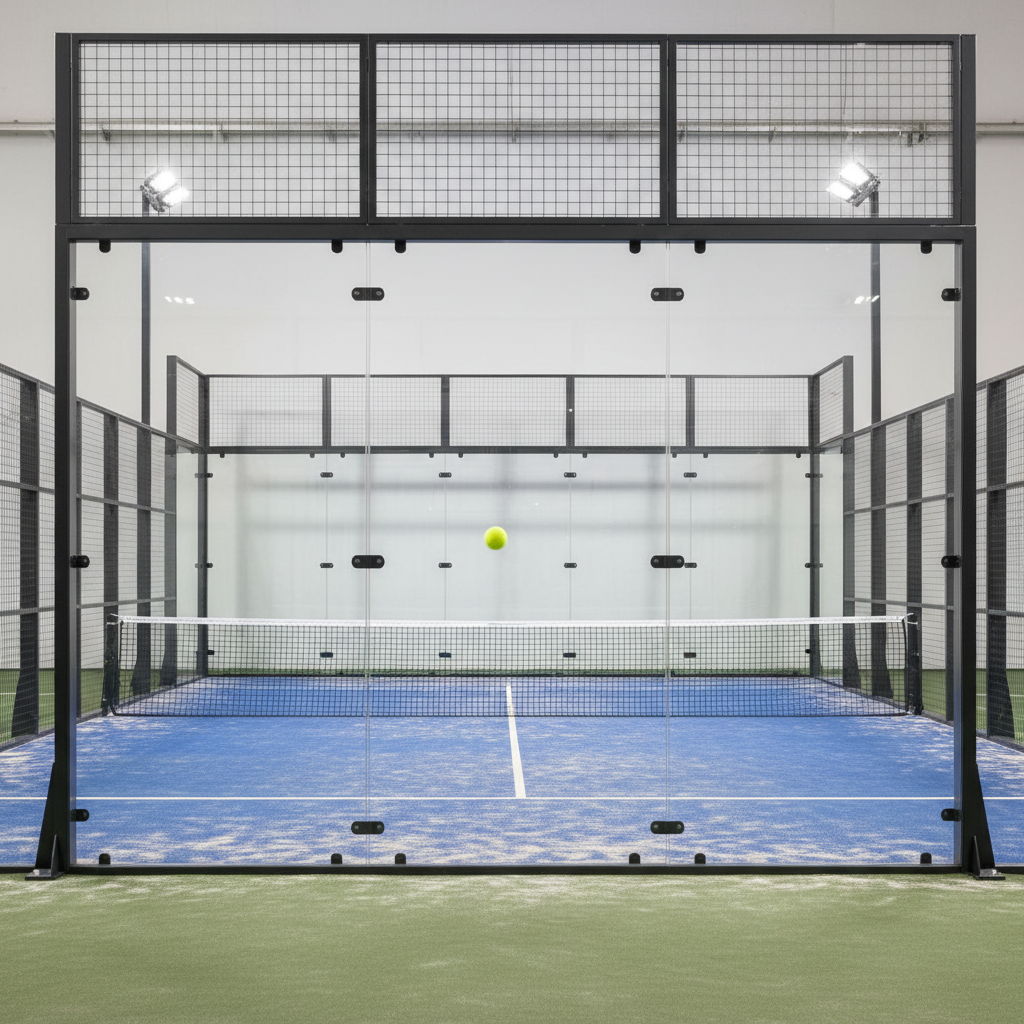
Padel courts utilize tempered safety glass that is typically 10mm or 12mm thick to ensure resistance to player impact and wind loads. These panels must comply with EN 12150 standards, meaning they shatter into harmless granules if broken rather than dangerous shards. High-quality padel glass provides the clarity required for spectators and the uniform bounce players expect.
When is a glass wall without a step permitted?
FIP regulations allow for a “Variant Glass” side wall where the solid section is a continuous 3 meters high by 4 meters long. This design removes the traditional step, offering cleaner visual lines and better visibility for broadcast matches.
- Standard Thickness: 10mm or 12mm.
- Panel Size: 2m x 3m (typical).
- Safety Standard: EN 12150.
- Edge Finish: Polished flat.
Why is 12mm glass recommended for panoramic courts?
For panoramic designs that lack rear corner posts, 12mm glass is essential to provide the necessary structural rigidity. The extra thickness prevents excessive flexing when a player crashes into the wall during intense points.
Key Takeaway: Visibility meets safety
Choosing 12mm tempered glass ensures spectator visibility while protecting players with maximum impact resistance.
| Panel Type | Thickness | Application |
|---|---|---|
| Standard | 10 mm | Frame-supported |
| Panoramic | 12 mm | Post-free rear |
| Competition | 12 mm | High impact |
Thicker glass improves both safety and the acoustic quality of the court.
What ceiling height is needed for an indoor padel court?
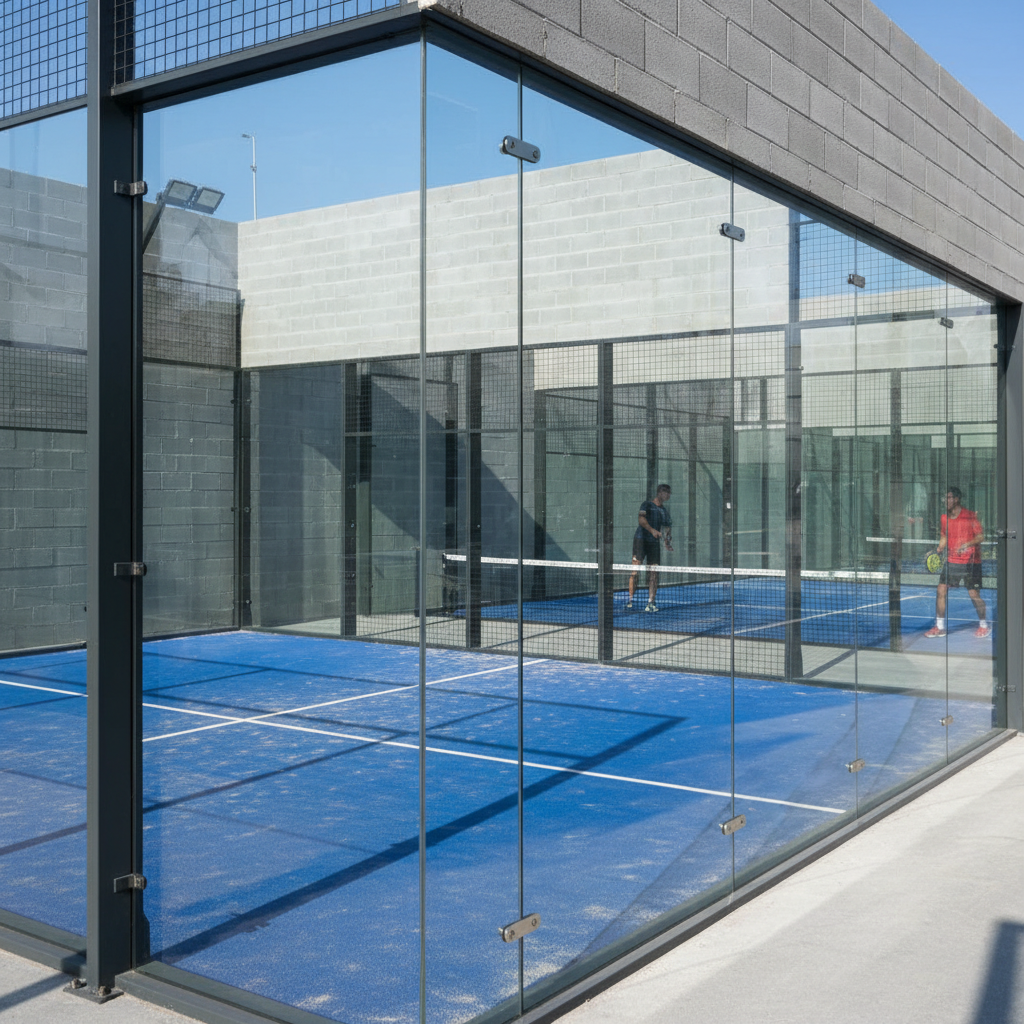
Indoor padel courts require a minimum free height of 6 meters over the entire playing surface to meet official standards. However, a clearance of 8 meters or more is highly recommended to accommodate the high lobs frequently used in advanced play. Many modern clubs install a Panoramic Padel Court indoors to maximize the open feel provided by high ceilings.
What is the absolute minimum vertical clearance?
No obstacle, including lights, beams, or ventilation ducts, can exist within 6 meters of the court floor. Failing to meet this minimum results in a non-compliant court that cannot host sanctioned tournaments.
- Minimum Height: 6 meters.
- Recommended: 8 meters.
- Obstacles: None allowed in zone.
- Measurement: From floor to lowest fixture.
Why is 8 meters superior for new builds?
An 8-meter ceiling future-proofs your facility for competitive events and enhances the player experience. It drastically reduces the number of points interrupted by the ball hitting the roof structure.
Key Takeaway: Higher is always better
While 6 meters is legal, aiming for 8 meters enables high-level lob play and attracts serious competitors.
| Court Type | Min Height | Rec. Height |
|---|---|---|
| Existing | 6 meters | N/A |
| New Build | 6 meters | 8+ meters |
| Tournament | 8 meters | 10+ meters |
Vertical clearance is often the deciding factor for players choosing a club.
What surface materials are best for a padel court?
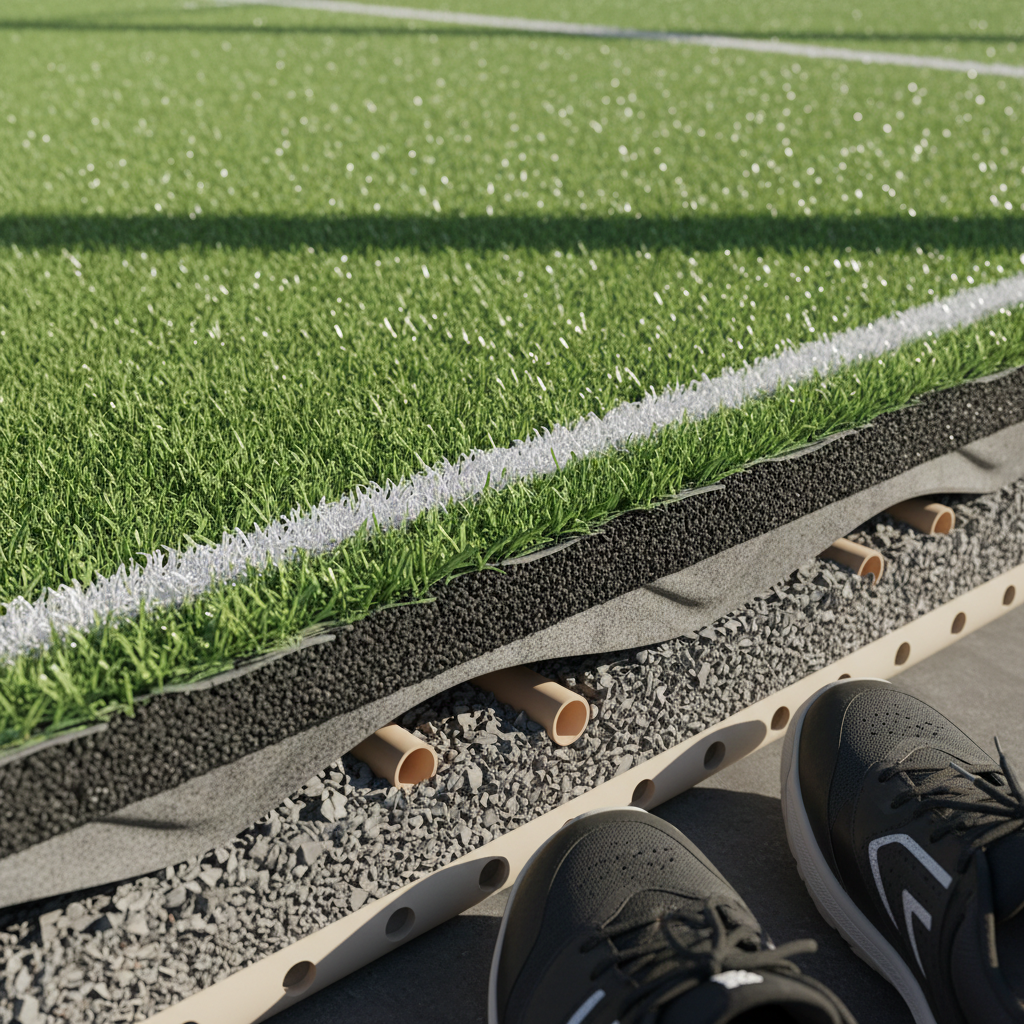
The playing surface is typically artificial turf filled with silica sand, designed to provide a consistent grip and ball bounce. While porous concrete or resin is permitted, sand-dressed padel grass is the industry standard for comfort and performance. This surface minimizes joint strain for players while allowing the controlled sliding motion unique to the sport.
How should the floor slope be handled?
Outdoor courts require a slope of up to 1% (from center to sides) to ensure proper water drainage. Indoor courts should be built perfectly flat (0% slope) since rain runoff is not a factor.
- Material: Artificial Turf (sand-infill).
- Outdoor Slope: Max 1%.
- Indoor Slope: 0%.
- Colors: Green, Blue, Terracotta.
Which colors are approved for the surface?
FIP regulations mandate that the floor color must contrast clearly with the walls. Green and blue are the most common choices, with blue being preferred for televised events due to its visual clarity.
Key Takeaway: Uniform bounce is the goal
Sand-filled artificial turf is the optimal choice for combining durability, player comfort, and consistent ball reaction.
| Feature | Specification | Note |
|---|---|---|
| Material | Synthetic Turf | Fibrillated/Mono |
| Infill | Silica Sand | Crucial for grip |
| Drainage | 1% Slope | Outdoor only |
The right surface material drastically reduces injury risk and improves game quality.
What are the access and door sizes for a padel court?
Access points must be located symmetrically on one or both sides of the court, typically in the center. These openings allow players to enter and also exit the court rapidly to retrieve balls during “out-of-court” play. The dimensions are strictly regulated to ensure players can move safely through them at speed.
What are the dimensions for a single access point?
A single open access per side must measure a minimum of 1.05 meters in width and 2.00 meters in height. This generous width ensures that players do not collide with the frame during intense moments of play.
- Single Width: 1.05 – 2.00 meters.
- Double Width: 0.72 – 1.00 meter (each).
- Height: 2.00 – 2.20 meters.
- Padding: Required on frame.
How do dimensions change for double access points?
For courts with two openings per side, each gap must be between 0.72 meters and 1.00 meter wide. A central metal post separates the two, and all edges must be protected with impact-absorbing foam.
Key Takeaway: Accessibility standards enable safety
Properly sized and padded access points are essential for safe entry and the exciting “out-of-court” plays seen in pro matches.
| Access Type | Min Width | Max Width |
|---|---|---|
| Single | 1.05 m | 2.00 m |
| Double | 0.72 m | 1.00 m |
Symmetrical and safe access points are a hallmark of a professional-grade court.
What lighting standards apply to a padel court?
Lighting must provide uniform illumination across the court without causing glare that blinds players during overhead shots. FIP standards require floodlights to be mounted at a minimum height of 6 meters, usually on columns located outside the court enclosure.
But wait, there is more…
Where should the floodlights be positioned?
The lights are typically mounted on four columns placed along the sides of the court. They must be angled specifically to cover the playing surface evenly, ensuring there are no dark spots or overly bright zones.
- Min Height: 6 meters.
- Location: Outside enclosure.
- Intensity: 200-500 lux (depending on level).
- Uniformity: >0.5 ratio.
What are the lux requirements for different levels?
Recreational courts generally require 200 lux, while local competitions need 300 lux. Professional televised matches demand at least 500 to 750 lux to ensure high-definition broadcast quality.
Key Takeaway: Lighting placement prevents glare
Mounting lights at least 6 meters high outside the court ensures players can track high balls without being blinded.
| Level | Min Lux | Uniformity |
|---|---|---|
| Training | 200 lux | 0.5 |
| Club Comp | 300 lux | 0.7 |
| Pro Tour | 500+ lux | 0.7 |
Proper lighting extends playable hours and enhances the visual appeal of the facility.
Why are accurate line markings on a padel court crucial?
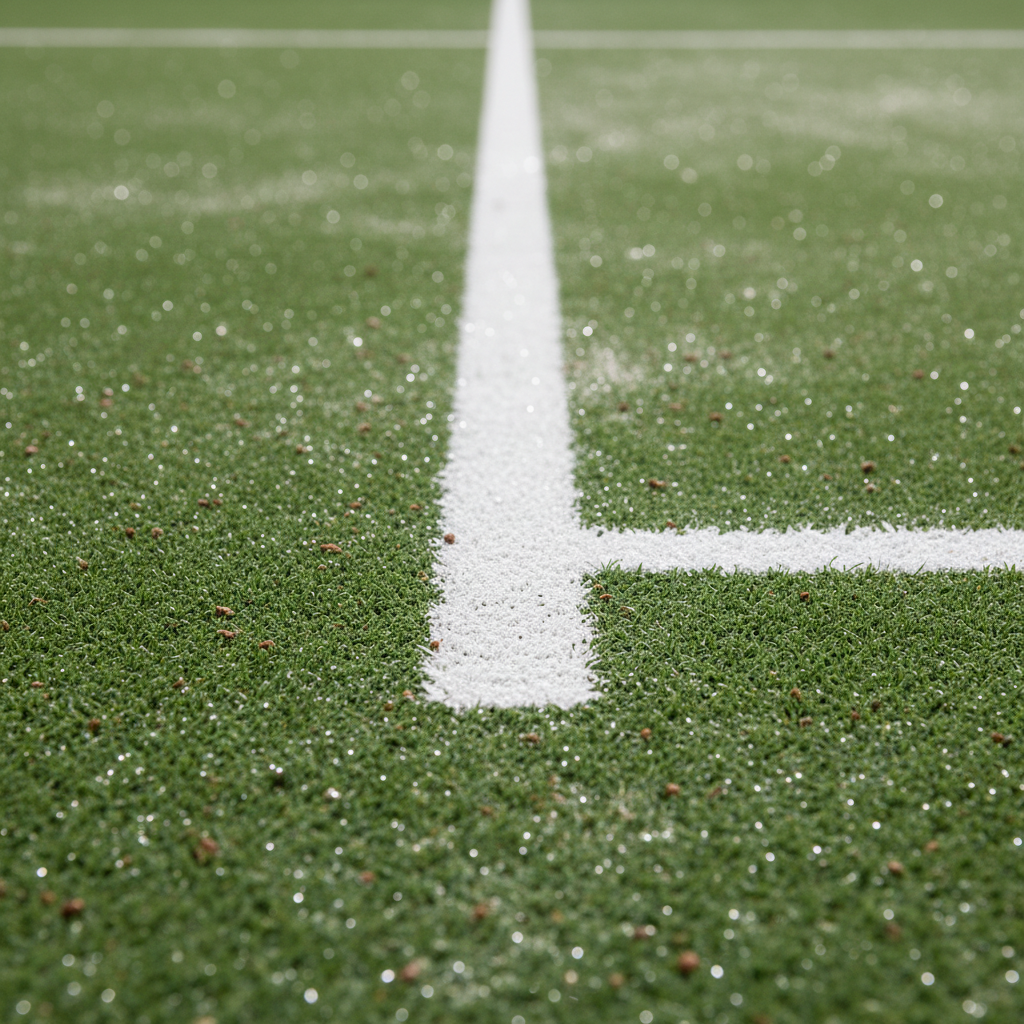
Line markings are not just paint; they are woven or inlaid into the turf to ensure permanence and accuracy. Detailed attention to these markings, along with proper court orientation, ensures the facility meets the highest standards of playability.
How should a padel court be oriented?
Ideally, the longitudinal axis of the court should run North-South. This orientation ensures that the sun travels laterally across the court, preventing players from being blinded by the rising or setting sun during morning and evening matches.
- Orientation: North-South recommended.
- Line Width: 5 cm constant.
- Color: White or Black.
- Material: Inlaid turf fibers.
Why is line width maintenance important?
Over time, lines can become obscured or shifted if the turf is not maintained. Keeping lines clearly visible and exactly 5cm wide reduces disputes and maintains the professional look of the court.
Key Takeaway: Orientation affects playability
A North-South orientation combined with crisp, permanent markings ensures the court is playable and fair at all times of day.
| Factor | Recommendation | Benefit |
|---|---|---|
| Orientation | N-S Axis | Low Sun Glare |
| Markings | Inlaid | Durability |
| Contrast | High | Visibility |
Attention to detail in orientation and markings distinguishes a top-tier club.
Conclusion
Adhering to strict dimensions—specifically the 10×20 meter footprint, 0.88m net height, and 6m minimum ceiling—is the foundation of a successful padel project. Compliance with FIP regulations guarantees a safe, professional environment that attracts players and minimizes liability risks.
If you are ready to build a facility that meets every global standard, contact us today to get professional advice and factory-direct solutions for your courts.
FAQ
Q1: What is the exact total area of a standard padel court?
A standard padel court covers exactly 200 square meters, derived from its 20-meter length and 10-meter width, not including external safety zones.
Q2: Can I build a padel court with a lower ceiling than 6 meters?
No, FIP regulations strictly require a minimum free height of 6 meters; anything lower is considered non-compliant and unsuitable for match play.
Q3: Is it mandatory to use tempered glass for the walls?
Yes, tempered safety glass (usually 10mm or 12mm) is required to ensure consistent ball rebound and player safety in case of breakage.
Q4: Do the service boxes have different dimensions for singles courts?
No, singles courts (6x20m) typically maintain similar service depth proportions, but standard 10x20m doubles courts always use 6.95m x 5m service boxes.
Q5: Why is sand used on the artificial turf surface?
Silica sand infill is essential to hold the turf fibers upright, provide the necessary grip for player movement, and ensure a consistent ball bounce.