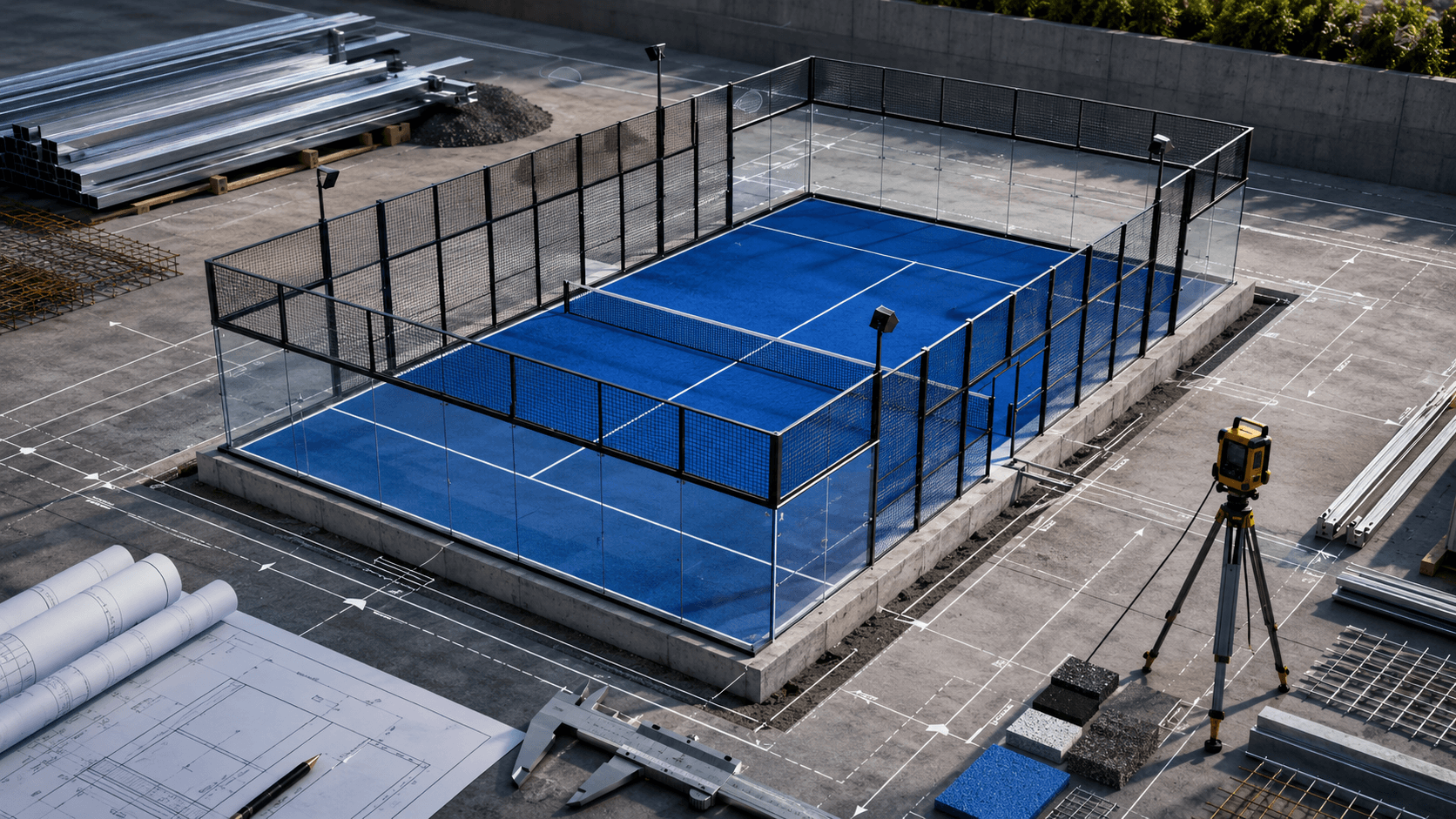
A standard padel court is 10 meters wide and 20 meters long, creating a playing area of 200 square meters.
You are likely facing the challenge of optimizing a limited footprint for a high-traffic sports facility while ensuring every millimeter complies with international standards. Miscalculating the necessary setbacks or structural clearances can lead to costly rework, safety hazards, or even project rejection by regulatory bodies. By understanding exactly how big is a padel court and the engineering requirements behind its dimensions, you can transform an empty lot into a professional-grade revenue stream.
What are the official padel court dimensions?
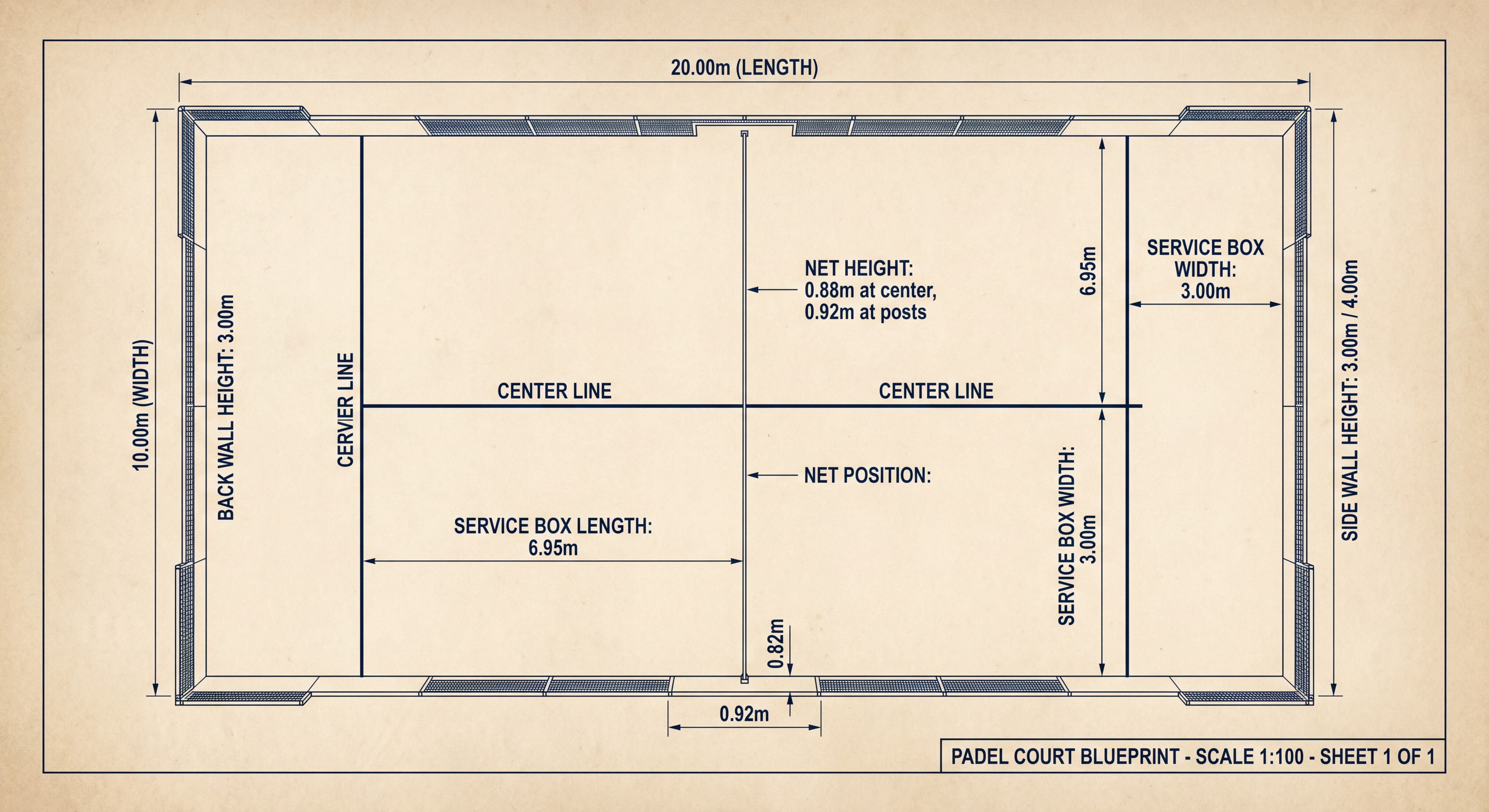
According to International Padel Federation (IPF) regulations, a standard padel court is exactly 10 meters (33 feet) in width and 20 meters (66 feet) in length. When determining how big is a padel court, you must focus on the internal playing area defined by the boundary lines. This rectangular footprint is divided in the middle by a net, creating two equal 10×10 meter squares.
Is the length always fixed at 20 meters?
The total length of 20 meters is non-negotiable for official competition and professional play. You must ensure that the distance between the two back glass walls remains consistent throughout the entire structure. If the court is even slightly shorter, the ball bounce dynamics and player movement patterns will be negatively impacted.
Think about it:
- Accuracy in length prevents structural stress on the corner glass.
- It ensures the service boxes are perfectly proportional to the playing field.
- Consistent dimensions allow players to develop reliable muscle memory.
- Professional certification depends entirely on these exact metric measurements.
How wide should the playing surface be?
The 10-meter width is the standard for doubles play, which is the primary format of the sport. While single-player courts do exist with a 6-meter width, they are significantly less common in commercial installations. You should prioritize the 10-meter width to maximize your facility’s booking potential and appeal to the widest audience.
The best part?
- A 10-meter width provides ample space for side-wall play maneuvers.
- It accommodates the standard modular steel frame sections.
- Proper width ensures the net tensioning system functions effectively.
- Standard sizing makes it easier to source replacement turf and glass.
Key Takeaway: A standard court requires a 10x20m playing area to meet international regulations and ensure proper gameplay.
| Dimension | Metric Measurement | Imperial Equivalent |
|---|---|---|
| Court Width | 10 Meters | 32.81 Feet |
| Court Length | 20 Meters | 65.62 Feet |
| Total Playing Area | 200 Square Meters | 2,152.78 Square Feet |
Precise adherence to these primary measurements is the foundation of any successful padel engineering project.
How much total space is required for installation?
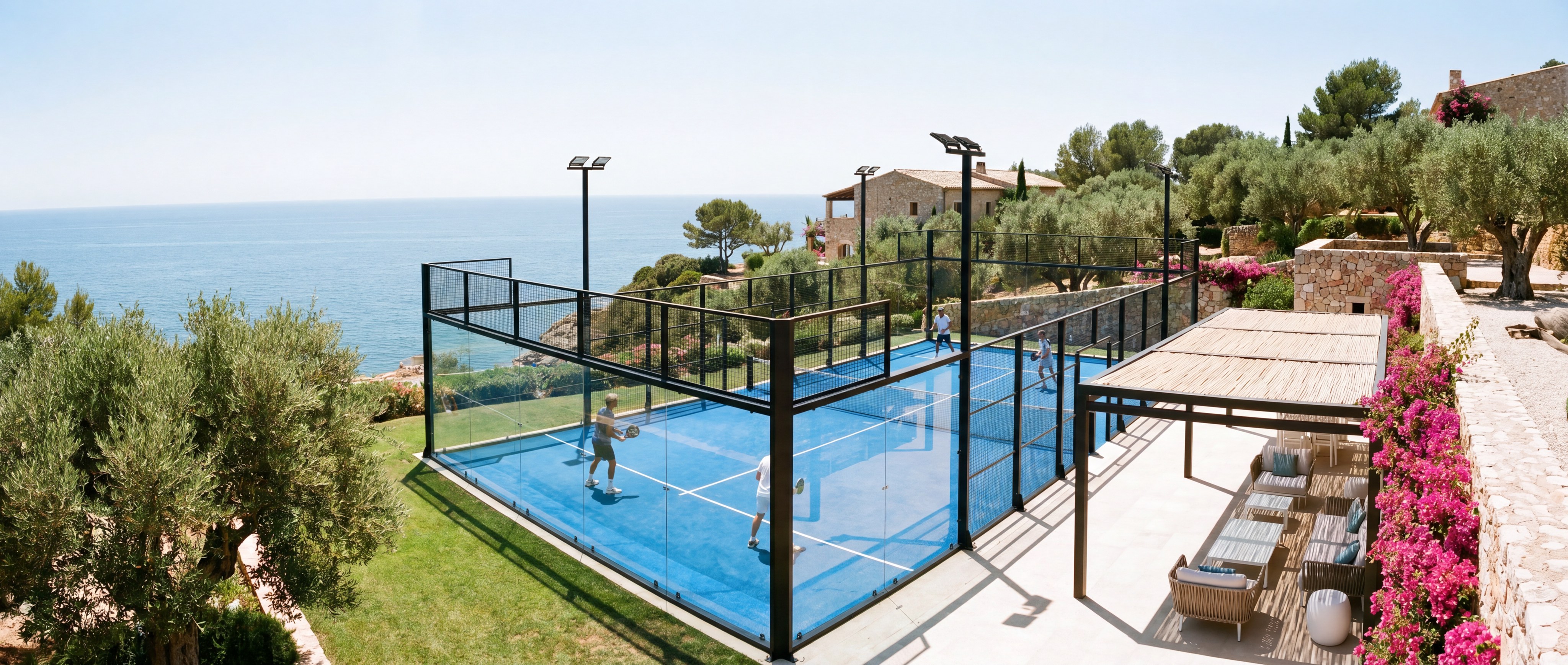
While the playing area is 200 square meters, the total installation footprint for how big is a padel court usually requires approximately 231 square meters. This includes the essential 0.5-meter safety perimeter that surrounds the external structure. You need this extra space to allow for maintenance access, player safety zones, and structural support anchorage.
Why is the safety perimeter necessary?
A safety perimeter prevents players from impacting external obstacles like fences or walls when chasing a ball near the court boundary. You must account for this space in your initial site plan to avoid “clipping” issues with existing infrastructure. For high-level professional tournaments, this run-out zone may need to be even larger to accommodate out-of-court play.
Here is the kicker:
- It provides a buffer for the installation of external lighting poles.
- Perimeter space allows for easier cleaning of the glass panels.
- It serves as a drainage zone for outdoor court runoff water.
- Safety zones reduce the risk of injury during high-intensity rallies.
How much space is needed between multiple courts?
When installing a multi-court facility, you should allow at least 2 to 4 meters of space between adjacent courts. This allows for spectator movement, the placement of seating benches, and better acoustic isolation between matches. If you cram courts too close together, the facility will feel claustrophobic and the playing experience will suffer.
The reality is:
- Extra space between courts improves the overall airflow in indoor facilities.
- It provides room for localized storage of bags and water bottles.
- Wider walkways facilitate easier emergency evacuation if necessary.
- Strategic spacing allows for the installation of shared central lighting.
Key Takeaway: Plan for a total footprint of at least 231sqm per court to account for the mandatory safety perimeter.
| Element | Recommended Space | Purpose |
|---|---|---|
| Safety Perimeter | 0.5 – 1.0 Meters | Player safety and maintenance access |
| Inter-court Walkway | 2.0 – 4.0 Meters | Spectator flow and seating areas |
| Total Site Requirement | ~240 Square Meters | Total footprint per single unit |
Providing adequate clearance around the structure is just as important as the internal court dimensions.
What is the standard height of a padel court?
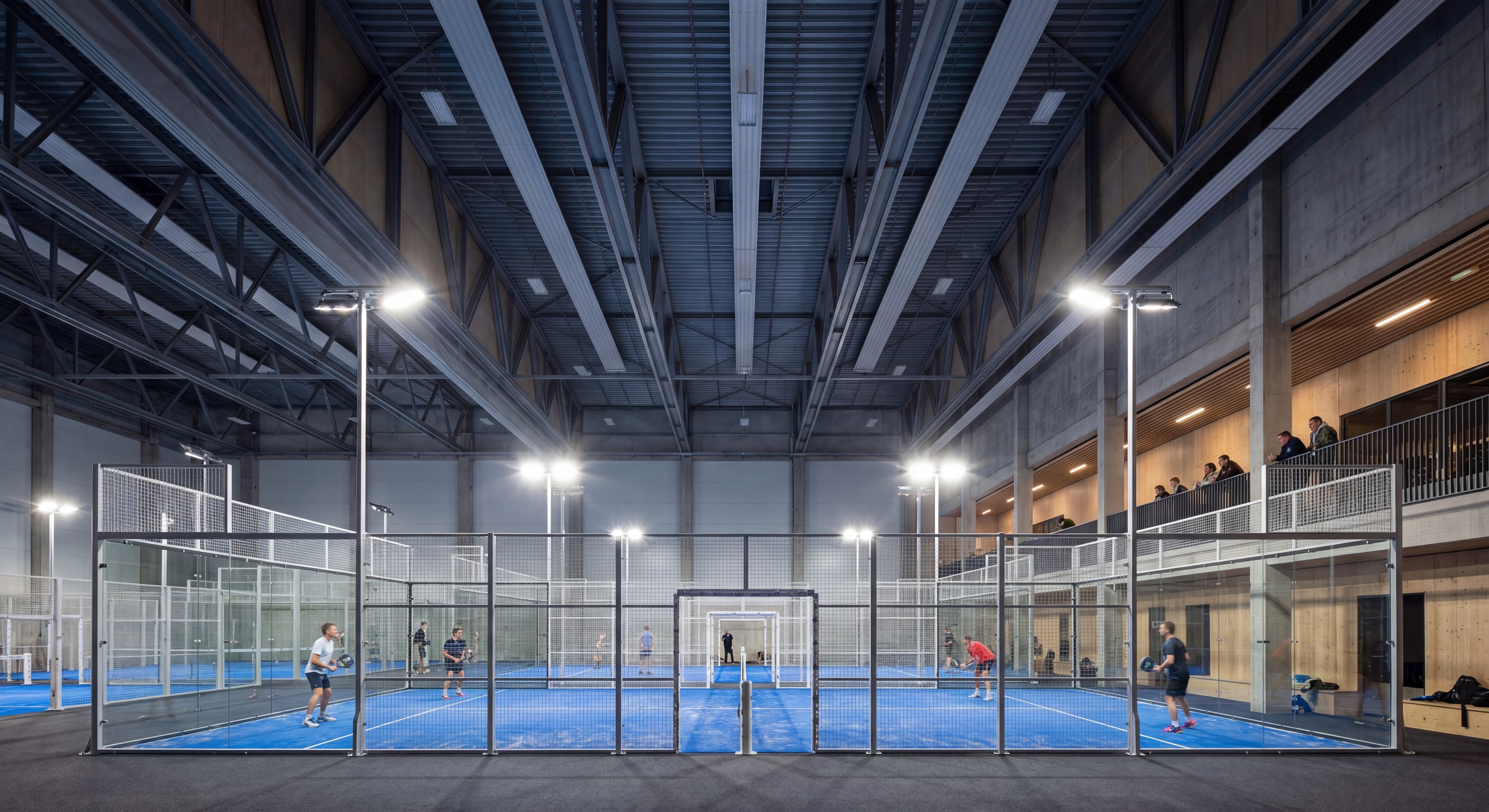
The vertical dimension for how big is a padel court includes a minimum ceiling clearance of 6 meters throughout the entire playing area. For professional facilities and high-end commercial clubs, an 8-meter or 10-meter clearance is often preferred. You must ensure there are no obstructions, such as hanging lights or beams, within this vertical envelope.
How high are the perimeter glass walls?
The back walls of a padel court are 4 meters high, consisting of 3 meters of glass topped with 1 meter of metallic mesh. Along the sides, the height is typically stepped or consistent depending on the specific court design. You should verify that your enclosure height meets the local safety codes for wind loading if the court is outdoors.
Believe it or not:
- 4-meter back walls are essential for high-lofted defensive shots.
- Stepped side walls allow for better spectator visibility near the net.
- Mesh height helps contain the ball within the court during play.
- Structural stability of the glass depends on these specific height ratios.
What is the minimum indoor clearance?
If you are building indoors, the 6-meter rule is the absolute minimum allowed by the IPF, but it is often considered too low for modern play. You should aim for 8 meters to accommodate the “glob” (lob) shot, which is a fundamental tactical element of padel. Lower ceilings significantly restrict the strategic options of the players and lower the facility’s quality.
Look at it this way:
- Higher ceilings improve the perceived value of your sports club.
- They allow for better heat dissipation in non-air-conditioned halls.
- Vertical space is crucial for the installation of recessed lighting.
- Professional players will often avoid facilities with a 6-meter limit.
Key Takeaway: Ensure a minimum height of 6 meters for recreation, but target 8+ meters for a premium playing experience.
| Feature | Standard Height | Engineering Note |
|---|---|---|
| Minimum Clearance | 6 Meters | Measured from court surface to lowest obstruction |
| Glass Back Walls | 3 Meters | Tempered safety glass panels |
| Total Wall Height | 4 Meters | Includes 1 meter of mesh above the glass |
Vertical clearance is a critical engineering factor that determines the technical level of play possible on your court.
How thick are the glass walls and steel mesh?
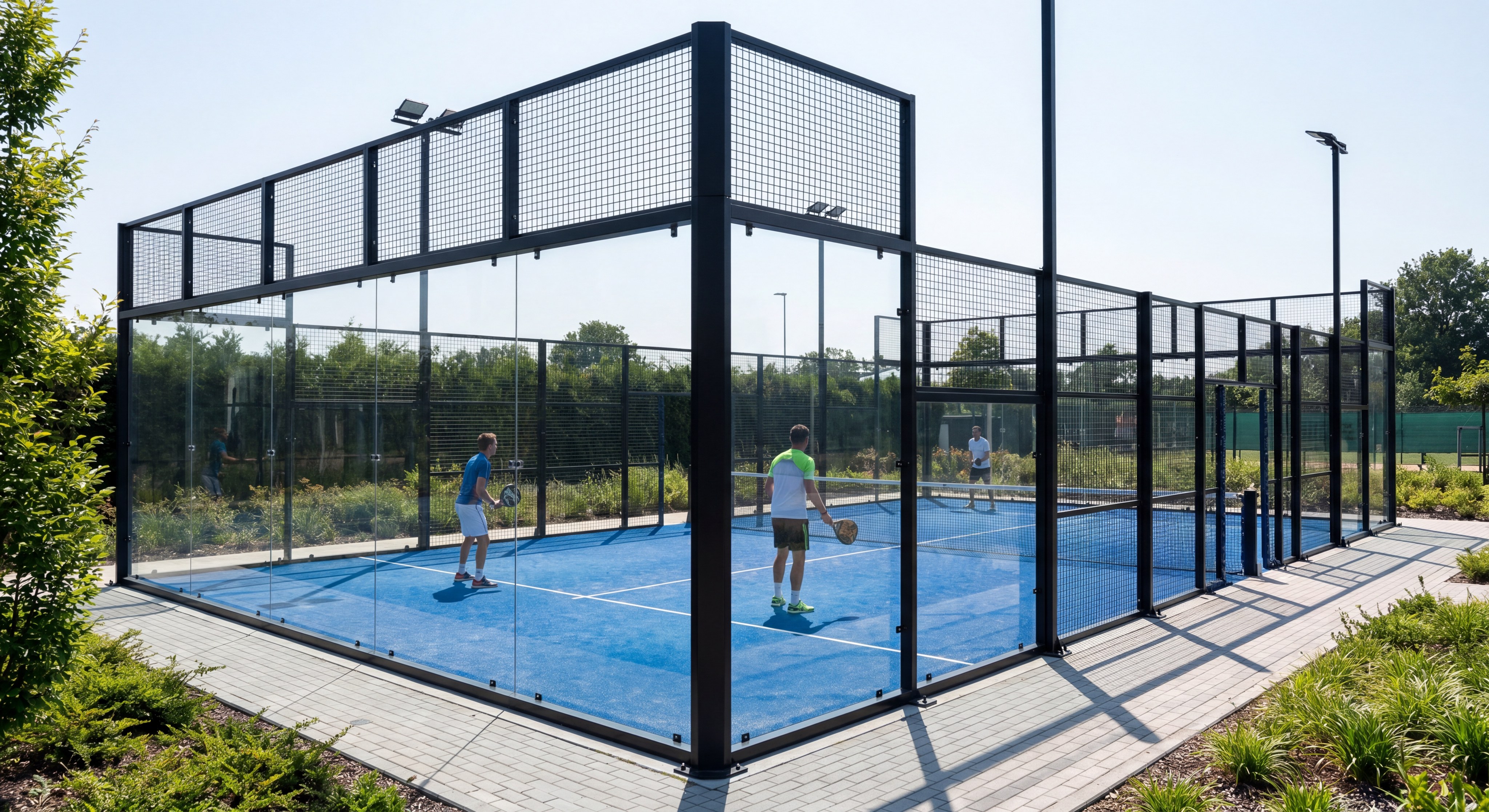
Engineering the structural components for how big is a padel court requires 10mm or 12mm tempered safety glass. The choice depends on the wind load requirements of your specific location and whether the court is panoramic or standard. You must also use hot-dip galvanized steel for the framework to prevent corrosion, especially in coastal environments.
Why is 12mm glass preferred over 10mm?
A 12mm glass panel offers superior impact resistance and a more consistent ball rebound compared to thinner 10mm options. While 10mm glass is lighter and cheaper, you should invest in 12mm for commercial facilities to ensure long-term durability and safety. The increased thickness also reduces the vibration of the panels when hit by players or the ball.
It gets better:
- 12mm glass provides a “truer” bounce for competitive matches.
- It is more resistant to accidental player collisions.
- Thicker panels handle the tension of panoramic designs more effectively.
- Enhanced safety certifications are easier to obtain with 12mm glass.
What are the steel mesh specifications?
The metallic mesh used in the side walls must be rigid enough to provide a predictable bounce while being safe for players’ hands. You should specify a mesh diameter of 3mm to 4mm with a 50x50mm aperture. This ensures that the ball cannot pass through the mesh and that the structure remains stable under tension.
Here is the deal:
- Galvanized mesh resists rust in humid indoor environments.
- Electro-welded joints prevent the mesh from sagging over time.
- Standard aperture sizes are optimized for the padel ball’s diameter.
- Proper mesh tensioning is vital for a high-quality court feel.
Key Takeaway: Use 12mm tempered glass and hot-dip galvanized steel for the most durable and safe court construction.
| Component | Specification | Material Grade |
|---|---|---|
| Glass Panels | 10mm or 12mm | Tempered Safety Glass (EN 12150) |
| Steel Frame | 80x80mm or 100x100mm | Hot-dip Galvanized Steel |
| Mesh Aperture | 50mm x 50mm | Electro-welded Steel Wire |
Material quality directly impacts the safety and maintenance costs of the facility over its 20-year lifespan.
What are the net and line marking specifications?
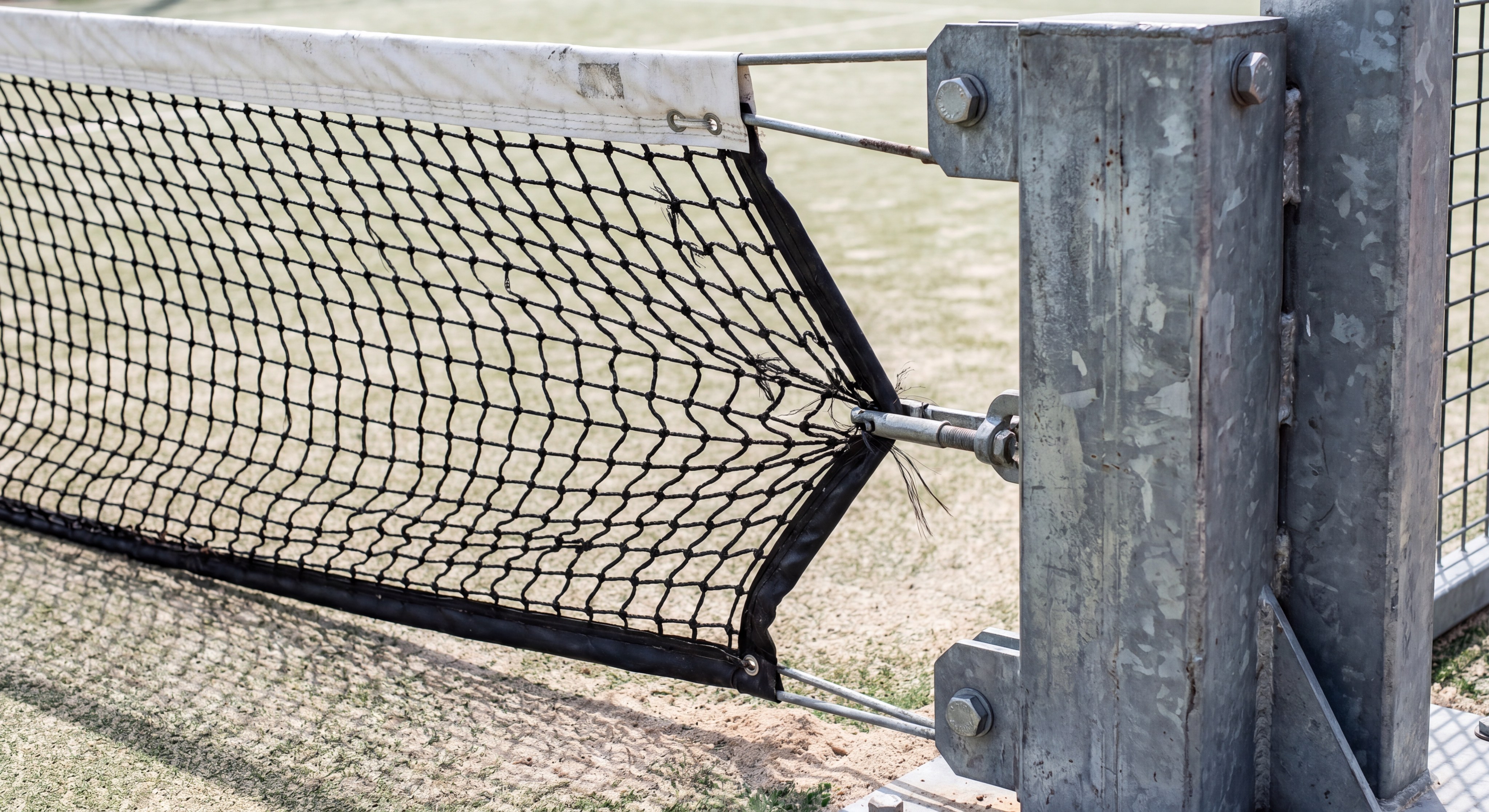
When calculating how big is a padel court, you cannot ignore the precision of the net height, which is 88 centimeters at the center. The net spans the full 10-meter width and is held by two lateral posts that stand no higher than 1.05 meters. You must also ensure all white lines on the turf are exactly 5 centimeters wide for official play.
How is the net tensioned correctly?
The net must be sufficiently taut to prevent the ball from passing through or under it, yet it must have enough “give” to satisfy IPF standards. You should use a high-quality winch system integrated into the steel posts to maintain the 88cm center height consistently. A center strap is often used to pull the net down to the exact regulation height.
Make no mistake:
- Proper tensioning prevents the net from sagging during long matches.
- A center strap ensures the height is uniform for both serving teams.
- High-density polyethylene nets resist UV damage on outdoor courts.
- Reinforced top bands protect the net from paddle impacts.
Where exactly are the service lines placed?
Service lines are located 6.95 meters from the net on each side of the court. When assessing how big is a padel court, this 6.95-meter distance is the most critical marking to get right for serving accuracy. The area between the service line and the back wall is approximately 3 meters, providing the necessary depth for return play.
Think of it this way:
- Precise service lines are the only way to ensure fair competition.
- Incorrect markings can lead to disputes and player dissatisfaction.
- The central perpendicular line must divide the service area into two equal 5m halves.
- Line paint or inlaid turf must be a high-contrast white color.
Key Takeaway: The net must be exactly 88cm at the center, with service lines placed precisely 6.95m from the net.
| Marking/Item | Dimension | Tolerance |
|---|---|---|
| Net Center Height | 88 cm | +/- 0.5 cm |
| Line Width | 5 cm | +/- 0.1 cm |
| Service Line Distance | 6.95 Meters | Exact |
Small errors in net height or line placement can fundamentally break the balance and rules of the game.
How does lighting impact the court’s footprint?
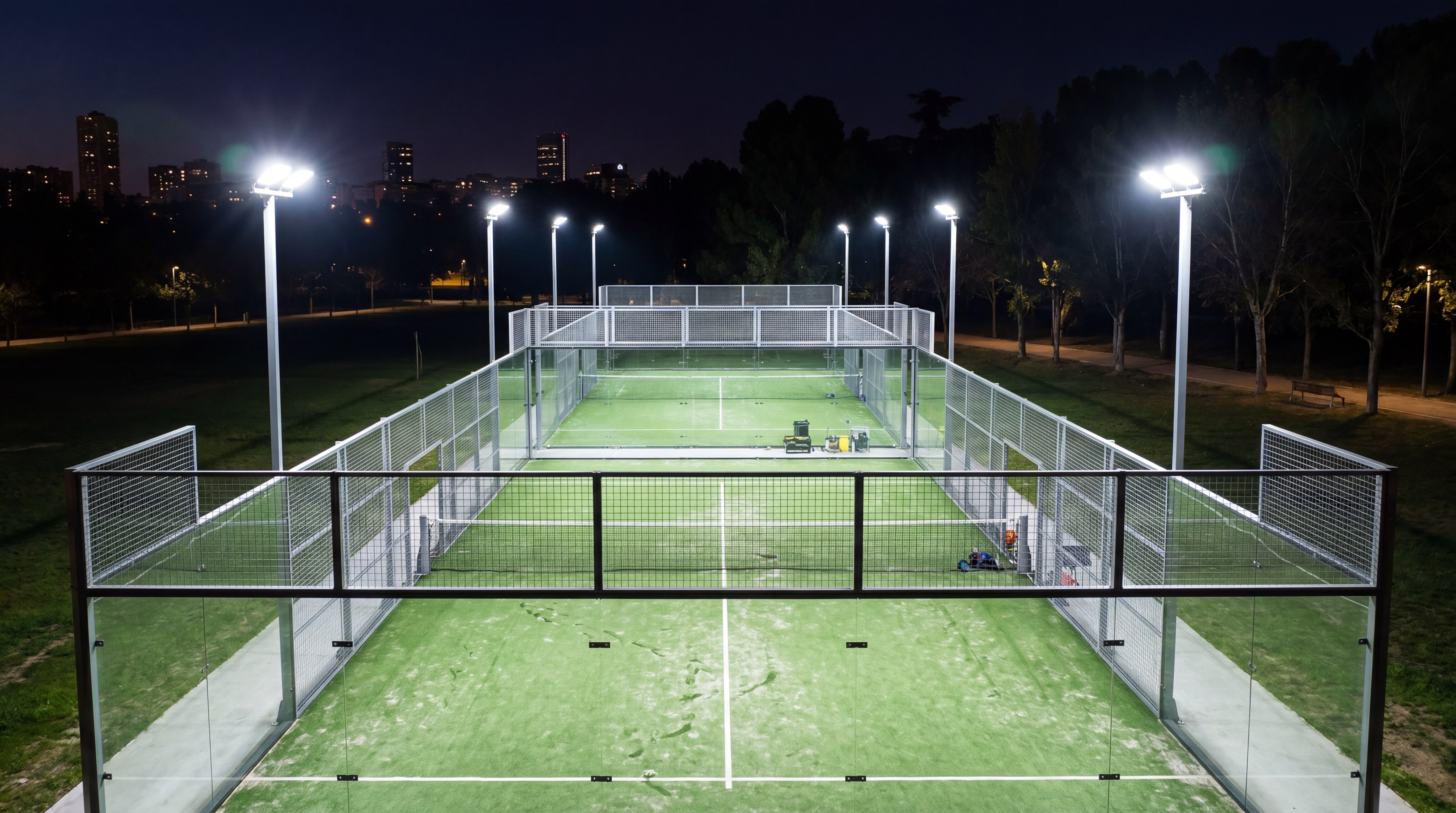
Properly illuminating how big is a padel court requires a system of 4 or 8 LED floodlights mounted on poles typically 6 meters high. You must ensure that the light poles do not intrude into the internal playing area or the immediate safety perimeter. The lighting should provide a uniform 300 to 500 lux for recreational play and up to 750 lux for televised competitions.
Should you use 4 or 8 light poles?
A 4-pole system is the standard for most commercial clubs, with poles placed at the corners or mid-points of the side walls. However, an 8-pole system provides more uniform light distribution and minimizes shadows on the turf. You should choose based on your budget and whether you plan to host high-level night tournaments.
The best part?
- LED lights consume significantly less energy than old HID systems.
- 8-pole configurations reduce glare for players looking upward for lobs.
- IP66-rated lights are essential for outdoor durability against rain.
- Modern LEDs have an instant-on capability with no warm-up time.
How do you prevent glare for the players?
Glare is a major issue in padel due to the high volume of overhead shots and lobs. You must position the floodlights at an angle and height that illuminates the ball’s trajectory without blinding the players. Using asymmetric lenses on your LED fixtures can help direct the light exactly where it is needed on the court surface.
Here is the kicker:
- Asymmetric lighting reduces light pollution for neighboring properties.
- Proper tilt angles ensure the back glass walls don’t reflect lights.
- Diffused lenses can soften the light for a more comfortable experience.
- Lighting uniformity prevents “dark spots” that hide the ball.
Key Takeaway: Use 6m poles and aim for at least 300 lux of uniform LED lighting to ensure safe and professional night play.
| Lighting Level | Recommended Lux | Use Case |
|---|---|---|
| Recreational | 300 Lux | Casual play and social clubs |
| Professional | 500 – 750 Lux | Tournaments and training academies |
| Televised | > 1000 Lux | World-class championship events |
Engineering the lighting requires a balance between visibility, energy efficiency, and neighborly consideration.
Is there a difference between indoor and outdoor sizes?
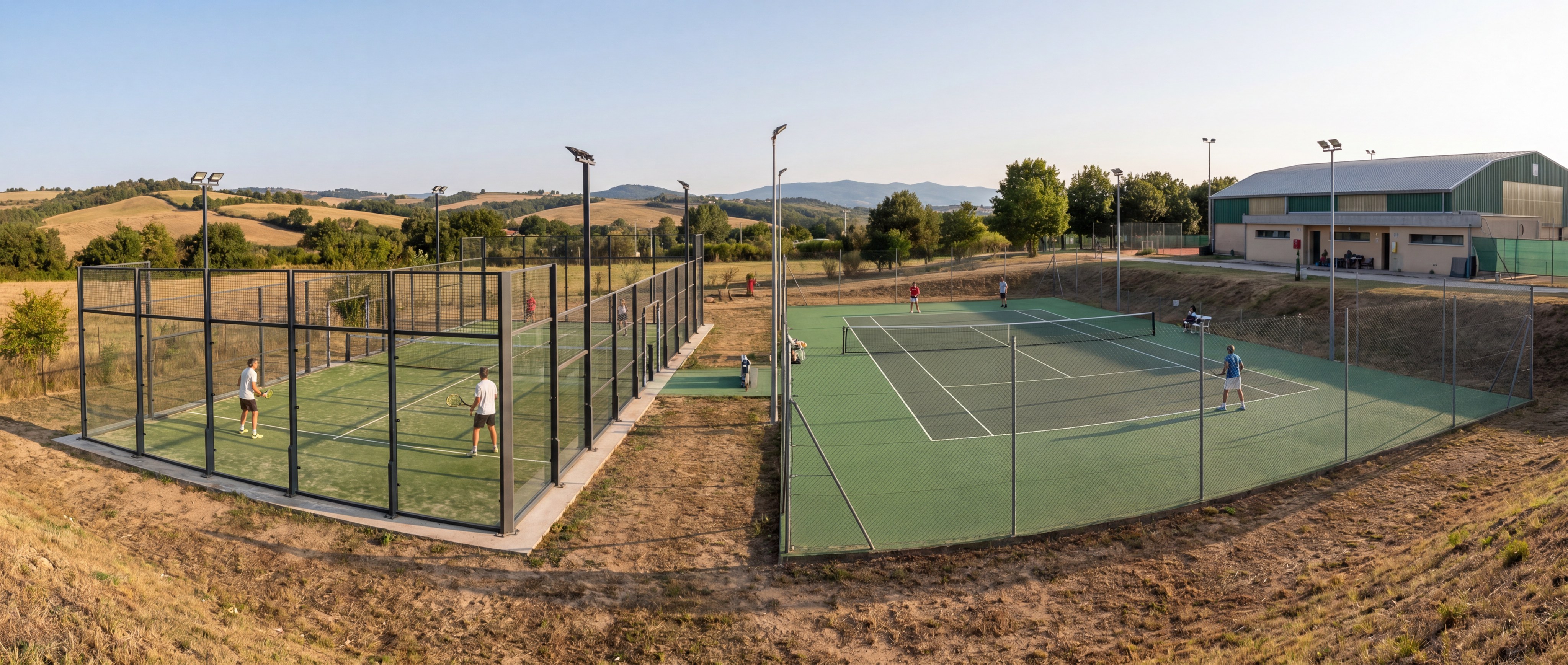
While the internal dimensions for how big is a padel court remain 10x20m for both types, outdoor courts require additional engineering for wind loads and drainage. You must account for a 1% to 2% slope on outdoor courts to ensure rainwater moves off the surface effectively. Indoor courts can be perfectly level, as they are protected from the elements.
How does wind load affect outdoor engineering?
Outdoor courts are essentially large “sails” made of glass and steel, meaning they must withstand significant wind pressure. You should ensure that the foundation and steel pillars are engineered to handle the maximum wind gusts recorded in your area. This often requires deeper anchor bolts and thicker steel profiles than indoor installations.
Consider this:
- Panoramic courts are more vulnerable to wind than standard framed courts.
- Engineering reports must verify the safety of the glass under pressure.
- Perforated mesh can help reduce the wind resistance of the structure.
- Rust protection is more critical for outdoor structural integrity.
Do indoor courts require different materials?
Indoor courts do not need to worry about UV degradation or heavy rain, which allows for more flexibility in turf selection. However, you must pay closer attention to acoustic dampening and ceiling heights. You should use non-reflective glass coatings if the indoor lighting creates too many highlights on the panels.
The reality is:
- Indoor turf stays cleaner and maintains its “grip” for longer periods.
- Humidity control is necessary to prevent the glass from fogging up.
- Acoustic panels on the ceiling can reduce the “clack” of the paddles.
- Indoor courts generally have lower long-term maintenance costs.
Key Takeaway: Internal 10x20m dimensions are identical, but outdoor courts need superior wind engineering and drainage.
| Factor | Outdoor Court | Indoor Court |
|---|---|---|
| Surface Slope | 1% for drainage | 0% (Perfectly level) |
| Structural Load | Wind + Snow + Dead Load | Dead Load only |
| UV Protection | High requirement | Not required |
Choosing the right environment dictates the structural reinforcement needed to keep the court safe.
What are the requirements for the concrete foundation?
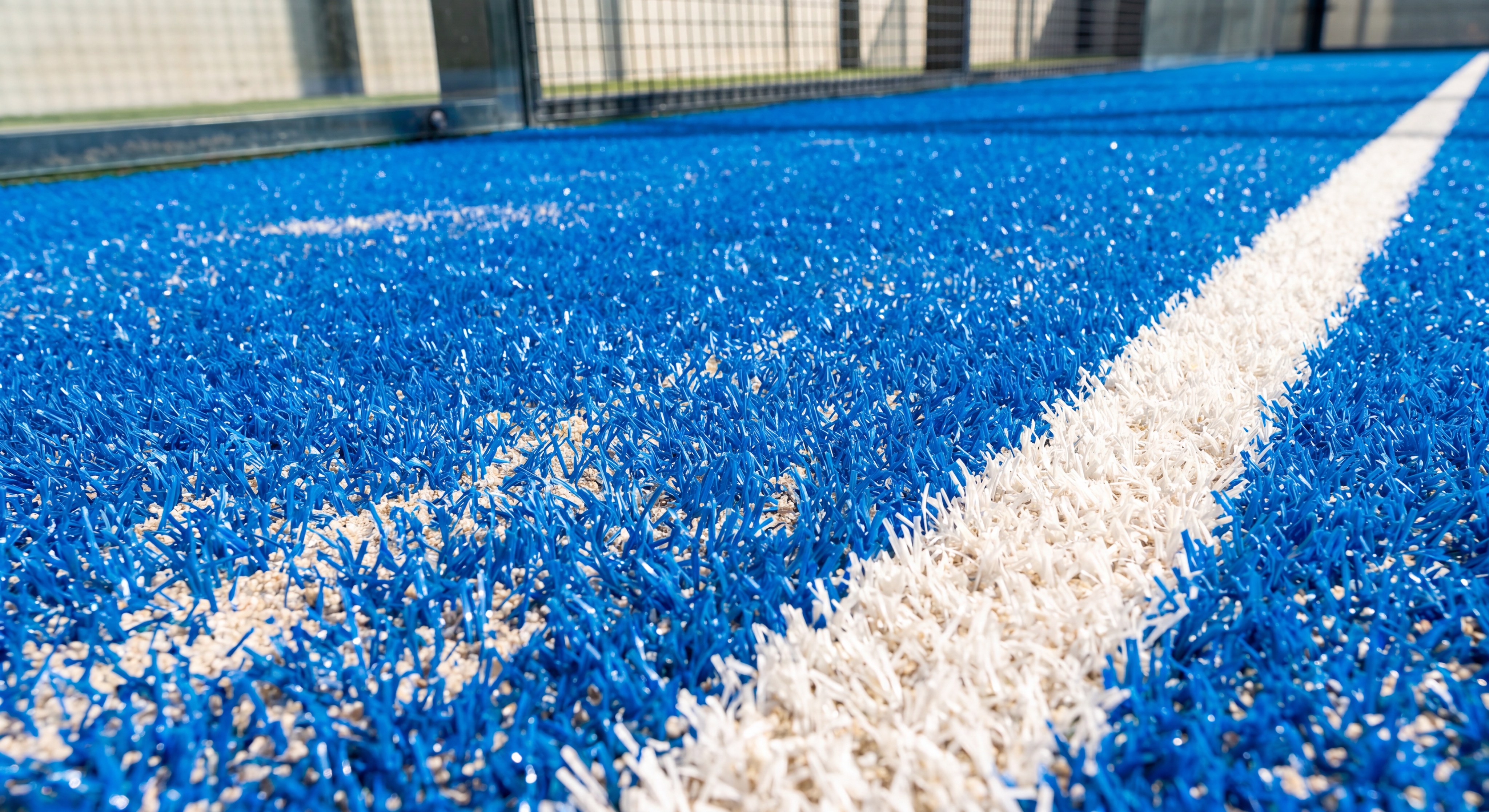
A stable foundation is the most important part of how big is a padel court, requiring a 15cm to 20cm thick reinforced concrete slab. You must ensure the concrete is perfectly cured and leveled to within a 3mm tolerance across the entire 200 square meters. A poor foundation will lead to cracked glass, uneven turf, and dangerous “dead spots” in the ball bounce.
Why is porous concrete used for drainage?
In many outdoor installations, porous concrete or asphalt is used to allow water to drain straight through the court surface. You should consider this if your site has high rainfall and you want to minimize downtime after a storm. This system requires a specialized sub-base of crushed stone to manage the water flow effectively.
The best part?
- Porous surfaces prevent puddles from forming on the turf.
- It allows for play to resume almost immediately after rain stops.
- Reduced surface runoff protects the surrounding landscaping.
- It can be more environmentally friendly in terms of water management.
How deep should the perimeter footings be?
The steel pillars that hold the glass and mesh exert significant leverage, so they require deeper perimeter footings than the rest of the slab. You should engineer these footings to a depth of at least 40cm to 60cm, depending on your soil type. This ensures that the structure remains perfectly vertical even when players crash into the walls.
Look at it this way:
- Deep footings prevent the glass from shifting and shattering.
- They provide the necessary “torque” resistance for panoramic posts.
- Proper anchoring is the only way to guarantee a 20-year structural life.
- Soil testing is a mandatory first step for any large-scale installation.
Key Takeaway: Invest in a 15-20cm reinforced concrete slab with deep perimeter footings to ensure structural safety.
| Layer | Recommended Depth | Material |
|---|---|---|
| Sub-base | 20 – 30 cm | Compacted Crushed Stone |
| Concrete Slab | 15 – 20 cm | Reinforced Concrete (C25/30) |
| Perimeter Footing | 40 – 60 cm | Extra Reinforcement for Pillars |
The longevity of your investment is entirely dependent on the quality of the concrete work beneath the turf.
How do panoramic designs change court measurements?
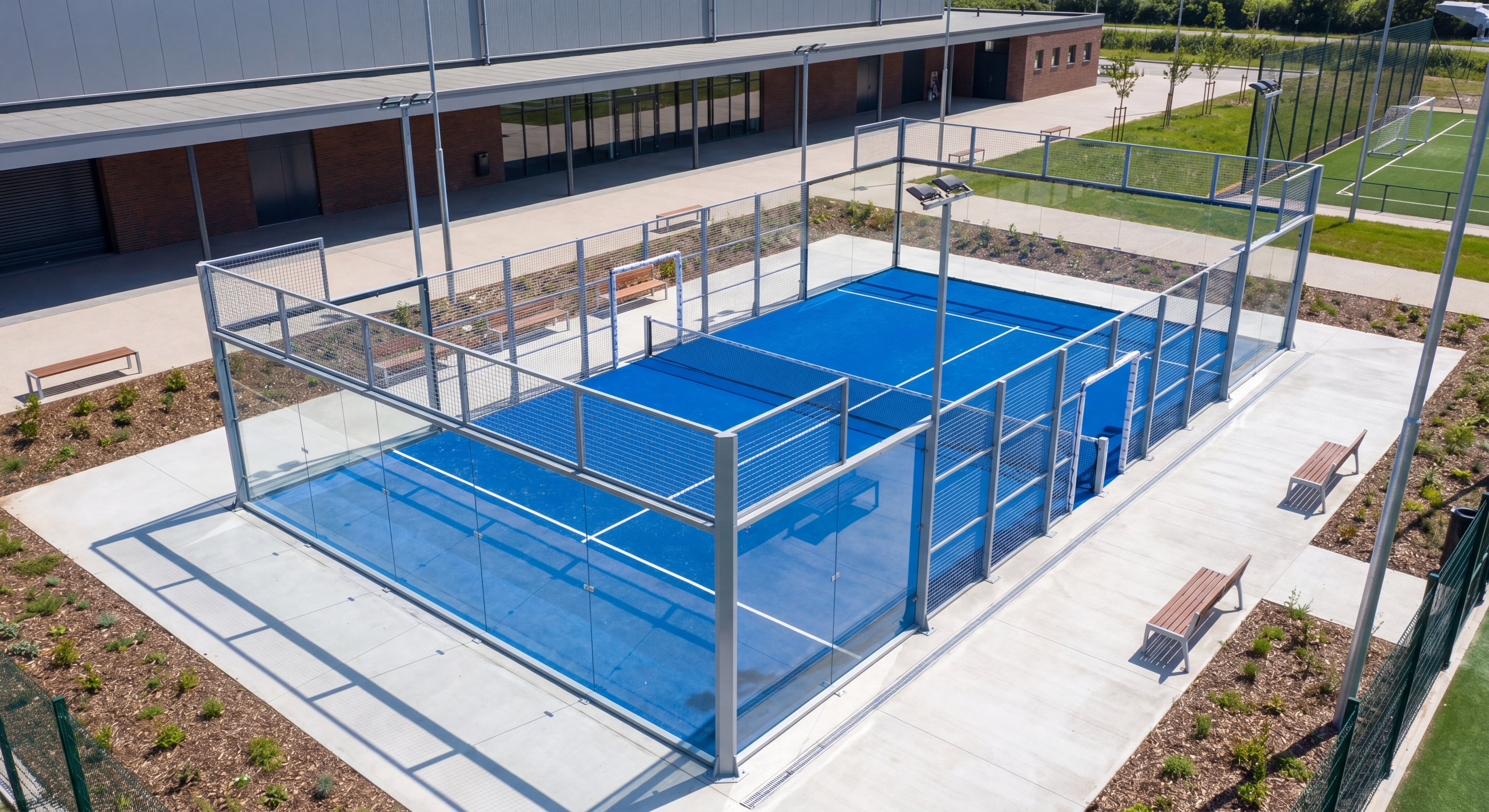
Panoramic courts maintain the same 10x20m playing area for how big is a padel court, but they remove the vertical steel pillars from the back walls. This creates a seamless glass viewing experience that is highly valued by spectators and television broadcasters. You must account for the use of thicker 12mm glass and more robust corner reinforcements to maintain structural integrity.
Are panoramic courts safe for high-traffic clubs?
Panoramic designs are extremely safe provided they are engineered with 12mm tempered glass and high-quality hardware. You should choose this design for your “center court” or premium areas to attract better players and sponsors. While they look more fragile, the structural loads are carefully distributed through the heavy-duty corner pillars.
Think about it:
- Unobstructed views are perfect for coaching and filming matches.
- They offer a “premium” feel that justifies higher rental rates.
- Modern panoramic hardware is designed for easy glass replacement.
- The aesthetic appeal is significantly higher than standard framed courts.
Does the foundation need to be stronger for panoramic?
Because the corner pillars on a panoramic court carry more weight and tension, the foundation footings at the four corners must be extra deep. You should specify reinforced anchor plates to ensure the structure remains rigid under the impact of play. Any movement in the foundation will be much more visible in a panoramic court due to the lack of intermediate support pillars.
The reality is:
- Precision leveling is even more critical for panoramic glass alignment.
- The “vibration” of the court is different without middle pillars.
- Corner reinforcements are the primary safety feature of the design.
- Installation takes slightly longer due to the complexity of the glass.
Key Takeaway: Panoramic courts provide a superior viewing experience with 10x20m dimensions but require 12mm glass.
| Court Type | Back Wall Structure | Visual Impact |
|---|---|---|
| Standard | Steel pillars every 2 meters | Industrial/Club style |
| Panoramic | No intermediate pillars | Professional/Premium style |
| Super Panoramic | Minimalist corner supports | Tournament/TV style |
Panoramic courts are the gold standard for modern facilities, blending engineering strength with visual elegance.
Why is precision critical in padel court engineering?
In the final assessment of how big is a padel court, precision is the difference between a successful business and a structural failure. Every millimeter of the 10x20m area affects ball bounce, player safety, and the ability to host official tournaments. You must work with certified manufacturers who understand the interplay between steel tension, glass weight, and turf density.
How does precision affect ball bounce?
If the glass panels are not perfectly vertical or the turf is not laid with the correct amount of silica sand, the ball will bounce unpredictably. You should prioritize “bounce consistency” above all else when evaluating the quality of a court installation. Players will quickly abandon a facility where the ball “dies” or takes weird angles off the walls.
Here is the deal:
- Even a 2mm gap between glass panels can ruin a match.
- Turf that isn’t perfectly flat creates dangerous tripping hazards.
- Uniform silica sand distribution ensures a consistent slide and grip.
- High-quality glass fixings prevent the “dead” sound of a loose panel.
What are the consequences of poor engineering?
Poor engineering can lead to catastrophic glass breakage, sagging nets, and foundation cracking within the first year of operation. You must verify that your supplier provides a structural warranty and that all materials meet European or international safety standards. Cutting corners on the initial build almost always leads to higher repair costs in the long run.
Make no mistake:
- Glass breakage is the most dangerous and expensive repair.
- Rusting steel ruins the aesthetic and structural safety of the club.
- Sagging turf is impossible to fix without a full re-installation.
- A bad reputation for court quality is very difficult to recover from.
Key Takeaway: Precision engineering ensures player safety, predictable ball bounce, and long-term facility profitability.
| Risk Area | Consequence of Error | Prevention Strategy |
|---|---|---|
| Glass Alignment | Spontaneous breakage | Use 12mm tempered glass |
| Foundation Level | Uneven ball bounce | 3mm tolerance leveling |
| Steel Coating | Premature rust | Hot-dip galvanization |
Precision isn’t just about following rules; it’s about protecting your investment and the people who play on it.
Conclusion
Understanding how big is a padel court is the first step toward building a world-class sports destination. By strictly adhering to the 10×20 meter standard, ensuring vertical clearance, and investing in high-quality materials like 12mm tempered glass and galvanized steel, you create a facility that is both safe and profitable. At Superbpadel, our vision is to empower facility owners with factory-direct, precision-engineered courts that stand the test of time and provide an unmatched playing experience.
Are you ready to bring the world’s fastest-growing sport to your community? Contact us today to receive a customized technical consultation and a detailed quote for your project.
Frequently Asked Questions
Can I build a padel court on a standard tennis court space?
Yes, because a tennis court is significantly larger than a padel court. A single tennis court footprint (approx. 18x36m) can actually accommodate two full-size padel courts, allowing you to double your player capacity in the same area.
What’s the best way to maintain the glass walls?
The best way is to use a standard squeegee and non-abrasive glass cleaner once a week. Regular cleaning is essential because sweat, dust, and handprints can affect the transparency and professional look of the court over time.
Can I install a padel court on a rooftop?
Yes, you can install a court on a roof, provided the building’s structural engineering can support the significant weight of the concrete slab and the wind loads of the enclosure. You will need a specialized structural survey before proceeding with any rooftop project.
What’s the best turf color for visibility?
Blue is the most popular and professional choice because it offers the highest contrast against the yellow padel ball. While green is traditional, blue has become the global standard for televised matches and high-end clubs.
Can I customize the court colors for my brand?
Yes, most premium manufacturers allow you to choose custom RAL colors for the steel structure and even add your logo to the turf or glass. This is an excellent way to strengthen your brand identity and create a unique atmosphere for your members.